Do Hyenas Really Laugh?
Despite their reputation as "laughing" animals, spotted hyenas are not actually laughing in the human sense. While they produce a series of high-pitched…
Do Hyenas Really Laugh?
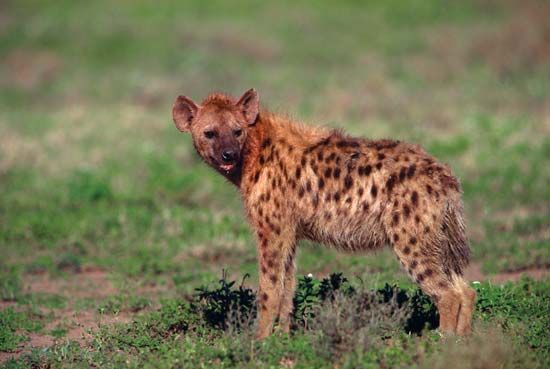
Despite their reputation as “laughing” animals, spotted hyenas are not actually laughing in the human sense. While they produce a series of high-pitched, giggle-like vocalizations that sound remarkably like human laughter, these sounds are not expressions of amusement or joy.1
Instead, these vocalizations serve as a form of communication during stressful situations. Hyenas typically produce these sounds when they are threatened, under attack, or feeling frustrated—such as when another member of their clan attempts to steal their food. The pitch of these giggles can also convey information about the individual’s age or social status within the clan.1
Are hyenas more closely related to dogs or cats?
Hyenas are neither cats nor dogs; they belong to their own distinct biological family, Hyaenidae.3
While they are often mistaken for dogs due to their appearance and scavenging habits, hyenas are actually more closely related to cats. The order Carnivora split into dog-like and cat-like lineages approximately 50 million years ago, and the hyena family eventually emerged from the cat-like group. The Hyaenidae family later diverged from other cat-like ancestors about 30 million years ago, developing unique physical traits—such as powerful jaws and specialized molars for crushing bones—that distinguish them from both modern felines and canines.23
What is the social structure of a hyena clan?
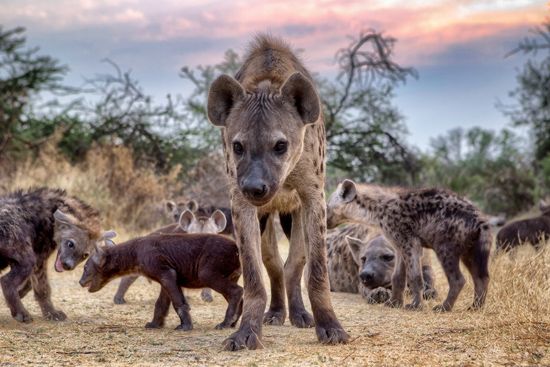
Spotted hyenas live in complex social groups known as clans, which can range from 5 to 80 individuals. These clans are defined by a strict linear dominance hierarchy where females are larger than males and hold higher social status; notably, the lowest-ranking female outranks the highest-ranking male.2
Key aspects of their social structure include:
- Dominance and Feeding: The dominant female typically monopolizes carcasses, ensuring better nutrition for her cubs. The dominant male generally secures the majority of mating opportunities.2
- Social Signaling: Hyenas use a “genital greeting” to reinforce social bonds, where individuals lift a hind leg to allow for mutual inspection.2
- Inheritance: Female cubs inherit the social status of their mothers, while young males may eventually disperse to join other clans to increase their breeding prospects.2
- Territoriality: Clans mark and defend their territory using scent from anal glands and communal dung piles known as “latrines”.2
While brown hyenas also live in clans, their social dynamics differ significantly: females do not outrank males, and clan members cooperatively nurse and feed each other’s cubs.2
How do spotted hyenas use scent to mark their territory?
Spotted hyenas mark and defend their territory primarily through the use of communal dung piles, known as “latrines,” and by secreting scent from their anal glands.6
These methods serve as essential chemical signals that allow clan members to advertise their presence and maintain boundaries against other groups. While many other mammals use various exocrine glands to communicate territorial information, the spotted hyena relies on these specific excretory behaviors to establish and reinforce their territorial claims.62
Sources
- Do Hyenas Really Laugh? — Encyclopædia Britannica
- hyena — Encyclopædia Britannica
- Are hyenas cats or dogs? — Encyclopædia Britannica
- Hyaenodontidae — Merriam-Webster
- Hyaenidae — Merriam-Webster
- Chemoreception - Territorial behavior — Encyclopædia Britannica
Published on · 2 min read