Hyena
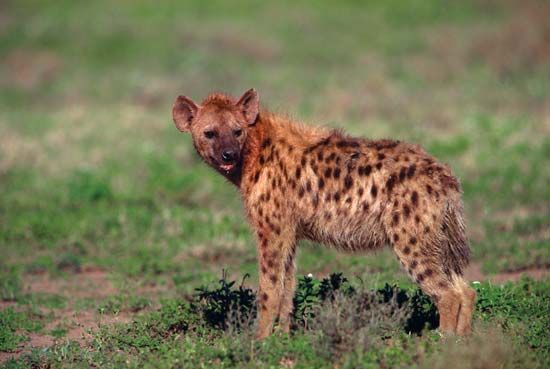
There are three extant species of hyenas, all belonging to the family Hyaenidae. Despite their doglike appearance, hyenas are evolutionarily more closely…
What are the different species of hyenas, and how are they classified?
There are three extant species of hyenas, all belonging to the family Hyaenidae. Despite their doglike appearance, hyenas are evolutionarily more closely related to cats within the order Carnivora.12
The three species are:
- Spotted hyena (Crocuta crocuta): The largest species, known for its complex social clans and distinct vocalizations.1
- Brown hyena (Parahyaena brunnea): A smaller, shaggy-coated species found in Southern Africa.1
- Striped hyena (H. hyaena): A smaller species ranging from North Africa to India, characterized by a crest of long hair.1
The family Hyaenidae also includes the aardwolf, though it is classified in a separate subfamily due to its specialized insectivorous diet. While these animals are often viewed as mere scavengers, they are also proficient hunters that play a vital role in their ecosystems. Unfortunately, all three species are currently in decline due to human persecution and habitat loss.12
What are the unique vocalizations of hyenas, and how do they use them for communication?
Spotted hyenas (Crocuta crocuta) are well-known for their complex vocal repertoire, which includes moans, yells, giggles, and whoops—sounds that can carry for several kilometers.4
Contrary to popular belief, the “laughter” vocalization—a high-pitched series of short, giggle-like sounds—is not an expression of amusement. Instead, these sounds are typically produced when a hyena is threatened, under attack, or frustrated, such as when another clan member attempts to steal its food.1
These vocalizations serve as important tools for social communication. The pitch of a giggle can convey specific information about the individual, such as its age or social status; for instance, older hyenas often produce lower-pitched and less variable sounds compared to younger individuals. By utilizing these distinct acoustic signals, spotted hyenas can effectively navigate the complex social dynamics of their clans.14
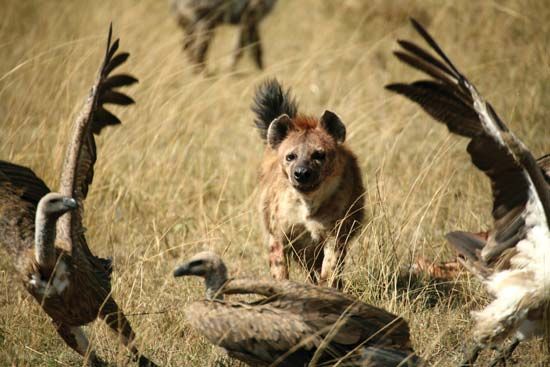
How do hyenas hunt and scavenge, and what is their role in the ecosystem?
Hyenas are highly adaptable carnivores that function as both proficient hunters and opportunistic scavengers, playing a critical role in maintaining the balance of their ecosystems.15
Hunting and Scavenging
While often stereotyped as mere scavengers, spotted hyenas are skilled predators that kill the majority of their own food, particularly in East and Southern Africa. They are tireless trotters with excellent senses that allow them to locate carrion or pursue prey—such as wildebeest, zebras, and gazelles—at speeds up to 65 km (40 miles) per hour.1
Their anatomy is uniquely suited for their diet:
- Bone-crushing power: Strong jaws and broad molars allow them to consume nearly every part of a carcass, including bones, which are digested using highly concentrated hydrochloric acid.1
- Social cooperation: While lone hyenas may rely more heavily on scavenging, clans often hunt in groups, sometimes driving off other predators like lions to steal their kills.15
- Dietary flexibility: Other species, such as the brown and striped hyena, incorporate a wider variety of food sources, including insects, fruit, small vertebrates, and eggs, in addition to scavenging leftovers from larger predators.1
Ecological Role
As top-tier predators, hyenas are essential to the “balance of nature.” By preying on both weakened and healthy individuals, they help keep prey populations within the carrying capacity of their environment, ensuring that surviving populations are better fed and less prone to disease. Furthermore, their role as scavengers helps clean the environment by consuming decomposing animal matter.615
What is a hyena?
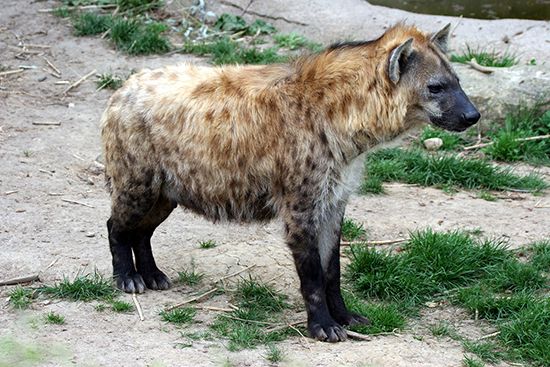
A hyena is a member of the family Hyaenidae, a group of three species of coarse-furred, doglike carnivores native to Africa and Asia. While their appearance often leads to confusion, hyenas are neither cats nor dogs; they belong to their own distinct family, though they share a more recent evolutionary ancestry with the cat group.189
The three primary species include:
- Spotted hyena (Crocuta crocuta): The largest species, known for its unique vocalizations and complex social structures.1
- Brown hyena (Parahyaena brunnea): A shaggy-coated species found in Southern Africa, often referred to as the “strand wolf”.1
- Striped hyena (H. hyaena): A smaller species found across North Africa, the Middle East, and India, characterized by its striped coat and erectile crest.1
Hyenas are noted for their powerful necks, shoulders, and jaws, which allow them to crush bones and consume nearly every part of a carcass. While they are famous for their scavenging habits, they are also proficient hunters.189
Sources
- hyena — Encyclopædia Britannica
- Hyaenodontidae — Merriam-Webster
- Hyaenidae — Merriam-Webster
- Do Hyenas Really Laugh? — Encyclopædia Britannica
- scavenger — Encyclopædia Britannica
- lion - Hunting — Encyclopædia Britannica
- carnivore - Importance of Carnivora — Encyclopædia Britannica
- Are hyenas cats or dogs? — Encyclopædia Britannica
- Did you know? — Merriam-Webster
Published on · 4 min read