Dormouse
Dormice are distinct from other rodents in several key ways, though their exact evolutionary relationship to other groups remains unclear. They are the sole…
What are the key characteristics that distinguish dormice from other rodents?
Dormice are distinct from other rodents in several key ways, though their exact evolutionary relationship to other groups remains unclear. They are the sole members of the family Myoxidae (also known as Gliridae).12
Key characteristics include:
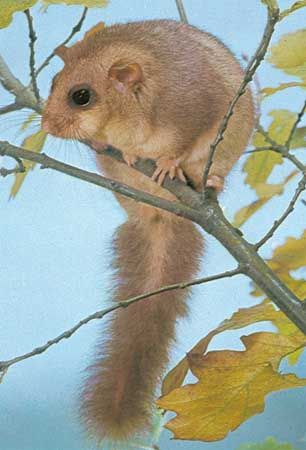
- Physical Appearance: They are small to medium-sized with large eyes, rounded ears, short legs, and soft, dense fur that ranges from gray to reddish. Many species possess a hairy or bushy tail, and some feature dark facial markings or a stripe along the back.13
- Behavior and Habitat: Most are agile, arboreal climbers that construct globular nests in trees, bushes, or rock crevices. Some species are noted for their ability to scale vertical rock faces or walk upside down under ledges.1
- Dormancy: A defining trait for many temperate and boreal species is their ability to accumulate body fat in the fall and enter hibernation during winter. Tropical and desert species may experience periods of torpor rather than full hibernation.1
- Diet: They are omnivorous, consuming fruit, nuts, insects, spiders, bird eggs, and occasionally small rodents.31
Where are dormice typically found, and what are their preferred habitats?
Dormice are found across a broad geographic range, including Eurasia—stretching from western Europe to eastern China—as well as southern Japan, the Mediterranean margin of North Africa, and throughout sub-Saharan Africa sub-Saharan Africa.2
They are highly adaptable and occupy a diverse array of habitats, ranging from boreal and deciduous forests to orchards and tropical rainforests. Their preferred environments also include open country characterized by scattered clusters of trees and shrubs, as well as more extreme landscapes such as clay and sandy deserts and rocky, dry plateaus.1
Regardless of the specific environment, dormice are primarily known for their agility as climbers. They construct globular nests using plant material in trees, bushes, rock crevices, and burrows, or among tree roots. Some species are particularly adept at navigating rocky terrain, capable of scaling vertical faces or moving along the undersides of rock ledges.21
What are the different species of dormice, and how do they vary?
There are 27 recognized species of dormice, which belong to the family Myoxidae. These rodents are categorized into three distinct subfamilies, each exhibiting unique traits and evolutionary adaptations.
Classification and Diversity
The family is organized into the following subfamilies and genera:
- Subfamily Graphiurinae: Contains the single genus Graphiurus, which includes 14 species of African dormice.1
- Subfamily Leithiinae: Comprises 10 species across four genera:
- Dryomys (forest dormice, 4 species)
- Myomimus (mouse-tailed dormice, 3 species)
- Eliomys (garden dormice, 2 species, including the lerot)
- Selevinia (desert dormouse, 1 species)1
- Subfamily Myoxinae: Includes three species in three separate genera:
- Glirulus (Japanese dormouse, 1 species)
- Muscardinus (hazel dormouse, 1 species)
- Glis (fat or edible dormouse, 1 species)fat or edible dormouse, 1 species)2
Variation Among Species
Dormice vary significantly in size and physical characteristics. The largest is the fat dormouse (Glis glis), which can weigh up to 180 grams and reach a body length of 19 cm. In contrast, the Japanese dormouse (Glirulus japonicus) is one of the smallest, weighing up to 40 grams with a body length of less than 8 cm. While most species share features like large eyes, rounded ears, and bushy tails, they differ in their environmental adaptations—ranging from the arboreal agility of forest-dwelling species to the specialized survival strategies of those living in arid, treeless deserts.1
We could dive deeper into the specific evolutionary history of these subfamilies or compare the hibernation behaviors of temperate versus tropical species.
How have dormice been represented in literature and popular culture?
Sorry, the Britannica knowledge base does not contain information regarding the representation of dormice in literature and popular culture.
Sources
- Did you know? — Merriam-Webster
- dormouse — Encyclopædia Britannica
- Dormancy - Endocrine activity — Encyclopædia Britannica
- glirid — Merriam-Webster
- Gliridae — Merriam-Webster
- Dormancy - Effects of temperature — Encyclopædia Britannica
Published on · 3 min read