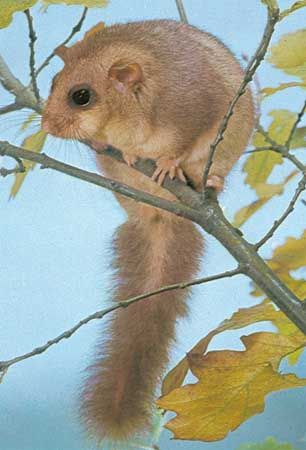
Desert Dormouse
The desert dormouse (Selevinia betpakdalaensis) is a small, rarely seen rodent native to Central Asia. Weighing less than 28 grams, it is distinguished by…
What is a desert dormouse and where can it be found?
The desert dormouse (Selevinia betpakdalaensis) is a small, rarely seen rodent native to Central Asia1. Weighing less than 28 grams, it is distinguished by its soft gray fur, white underside, and a unique molting process where it sheds both skin and hair. While originally misclassified, it is now recognized as a specialized member of the dormouse family (Myoxidae).1
This endangered species is found exclusively in the clay and sandy deserts surrounding Lake Balkhash in southeastern Kazakhstan. It specifically inhabits areas with thickets of saltbush and wormwood growing on salty clay soils. Primarily nocturnal, the desert dormouse is known to climb well and may enter a state of dormancy during cold weather to survive.1
What are the physical characteristics of a desert dormouse?
The desert dormouse (Selevinia betpakdalaensis) is a small rodent with several distinct physical characteristics:1
- Size and Build: It has a stout, rounded body measuring 8 to 10 cm (3.1 to 3.9 inches) in length, with a slightly shorter, fine-haired tail of 6 to 8 cm. It weighs less than 28 grams (1 ounce).1
- Fur: The animal possesses long, soft, and dense gray fur, contrasted by a white underside.1
- Unique Molting: Unlike other rodents that only replace their hair, the desert dormouse sheds both its skin and hair in patches, which are then replaced by a dense new growth.1
- Dentition: It features large upper incisor teeth, while its cheek teeth are notably small and barely protrude above the gums.1
How does the desert dormouse’s lifestyle differ from other rodents?
The desert dormouse (Selevinia betpakdalaensis) exhibits several lifestyle characteristics that distinguish it from other rodents:
- Unique Molting: Unlike other rodents that replace only their hair during a molt, the desert dormouse sloughs off patches of both skin and hair, which are then replaced by a dense new growth.1
- Thermoregulation and Dormancy: While many temperate rodents undergo full hibernation, the desert dormouse experiences periods of torpor when temperatures drop below 5 °C (41 °F). Its burrowing behavior is also temperature-dependent; it digs burrows in cold conditions but seeks shelter under rocks or leaves when temperatures are high.1
- Locomotion: It typically ambles along but moves with slow, short leaps when disturbed. Despite its desert habitat, it is also an adept climber.1
- Dietary Habits: While many rodents are primarily herbivorous or granivorous, the desert dormouse is known to consume spiders and insects, in addition to the leaves of saltbush shrubs.1
How long do desert dormice typically live in the wild?
I cannot provide information regarding the typical lifespan of a desert dormouse in the wild. Because this species is rarely seen or captured and the ecology of wild populations has not been studied, most available information is derived from captive individuals, which does not provide reliable data on their natural longevity.1
Sources
- desert dormouse — Encyclopædia Britannica
- dormouse — Encyclopædia Britannica
Published on · 2 min read