Gelada
The gelada (Theropithecus gelada) is a large primate belonging to the Old World monkey family, Cercopithecidae. While often described as baboon-like, it is…
What is gelada?
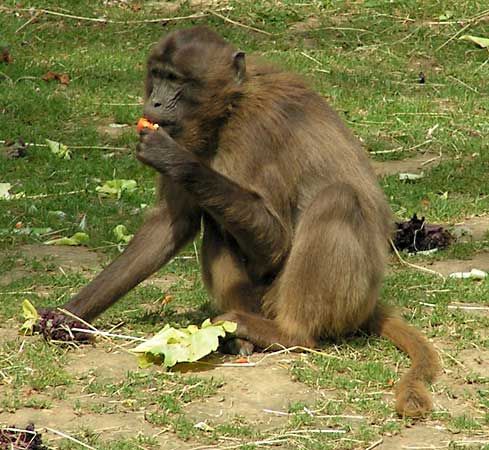
The gelada (Theropithecus gelada) is a large primate belonging to the Old World monkey family, Cercopithecidae. While often described as baboon-like, it is distinct from true baboons because its nostrils are located some distance from the tip of its muzzle.1
Native to the mountains of Ethiopia, these terrestrial animals inhabit steep cliffs and high plateaus. They are diurnal, feeding primarily on grasses, roots, leaves, and tubers. Physically, the gelada is stocky with brown fur, white eyelids, and a characteristic bald pink chest. Males are significantly larger than females, weighing about 19 kg (42 pounds), and possess a heavy mane.1
Socially, geladas live in groups consisting of one male and several females. These units frequently aggregate with other groups and bachelor herds to form large foraging populations that can reach several hundred individuals.1
How do geladas differ from other baboons?
While the gelada (Theropithecus gelada) is often referred to as a “gelada baboon,” it is distinct from the true baboons belonging to the genus Papio.123
The primary physical difference lies in the structure of the muzzle: in true baboons, the nostrils are located at the very tip of the snout, whereas in the gelada, the nostrils are positioned some distance back from the tip.13
Additionally, while both are members of the Old World monkey family, Cercopithecidae, they exhibit different ecological and physical traits:
- Diet and Habitat: Geladas are specialized herbivores found in the high plateaus and steep cliffs of Ethiopia, feeding primarily on grasses, roots, and tubers. In contrast, true baboons are generally found in savanna and semiarid regions and have a more varied diet that includes plants, fruits, and small animals.13
- Appearance: The gelada is characterized by a distinctive bald, pink chest patch, which is absent in true baboons.1
- Classification: Although the gelada is the only monkey closely related to the genus Papio, it remains a separate genus, Theropithecus.3
What makes the Ethiopian Highlands a unique habitat?
The Ethiopian Highlands, often called the “Roof of Africa,” represent a unique habitat defined by their extreme topography and ecological isolation. Comprising about half of all the highlands on the African continent, the region forms a sharp contrast to the surrounding lowlands, featuring rugged massifs like the Simien Mountains and peaks reaching over 14,000 feet.41
This environment supports a distinct array of flora and fauna found nowhere else on Earth. The highlands are home to several endangered species that have adapted to these high altitudes, including the walia ibex, the mountain nyala, the Simien jackal, and the gelada monkey. The vegetation is equally specialized, characterized by moorlands and grasslands punctuated by unique species such as the giant lobelia, which can reach 20 feet in height, and the endemic Rosa abyssinica.45
Beyond its biological significance, the region’s moderate climate and fertile soils have historically made it the economic and demographic core of Ethiopia, fostering long-standing agricultural communities and unique cultural developments, such as the rock-hewn churches of Lalibela.1
Why do geladas have a bald patch on their chest?
The bald, pink patch on a gelada’s chest is a distinctive physical feature that serves as a key indicator of the animal’s social and reproductive status.
In females, this patch is particularly notable for a necklacelike row of bead-shaped, fleshy growths that develop along its edges. While the patch is a defining characteristic of the species, it functions primarily as a visual signal within their complex social group structures. These markings, which become more vibrant during certain phases of the reproductive cycle, allow individuals to communicate information about their hormonal state and social standing to other members of the herd.
Sources
- gelada — Encyclopædia Britannica
- gelada baboon — Merriam-Webster
- baboon — Encyclopædia Britannica
- Exploring 7 of Earth’s Great Mountain Ranges - Ethiopian Highlands — Encyclopædia Britannica
- Ethiopia - Plant and animal life — Encyclopædia Britannica
- Ethiopian Plateau — Encyclopædia Britannica
Published on · 3 min read