Dry Tortugas
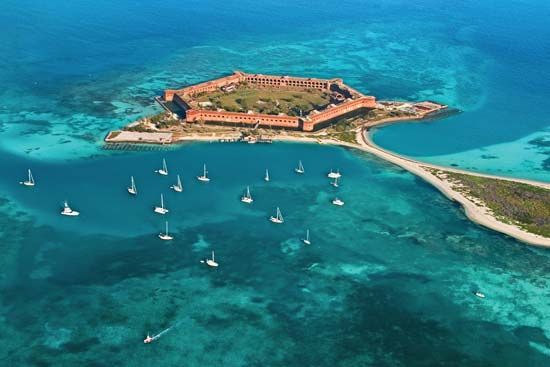
Fort Jefferson, located on Garden Key in the Dry Tortugas, holds significant historical status as the largest all-masonry fortification in the Americas.…
What is the historical significance of Fort Jefferson in the Dry Tortugas?
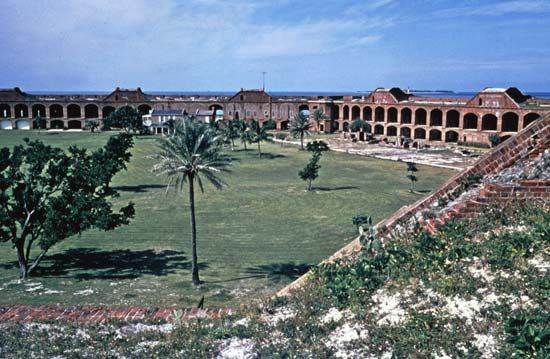
Fort Jefferson, located on Garden Key in the Dry Tortugas, holds significant historical status as the largest all-masonry fortification in the Americas. Construction of the massive structure spanned from 1846 to 1876.1
During the American Civil War, the fort served as a strategic Union stronghold. Following the conflict, it functioned as a prison until 1873. Its most notable inmate was Samuel A. Mudd, a physician imprisoned for his role in the conspiracy to assassinate President Abraham Lincoln; Mudd had treated the broken leg of the assassin, John Wilkes Booth.1
In 1935, the site was designated as Fort Jefferson National Monument to preserve its historical and architectural legacy, eventually becoming part of the Dry Tortugas National Park in 1992.12
Where are the Dry Tortugas located and how many islands make up this archipelago?
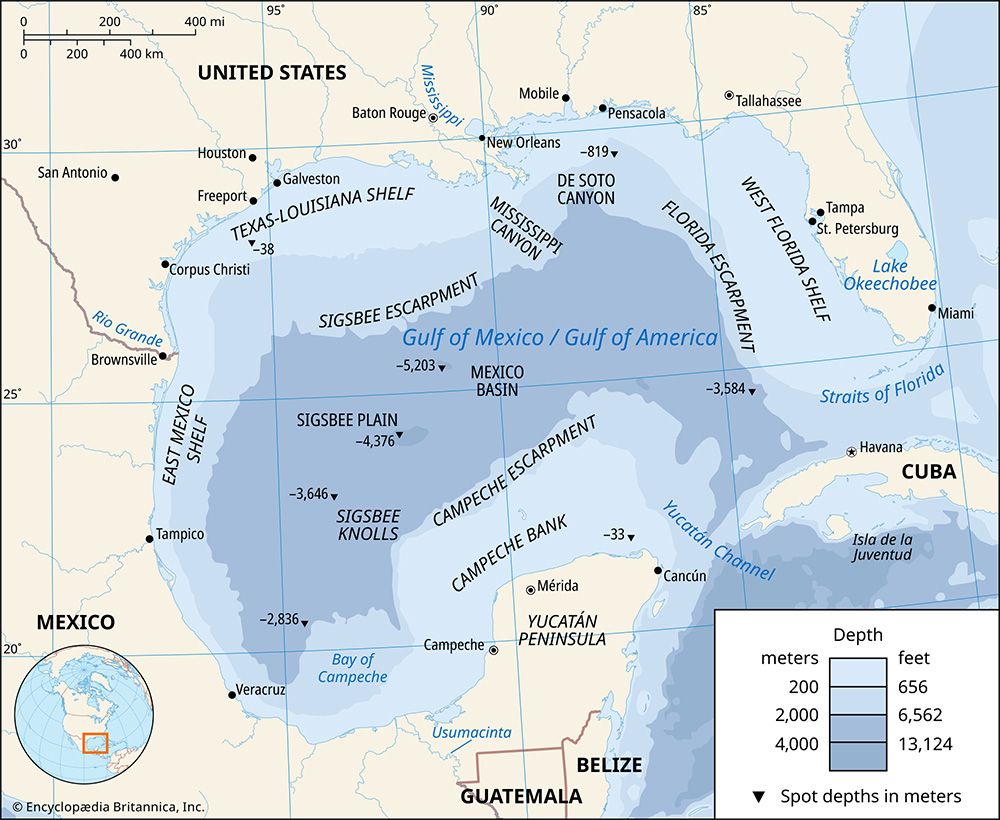
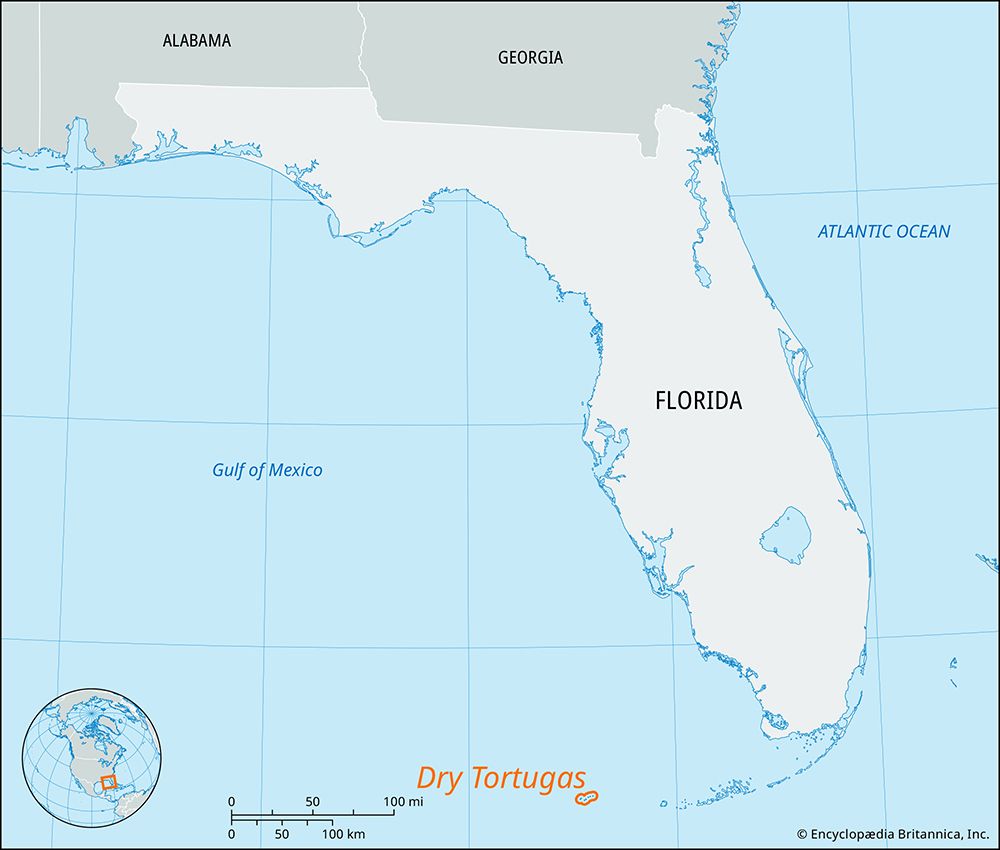
The Dry Tortugas are a group of seven coral islands and sandbars located in the Gulf of Mexico, situated west of Key West at the tip of southern Florida.21
The archipelago consists of the following seven keys:
- Bush Key
- East Key
- Garden Key
- Hospital Key
- Loggerhead Key
- Long Key
- Middle Key1
These islands, along with the surrounding waters, comprise Dry Tortugas National Park, which covers approximately 101 square miles.21
How did the Dry Tortugas get their name, and what does it mean?
The name “Dry Tortugas” originates from the Spanish explorer Juan Ponce de León, who discovered the islands in 1513. He named them Tortugas because of the abundance of tortoises found there at the time. Later, mariners added the adjective “dry” to the name to accurately reflect the lack of fresh water on the islands.3
What types of birds can be found in the Dry Tortugas, and why is it an important site for birdwatchers?
The Dry Tortugas serve as a vital stopover and nesting ground for thousands of migrating birds. The archipelago is particularly significant to birdwatchers because it provides a critical refuge for avian species traveling across the Gulf of Mexico.
Among the notable species found in the park is a large colony of sooty terns, which utilizes Bush Key as a nesting site each spring and summer. Because the islands are remote and accessible only by boat or seaplane, they offer a unique environment for observing these birds in a relatively undisturbed habitat.1
Sources
- Dry Tortugas — Encyclopædia Britannica
- Dry Tortugas National Park — Encyclopædia Britannica
- Dry Tortugas — Merriam-Webster
Published on · 2 min read