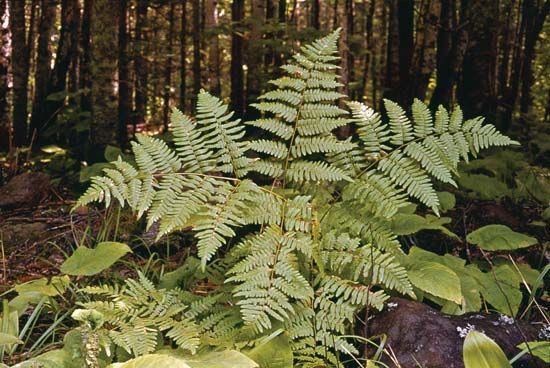
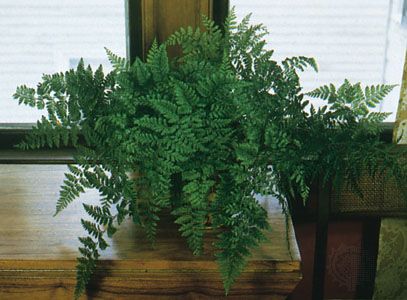
Dryopteridaceae
The Dryopteridaceae family, commonly known as the shield fern family, is distinguished from other fern families primarily by its reproductive structures and…
What are the main differences between Dryopteridaceae and other fern families?
The Dryopteridaceae family, commonly known as the shield fern family, is distinguished from other fern families primarily by its reproductive structures and morphological characteristics.12
Key Characteristics and Distinctions
- Soral Structure: A defining feature of many Dryopteridaceae is the presence of round sori protected by a membranous, kidney-shaped (reniform) or umbrella-shaped (peltate) flap of tissue called an indusium. While other families also possess indusia, the specific shape and attachment of these structures are diagnostic for the family.1342
- Leaf Morphology: The family exhibits extreme variability in leaf form, ranging from entire to highly divided (up to four times pinnately compound). Unlike the Polypodiaceae, which typically lack indusia entirely, Dryopteridaceae species frequently utilize these protective flaps.123
- Habitat and Growth: Members are primarily terrestrial or rock-dwelling, though some are epiphytic. They are considered relatively advanced ferns.12
- Comparison to Related Families:
- Thelypteridaceae: Often possess slender, needlelike hairs, whereas Dryopteridaceae are more varied in their vestiture (scales, hairs, or glands).2
- Polypodiaceae: Generally lack indusia and often feature distinct clathrate (latticed) scales on their rhizomes.2
- Tectariaceae: Formerly grouped with Dryopteridaceae, this family was separated based on distinct evolutionary and morphological traits.12
How many genera and species are included in the Dryopteridaceae family?
The Dryopteridaceae family, also known as the shield fern family, comprises approximately 40–50 genera and includes about 1,700 species.1
These vascular plants are distributed globally, showing the greatest diversity in temperate regions and tropical mountainous areas. While the family’s exact limits remain a subject of ongoing study, it includes several notable genera, such as:1
- Elaphoglossum: A large genus containing more than 700 species.1
- Dryopteris: Comprising approximately 250 species.1
- Polystichum: Containing between 160 and 200 species.1
- Cyrtomium: Including as many as 20 species.1
- Polybotrya: Consisting of about 35 species.1
It is important to note that the classification of this family has evolved; for instance, the genus Tectaria and its relatives were previously associated with Dryopteridaceae but are now classified within the separate family Tectariaceae.1
What are the main characteristics of plants in the Dryopteridaceae family?
The Dryopteridaceae family, commonly known as the shield fern family, consists of approximately 40–50 genera and 1,700 species of vascular plants distributed globally, with the highest diversity found in temperate and tropical mountainous regions.14
Key Characteristics
- Habitat and Growth: Most species are terrestrial or grow on rocks, though some are epiphytic or hemiepiphytic (climbing). Their rhizomes are typically scaly and range from short-creeping to erect.14
- Leaf Morphology: The leaves are highly variable, ranging from entire to four times pinnately divided. They may be glabrous, hairy, glandular, or scaly, and some species exhibit dimorphism between vegetative and fertile leaves.14
- Reproductive Structures: A primary diagnostic feature is the presence of round sori located on the undersurface of the leaves. These are often protected by a membranous, kidney-shaped (reniform) or umbrella-shaped (peltate) indusium, though some species lack this covering.143
- Spores: The spores are generally monolete, meaning they are bean-shaped.14
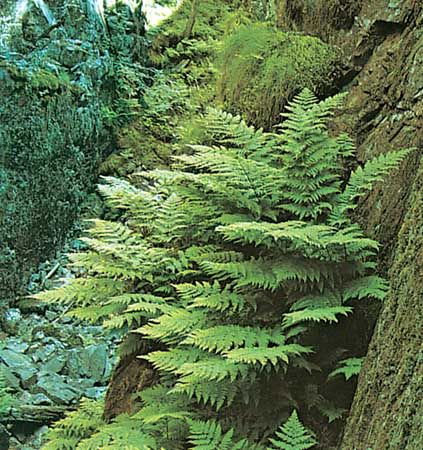
Where are Dryopteridaceae plants typically found in nature?
Plants in the Dryopteridaceae family are distributed nearly worldwide, showing their greatest diversity in temperate regions and tropical mountainous areas.14
In their natural habitats, these plants are typically found in the following settings:
Sources
- Dryopteridaceae — Encyclopædia Britannica
- plant - Subclass Polypodiidae — Encyclopædia Britannica
- fern - The sorus — Encyclopædia Britannica
- fern - Annotated classification — Encyclopædia Britannica
- shield fern — Encyclopædia Britannica
- fern - The indusium — Encyclopædia Britannica
- fern - Ecology — Encyclopædia Britannica
Published on · 3 min read