Calamites
Calamites were significant Carboniferous sphenopsids that distinguished themselves from earlier or related flora through specific structural adaptations.…
How did Calamites differ from their predecessors in the plant kingdom?
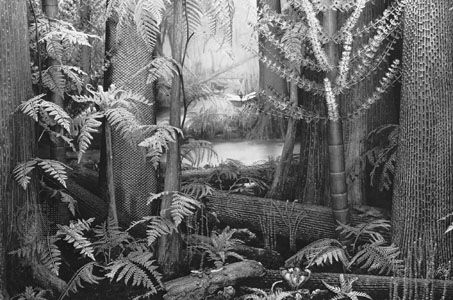
Calamites were significant Carboniferous sphenopsids that distinguished themselves from earlier or related flora through specific structural adaptations. Unlike the earlier genus Sphenophyllum, which featured a solid central core of water-conducting cells, Calamites possessed a distinct hollow central stem. This hollow architecture is a defining feature often preserved in the fossil record as internal casts.12
While Calamites shared a node-internode architecture and whorled leaf arrangement with other sphenopsids, they evolved into tree-sized plants reaching up to 20 meters (66 feet) in height. They were well-adapted to riparian environments, growing along sandy riverbanks, and possessed a resilient growth strategy: they could sprout vigorously from underground rhizomes if the upper stem was damaged. In contrast to the massive, diamond-barked lycopods of the same era, Calamites were smaller but thrived in diverse habitats, including drier, upland environments.123
How are Calamites related to modern-day plants, if at all?
Calamites are closely related to modern-day plants as extinct members of the order Equisetales, a group of sphenophytes that includes the only living representative, the horsetail (Equisetum).16
While Calamites were massive, tree-sized plants that reached heights of up to 30 meters (100 feet) during the Carboniferous Period, they shared fundamental structural characteristics with modern horsetails that define the group:217
- Jointed Stems: Both possess a distinct node-internode architecture, where stems are segmented and jointed.216
- Whorled Arrangement: In both Calamites and modern Equisetum, branches and leaves emerge in whorls at these nodes.21
- Reproductive Structures: Both produce spores in terminal cones, known as strobili.16
- Silica Content: Like their modern relatives, Calamites were vascular plants that utilized silica in their tissues, a trait that gives modern horsetails their characteristic abrasive texture.16
Although Calamites were significantly larger and possessed woody stems capable of secondary growth, they are considered the ancient, treelike ancestors of the smaller, herbaceous horsetails we see today.17
How tall could Calamites grow, and what was their overall structure?
Calamites were impressive, tree-sized plants that thrived during the Carboniferous and Permian periods, reaching heights of up to 20 meters (approximately 66 feet).1
Their physical structure was defined by several key characteristics:
- Node-Internode Architecture: Similar to modern horsetails, Calamites featured a segmented stem structure where branches and leaves emerged in whorls from specific nodes.1
- Hollow Stems: Unlike some of their contemporaries, Calamites possessed a hollow central stem. Because of this, many fossils are preserved as casts of this internal space.1
- Woody Growth and Rhizomes: The plants had woody upright stems connected by an extensive system of underground rhizomes. This allowed them to sprout vigorously if the upper portions of the plant were damaged.1
- Habitat: They were primarily found growing along the sandy banks of rivers.1
What types of reproductive structures did Calamites have?
Calamites reproduced using specialized structures known as cones, or strobili, which formed at the ends of their branches. These reproductive organs are believed to be among the most elaborate strobili ever developed by vascular plants.1
The key features of their reproductive system included:
- Strobili: These were greatly compressed stems that functioned as the primary reproductive units.1
- Sporangiophores: The fertile components within the strobilus, which consisted of a stalk topped by a flattened disk.1
- Sporangia: A ring of 5 to 10 spore-bearing cases was attached to the lower edge of each sporangiophore disk. These sporangia opened via longitudinal slits to release spores.1
- Sterile Bracts: The strobili of Calamites were often associated with sterile bracts, which were much-reduced leaves.1
- Homospory: As members of the Equisetopsida class, Calamites were homosporous, meaning they produced only one type of spore. These spores were equipped with four bands called elaters that responded to humidity changes to assist in dispersal.1
Sources
- Calamites — Encyclopædia Britannica
- Carboniferous Period - Plants — Encyclopædia Britannica
- Calamitaceae — Merriam-Webster
- Archaeocalamites — Merriam-Webster
- Sphenophyllum — Encyclopædia Britannica
- Equisetopsida — Encyclopædia Britannica
- Calamariaceae — Merriam-Webster
- plant - Order Equisetales — Encyclopædia Britannica
- strobilus — Merriam-Webster
Published on · 3 min read