Ecological Footprint
While the ecological footprint (EF) is a widely used tool for measuring human impact on the environment, it faces several significant criticisms and…
What are some criticisms or limitations of the ecological footprint concept?
While the ecological footprint (EF) is a widely used tool for measuring human impact on the environment, it faces several significant criticisms and limitations:
- Aggregation and Simplification: By providing a single aggregate indicator, the EF simplifies complex environmental realities. It assumes, for instance, that technology remains consistent across the globe and over time.1
- Methodological Biases: Critics argue the methodology may reward intensive production methods that increase short-term yields but potentially accelerate long-term land degradation. Conversely, sustainable practices like organic farming may appear to have a larger footprint due to lower yields.1
- Anthropocentric Focus: The EF is criticized for being overly anthropocentric, as it focuses on land and sea area useful to the human economy rather than allocating space for other species. It does not directly measure changes in biodiversity.1
- Excluded Impacts: The metric fails to account for several critical environmental issues, including toxic substances, water consumption, and greenhouse gases other than carbon dioxide.1
- Geographic Misinterpretations: Some object to the implication that populations should live strictly within their own territory’s biocapacity, as this penalizes densely populated, efficient regions while potentially favoring large, sparsely populated countries.1
What is the concept of ‘Earth Overshoot Day’ and how does it relate to ecological footprints?
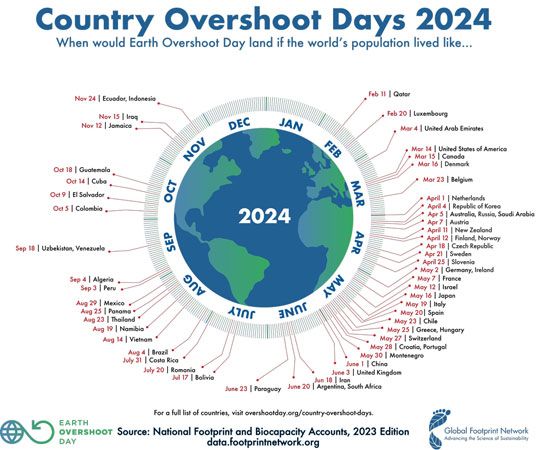
Earth Overshoot Day marks the calendar date each year when humanity’s demand for natural resources and services exceeds what Earth can regenerate in that entire year. It is a direct application of ecological footprint (EF) analysis, which calculates the biologically productive land and sea area required to support human consumption and absorb waste.1
The relationship between the two is foundational: while the ecological footprint measures the total demand placed on the planet, Earth Overshoot Day illustrates the temporal consequence of that demand. When humanity’s global footprint exceeds the planet’s annual biocapacity, we enter a state of “ecological overshoot.” This means we are depleting natural capital—such as fisheries, forests, and rangelands—faster than they can be replenished.1
Since the mid-1970s, humanity has consistently operated in this state of overshoot. By comparing the global footprint to available biocapacity, researchers can determine how many “Earths” would be required to sustain current consumption levels, highlighting the systemic unsustainability of modern production and consumption practices.1
How has the global ecological footprint changed over the past few decades?
Over the past few decades, the global ecological footprint (EF) has consistently exceeded the planet’s capacity to regenerate resources. Humanity has been in a state of “ecological overshoot” since the mid-1970s, meaning we are depleting biological resources—such as fisheries, forests, and agricultural land—faster than they can be replenished.1
Recent data underscores the scale of this imbalance. In 2023, the per capita global footprint was 2.6 global hectares (gha), while the available global biocapacity was only 1.5 gha per person. This indicates that humanity’s demand overshot Earth’s capacity by 1.1 gha, effectively requiring 1.7 “Earths” to sustain current consumption levels. Essentially, it now takes the planet more than one year and eight months to regenerate the resources consumed in a single year.1
While the concept has gained mainstream attention, it remains a subject of ongoing refinement to better account for complex environmental impacts and regional disparities in resource consumption.1
What is an ecological footprint and how is it measured?
An ecological footprint (EF) is a measure of the demands placed by individuals or groups on global natural resources. It estimates the biologically productive land and sea area required to provide the renewable resources a population consumes and to absorb the waste it generates.1
The footprint is measured in “global hectares” (gha) and accounts for several categories of productive areas:
- Croplands and grazing lands for food production.
- Forested areas for wood products and carbon sequestration.
- Marine areas for fisheries.
- Built-up land for infrastructure and housing.1
By calculating these requirements, the EF can be compared against the available biocapacity—the planet’s ability to regenerate these resources. When the EF exceeds biocapacity, it results in ecological overshoot, signaling that natural capital is being depleted faster than it can be replenished.1
Sources
- ecological footprint — Encyclopædia Britannica
- Carbon footprint — Encyclopædia Britannica
Published on · 3 min read