Egyptian Goose
The Egyptian goose (Alopochen aegyptiaca) is a species of waterfowl belonging to the family Anatidae. Despite its name, it is a sheldgoose more closely…
What is an Egyptian goose?
The Egyptian goose (Alopochen aegyptiaca) is a species of waterfowl belonging to the family Anatidae. Despite its name, it is a sheldgoose more closely related to ducks than to true geese. It is the only living member of the genus Alopochen.1
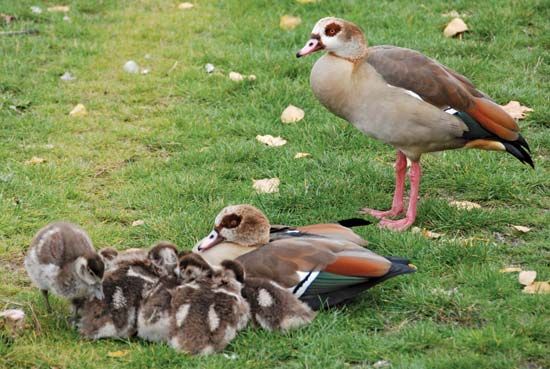
Native to Africa, these birds are common in wetlands and grassy areas south of the Sahara and along the Nile River. They are characterized by their grayish-brown plumage, distinctive brown eye patches, and pink legs. While they feed primarily on vegetation and crops, they are often viewed as agricultural pests.21
Egyptian geese are monogamous and known for their territorial behavior during the breeding season. Currently classified as a species of least concern by the International Union for Conservation of Nature, they have established introduced populations in parts of Europe, North America, and the Middle East.1
Where does the Egyptian goose live?
The Egyptian goose (Alopochen aegyptiaca) is native to Africa, where it is commonly found in wetlands and open grassy areas. Its primary range includes the continent south of the Sahara and the northern regions of the Nile River valley.2
Beyond its native African range, the species has established introduced populations in several other parts of the world, including:
- Middle East: Israel, Jordan, Lebanon, and areas within the Persian Gulf region.2
- Europe: Various locations across the continent.2
- North America: Established populations exist in parts of the continent.2
What does the Egyptian goose look like?
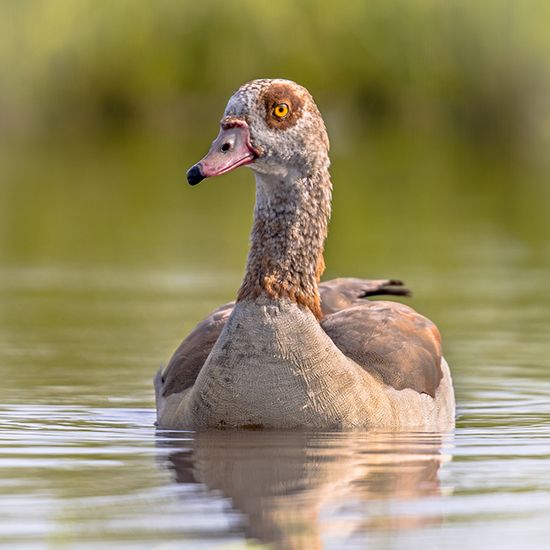
The Egyptian goose (Alopochen aegyptiaca) is a waterfowl that stands approximately 63 to 73 cm (25 to 29 inches) tall, with a wingspan reaching up to 1.4 meters (4.6 feet) and a weight of about 2.3 kg (5 pounds).2
Its physical appearance is characterized by:
- Plumage: The body is primarily grayish brown with a lighter-colored underside.2
- Distinctive Markings: A large brown spot marks the breast, and dark brown circles surround the orange eyes.21
- Limbs: The bill and long legs are pink.2
- Wings: The undersides of the wings display a pattern of white, black, and green.2
While males and females are similar in appearance, females are slightly smaller than males. The two sexes can also be distinguished by their vocalizations: males produce a hoarse hissing or blowing sound, whereas females emit a harsher honking sound.2
What kind of food does the Egyptian goose eat?
The Egyptian goose is primarily a terrestrial feeder, meaning it finds most of its food on land rather than in the water. Its diet is diverse, consisting of both plant matter and small animals:2
- Plant-based diet: They consume grass, leaves, wheat, and various other cereal crops.2
- Animal-based diet: They also eat worms, bees, wasps, locusts, ants, and frogs.2
Because they frequently feed on agricultural crops, farmers often view the Egyptian goose as a significant pest that can damage harvests and potentially spread disease to poultry.2
Sources
- Egyptian goose — Merriam-Webster
- Egyptian goose — Encyclopædia Britannica
- Goose — Encyclopædia Britannica
Published on · 2 min read