Bee
The life cycle of a western honeybee follows a process of complete metamorphosis, consisting of four distinct stages: egg, larva, pupa, and adult.
What is the life cycle of a bee, from egg to adult?
The life cycle of a western honeybee follows a process of complete metamorphosis, consisting of four distinct stages: egg, larva, pupa, and adult.12
- Egg: The queen bee lays an egg, typically one per cell, within the broodnest. Regardless of the bee’s future role, the egg hatches after three days.1
- Larva: The hatched egg becomes a larva, commonly referred to as a grub. All larvae are initially fed royal jelly, though only those destined to become queens continue this specific diet.1
- Pupa: Once fully grown, the grub transforms into a pupa within a sealed cell.1
- Adult: The final transformation into an adult occurs within the cell. The time required to reach adulthood varies by caste: queens emerge in about 16 days, workers in approximately 21 days, and drones in 24 days.1
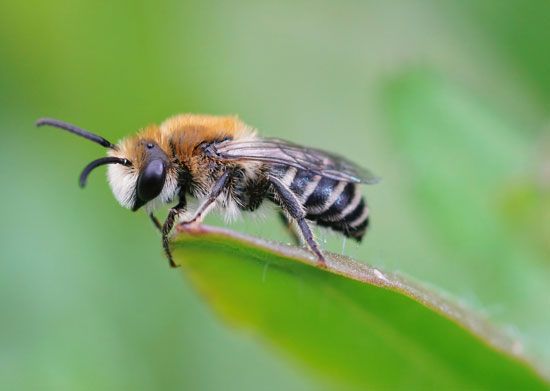
How do bees make honey and why do they store it?
Honeybees produce honey through a sophisticated process of collection and chemical transformation. Worker bees gather nectar from flowers and store it in their “honey stomachs,” where enzymes begin breaking down complex sucrose into simpler sugars like fructose and glucose.4
Once back at the hive, the bees deposit the nectar into honeycomb cells. To convert the watery nectar (which is 50–80% water) into stable honey (about 16–18% water), the bees rapidly beat their wings to promote evaporation. Once the desired consistency is reached, they seal the cells with beeswax to preserve it.14
Bees store honey primarily as a vital food source for the colony. It serves as their main carbohydrate diet, which is essential for survival during winter months when flowers are scarce. By maintaining these reserves, the colony can sustain itself and generate the heat necessary to survive cold temperatures, with the bees consuming their stored honey to fuel the shivering required to keep the hive warm.415
How do beekeepers manage and care for honeybee colonies?
Beekeepers manage honeybee colonies through a structured yearly cycle focused on health, nutrition, and hive expansion. Modern beekeeping relies on the use of movable-frame hives, which allow for regular inspections using standard tools like a smoker to calm the bees, a veil and gloves for protection, and a hive tool to separate frames.
Seasonal Management
- Fall: Beekeepers ensure colonies have adequate food stores (at least 50 pounds of honey and pollen) and may requeen colonies with low brood production. In colder regions, hives are insulated to protect against harsh winds.
- Winter: Colonies require little attention if well-prepared, though beekeepers monitor for starvation.
- Spring: Inspections are critical to ensure the colony has enough food as the population grows. Beekeepers add supers (extra boxes) to accommodate the expanding broodnest and prevent swarming.
Disease and Pest Control
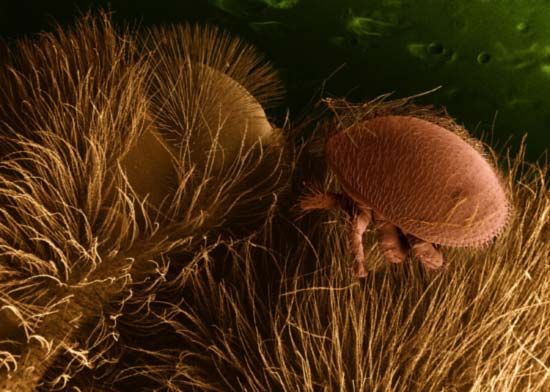
A primary challenge is the varroa mite, a parasite that can devastate colonies. Effective management involves integrated pest management, which combines monitoring mite populations with rotating treatments such as fumigants, genetic stock selection, and physical barriers like screened bottom boards.
How do bees contribute to pollination and why is this process important?
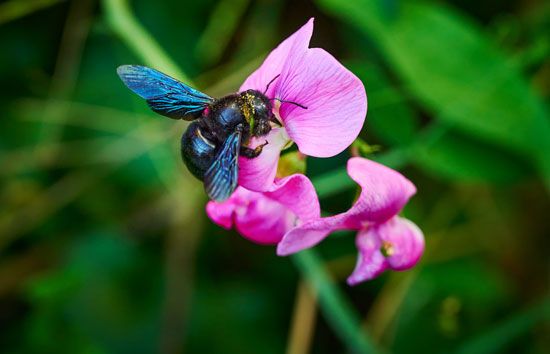
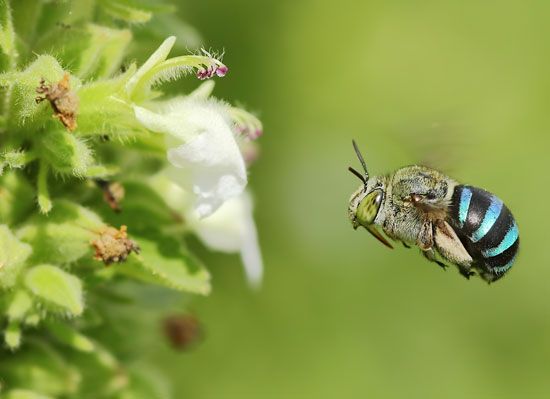
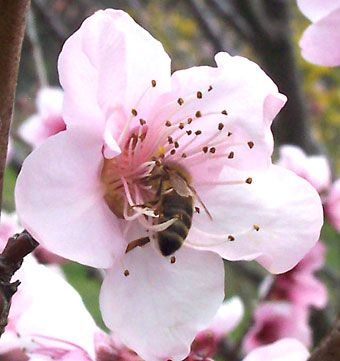
Bees are the most significant insect pollinators globally, playing a vital role in the reproduction of flowering plants. As they visit flowers to collect nectar and pollen for food, they inadvertently transfer pollen from the anthers to the stigma of the same species, facilitating fertilization and the formation of seeds and fruits.12131415
This process is essential for several reasons:
- Ecosystem Health: Many plants rely exclusively on bees for pollination. Without them, these plants would struggle to reproduce, leading to a decline in biodiversity that would ripple through food webs, affecting wildlife that depends on those plants for food and shelter.1213
- Human Agriculture: Bees are responsible for pollinating numerous crops, including almonds, blueberries, and cucumbers. Their activity increases crop yields and improves produce quality, making fresh food more available and affordable.1213
Sources
- western honeybee - Colony and life cycle — Encyclopædia Britannica
- Coleoptera - General features — Encyclopædia Britannica
- insect - Types of metamorphosis — Encyclopædia Britannica
- Beekeeping - Honeybees — Encyclopædia Britannica
- Beekeeping - Liquid honey — Encyclopædia Britannica
- How is honey made? — Encyclopædia Britannica
- Where Do Honeybees Go in the Winter? — Encyclopædia Britannica
- varroa mite — Encyclopædia Britannica
- Beekeeping - The yearly work cycle — Encyclopædia Britannica
- Beekeeping - Beekeeping equipment — Encyclopædia Britannica
- Beekeeping — Encyclopædia Britannica
- Why are bees important? — Encyclopædia Britannica
- What Would Happen If All the Bees Died? — Encyclopædia Britannica
- pollination - Bees — Encyclopædia Britannica
- angiosperm - Pollination — Encyclopædia Britannica
Published on · 3 min read