Elodea
Elodea is a genus of submerged aquatic plants belonging to the Hydrocharitaceae family. These herbaceous perennials are native to the New World and are…
What is Elodea?
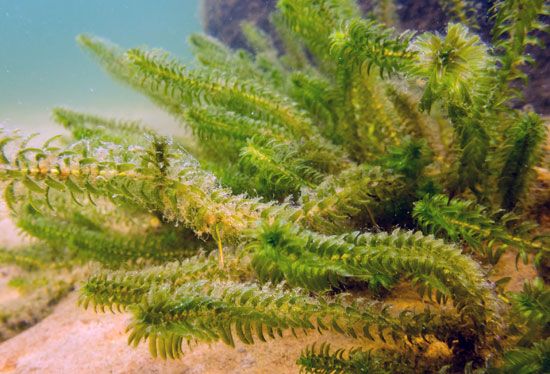
Elodea is a genus of submerged aquatic plants belonging to the Hydrocharitaceae family. These herbaceous perennials are native to the New World and are widely recognized for their utility in aquarium systems and laboratory settings, where they are frequently used to demonstrate photosynthesis and cellular structures like chloroplasts.1
The plants feature dark green leaves arranged in whorls along the stem and can grow while anchored by thin roots or while floating. While they are valued for their oxygen production, some species, such as the Canadian waterweed, have become invasive species globally. These invasive populations often spread through asexual fragmentation, sometimes creating significant obstacles to navigation in waterways across Asia, Africa, Australia, and Europe.1
How does Elodea demonstrate photosynthesis in a classroom setting?
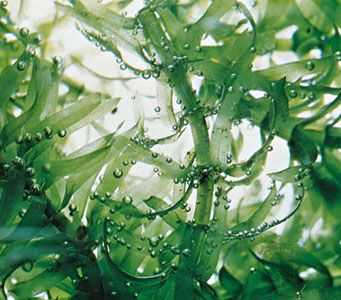
In a classroom setting, Elodea is frequently used to demonstrate photosynthesis because it is a submerged aquatic plant that makes its metabolic activity easily observable. Students typically monitor the plant’s oxygen production, which appears as visible bubbles escaping from the cut stems or leaves when the plant is exposed to light.1
This demonstration allows for the study of how environmental factors influence the rate of photosynthesis. By adjusting variables such as light intensity or temperature, students can observe how the rate of oxygen production changes. For instance, in the light-dependent range, increasing light intensity typically increases the rate of photosynthesis until the plant reaches a point of light saturation. Additionally, because Elodea has thin, transparent leaves, it is an excellent specimen for microscopic examination, allowing students to directly view chloroplasts and other cellular structures involved in these processes.21
Why are some Elodea species considered invasive in new environments?
Elodea species are considered invasive species in new environments primarily due to their ability to reproduce rapidly through asexual fragmentation. When a small piece of the plant is introduced to a new body of water, it can grow into a new, self-sustaining population. In many cases, these invasive colonies consist entirely of individuals of the same sex, all originating from a single introduced fragment.1
This efficient method of propagation allows Elodea to colonize ponds and quiet waterways quickly. Once established, their fast growth rate can lead to dense mats of vegetation that become significant obstacles to lake navigation and disrupt local aquatic ecosystems. Because they can thrive either anchored in soft substrate or while floating, they are highly adaptable to various water conditions, further facilitating their spread across regions like Asia, Africa, Australia, and Europe.1
What are the differences between asexual and sexual plant reproduction?
The primary difference between asexual and sexual reproduction in plants lies in the genetic outcome and the mechanisms involved in creating new individuals.
Asexual Reproduction
Asexual, or vegetative reproduction, involves the regeneration of new plants from vegetative parts or specialized structures without the union of gametes or the process of meiosis.456
- Genetic Outcome: Offspring are genetically identical clones of the parent plant.45
- Advantages: It allows for rapid population growth and the perpetuation of superior traits without variation. It can also bypass environmental limitations, such as the need for water for motile sperm in some species.45
- Mechanisms: This can occur naturally or artificially through structures like rhizomes, stolons, tubers, bulbs, corms, cuttings, or tissue culture.47
Sexual Reproduction
Sexual reproduction requires the fusion of male and female gametes to form a zygote, which then develops into a new individual.8910
- Genetic Outcome: Through the segregation and recombination of genetic material, sexual reproduction produces offspring with unique genetic makeups, fostering genetic variation within a population.85
- Mechanisms: In angiosperms, this process typically involves pollination, where pollen grains deliver sperm to the ovary to fertilize an egg.810
- Life Cycle: It involves an alternation between a diploid sporophyte phase and a haploid gametophyte phase, with meiosis reducing the chromosome number to produce gametes.810
Sources
- Elodea — Encyclopædia Britannica
- photosynthesis - Internal factors — Encyclopædia Britannica
- photosynthesis - Light intensity and temperature — Encyclopædia Britannica
- horticulture - Vegetative propagation — Encyclopædia Britannica
- sexual reproduction — Encyclopædia Britannica
- Reproduction - Reproduction of organisms — Encyclopædia Britannica
- plant reproductive system - Reproduction by special asexual structures — Encyclopædia Britannica
- plant - Asexual reproduction — Encyclopædia Britannica
- plant reproductive system - General features of asexual systems — Encyclopædia Britannica
- angiosperm - General features — Encyclopædia Britannica
Published on · 3 min read