Epidendrum
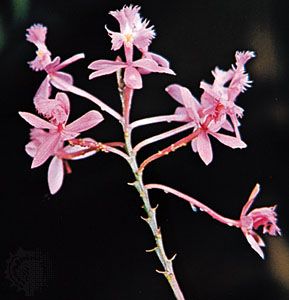
Epidendrum is a genus comprising more than 1,000 species of tropical and semitropical orchids. These plants are primarily epiphytic, meaning they grow on…
What is Epidendrum?
Epidendrum is a genus comprising more than 1,000 species of tropical and semitropical orchids. These plants are primarily epiphytic, meaning they grow on other plants, though some varieties are found growing on rocks or in soil. Their range extends from southeastern North America to central South America.1
The genus is highly diverse in its physical characteristics. Some species feature swollen stems known as pseudobulbs with leathery leaves, while others possess long, thin stems. Their flowers, which are typically borne on a terminal spike, appear in a wide array of colors. While many are grown as ornamentals for their attractive blooms, the greenfly orchid (E. conopseum) is notable as the only species native to nontropical North America.1
What does it mean for a plant to be epiphytic?
An epiphyte is a plant that grows upon another plant or object solely for physical support. Often referred to as “air plants,” these organisms do not rely on their host for nourishment and are not parasitic; they use the host merely as a structure to grow on.234
Most epiphytes are found in moist tropical regions, where growing above the ground allows them to access sunlight in dense forests and utilize nutrients from organic debris that collects in the tree canopy. They obtain water from rain and atmospheric moisture, typically absorbing it through their roots or specialized leaves. Because they lack a connection to the ground, they have evolved various methods for survival, including wind-dispersed, dustlike seeds.2
Common examples include many species of orchids, ferns, mosses, and members of the pineapple family (Bromeliaceae). While they are most common in the tropics, some species, such as ball moss, can be found in more arid environments.32
How do orchids differ from other types of flowering plants?
Orchids (family Orchidaceae) are distinguished from other flowering plants primarily by a unique combination of structural characteristics, particularly within their flowers. While individual features—such as the fusion of reproductive organs—can be found in other groups, the specific organization of the orchid flower is what defines the family.5
Key Distinctions
- Floral Structure: Unlike generalized flowers, orchids have their stamens and pistil fused into a single structure called the column. They typically exhibit bilateral symmetry, with one petal modified into a specialized landing platform known as the lip.56
- Pollen: Orchids often package their pollen into cohesive masses called pollinia, rather than releasing individual grains.56
- Seeds: Orchid seeds are exceptionally small and lack endosperm, the nutrient-rich tissue found in most other angiosperm seeds. Because they lack this internal food source, orchid seeds generally require a symbiotic relationship with a mycorrhizal fungus to germinate and survive in nature.578
What are pseudobulbs and what is their function?
A pseudobulb is a solid, bulbous enlargement of the stem found in many orchid species, particularly those that are epiphytic. While these structures are diverse in form, they are essentially thickened stem bases that can consist of one or several internodes.910
Functionally, pseudobulbs serve as vital storage organs for the plant. Because many epiphytic orchids grow in environments where water and nutrients may be intermittently scarce, these thickened stems allow the plant to store water and energy reserves, helping it survive periods of drought or unfavorable conditions. They are a key feature in the sympodial growth habit, where the plant develops through a succession of these specialized stem elements.1011
Sources
- Epidendrum — Encyclopædia Britannica
- Did you know? — Merriam-Webster
- epiphyte — Encyclopædia Britannica
- parasitic plant — Encyclopædia Britannica
- orchid - Structural diversity — Encyclopædia Britannica
- orchid - Natural history — Encyclopædia Britannica
- orchid - Seeds — Encyclopædia Britannica
- orchid - Floral structure — Encyclopædia Britannica
- pseudobulb — Merriam-Webster
- orchid - Growth forms — Encyclopædia Britannica
- Bulbophyllum — Encyclopædia Britannica
Published on · 3 min read