Enaliarctos
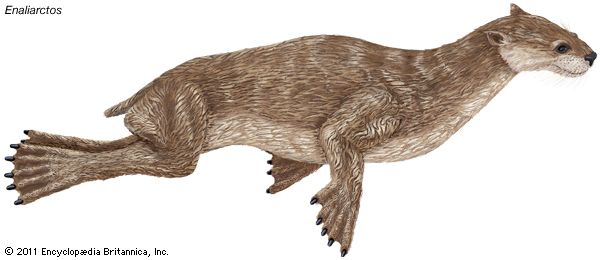
Evidence for the transitional lifestyle of Enaliarctos is found in its unique combination of aquatic and terrestrial anatomical features. As the oldest known…
What evidence suggests that Enaliarctos was transitioning from a terrestrial to an aquatic lifestyle?
Evidence for the transitional lifestyle of Enaliarctos is found in its unique combination of aquatic and terrestrial anatomical features. As the oldest known member of the Pinnipedia group, it possessed specialized hind limbs that functioned as flippers and a vertebral column adapted for strong flexion and extension, which provided the animal with significant swimming ability for hunting fish in marine environments.1
Despite these aquatic adaptations, Enaliarctos retained the ability to use its hind limbs for locomotion on land, a trait it shares with modern sea lions but not with true seals. This semiaquatic nature places it as a bridge between terrestrial ancestors and the fully aquatic, highly specialized skeletons seen in later pinnipeds. Its evolutionary path reflects the broader transition of the order Carnivora into marine niches, driven by changing ocean circulation patterns and increased biological productivity off the coast of North America during the late Oligocene and early Miocene epochs.1
What other extinct marine mammal genera were contemporaries of Enaliarctos?
The provided search results do not contain information regarding other extinct marine mammal genera that were contemporaries of Enaliarctos. While the provided text mentions Puijila as a nonpinniped relative with semiaquatic specializations that lived during the Miocene, it does not specify other marine mammal genera that were contemporaries of Enaliarctos during its existence from the late Oligocene through the Miocene.
How did the discovery of Enaliarctos contribute to our understanding of pinniped evolution?
The discovery of Enaliarctos has been pivotal in clarifying the evolutionary origins of Pinnipedia. By identifying this genus as the oldest known member of the group, paleontologists have been able to bridge the gap between terrestrial ancestors and modern seals, sea lions, and walruses.1
Key contributions to our understanding include:
- Taxonomic Placement: Enaliarctos confirms that pinnipeds belong to the order Carnivora, refuting earlier theories that suggested they occupied a distinct mammalian order due to their extreme aquatic specializations.1
- Evolutionary Transition: It provides a clear example of a semiaquatic lifestyle, demonstrating how early pinnipeds utilized both specialized flippers for swimming and hind limbs for terrestrial locomotion—a trait retained by modern sea lions but lost in true seals.1
- Environmental Context: The genus highlights how shifts in ocean circulation and increased biological productivity off the North American coast during the late Oligocene Epoch drove the evolution of marine specializations.1
How does the size of Enaliarctos compare to modern pinnipeds?
In terms of size, the extinct genus Enaliarctos was significantly smaller than many modern pinnipeds. Specifically, the species E. mealsi, which is the best-known of the group, weighed between 73 and 88 kg (161 to 194 pounds).1
This weight range is comparable to some smaller modern pinnipeds, such as female fur seals or female California sea lions, which typically weigh between 50 and 100 kg. However, Enaliarctos is dwarfed by many other living species. For instance, male elephant seals can reach weights of up to 3,700 kg, and even the northern sea lion can reach 1,000 kg. While Enaliarctos shared a body shape similar to that of a modern sea lion, it lacked the massive size variation and extreme sexual dimorphism seen in many contemporary pinniped species.451
Sources
- Enaliarctos — Encyclopædia Britannica
- list of seals, sea lions, and walruses — Encyclopædia Britannica
- Oligocene Epoch — Encyclopædia Britannica
- pinniped — Encyclopædia Britannica
- sea lion — Encyclopædia Britannica
Published on · 2 min read