Enderbury Atoll
Enderbury Atoll, like other atolls, was formed through the process of coral reef growth around a subsiding volcanic island. According to the theory…
How was Enderbury Atoll formed geologically?
Enderbury Atoll, like other atolls, was formed through the process of coral reef growth around a subsiding volcanic island. According to the theory originally proposed by Charles Darwin, as a volcanic island sinks, reef-building organisms continue to grow upward toward the surface of the water.
Over thousands of years, the reef structure expands outward and upward, eventually becoming separated from the original volcanic shoreline by a lagoon. As the volcanic island continues to subside until it disappears beneath the ocean surface, it leaves behind a ring-shaped reef structure that reaches the sea level, enclosing a central lagoon. Geologic drilling at other atolls has confirmed this process by revealing deep layers of volcanic rock beneath the modern coral reef surface. While cycles of glaciation and changes in sea level have further influenced the development of these features, the fundamental structure of Enderbury Atoll is the result of this long-term subsidence and reef accumulation.1
Where is Enderbury Atoll located in the Pacific Ocean?
Enderbury Atoll is located in the west-central Pacific Ocean as part of the Phoenix Islands chain, which belongs to the nation of Kiribati. It is situated approximately 1,650 miles (2,660 km) southwest of Hawaii.15
What economic activities, if any, are associated with Enderbury Atoll?
Enderbury Atoll currently has no permanent inhabitants and is not the site of active, ongoing economic operations. Historically, however, the atoll supported specific commercial activities:
- Guano Mining: Between 1857 and 1890, the atoll was exploited for its guano deposits, with operations conducted by both American and British interests.1
- Aviation Support: In 1939, the United States and Great Britain established a joint agreement to use Enderbury and nearby Kanton Atoll as transpacific air stops. This economic and strategic utility diminished significantly following the development of long-range jet aircraft.1
In recent decades, the atoll’s primary “activity” has been scientific research, such as studies on bird migration patterns conducted in the 1960s. Today, it remains part of the nation of Kiribati and is largely uninhabited.1
What is the geological formation and structure of Enderbury Atoll?
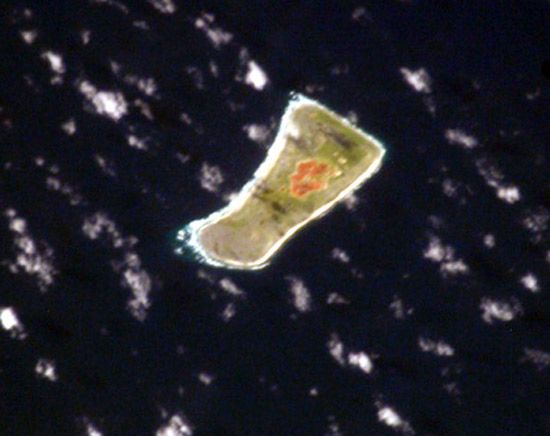
Enderbury Atoll is a coral island characterized as a low, sandy atoll. Structurally, it consists of a ribbon of reef that encloses a shallow, brackish lagoon.142
Like other atolls in the Phoenix Islands group, Enderbury represents the final stage of a geological process described by the subsidence theory. According to this model, the atoll formed through the continuous upgrowth of coral reefs around a sinking, extinct volcanic island. Over thousands of years, as the volcanic foundation subsided, the reef grew upward to maintain its position near the surface, eventually leaving behind a saucer-like structure with a central lagoon. The atoll covers a total land area of approximately 2.5 square miles (6.5 square km).21
Sources
- Enderbury Atoll — Encyclopædia Britannica
- atoll — Encyclopædia Britannica
- Phoenix Islands — Merriam-Webster
- Phoenix Islands — Encyclopædia Britannica
- Enderbury — Merriam-Webster
Published on · 2 min read