Eospermatopteris
Eospermatopteris is significant in the fossil record as it is considered one of the oldest known trees, forming the world’s first terrestrial forests during…
What is the significance of Eospermatopteris in the fossil record of early land plants?
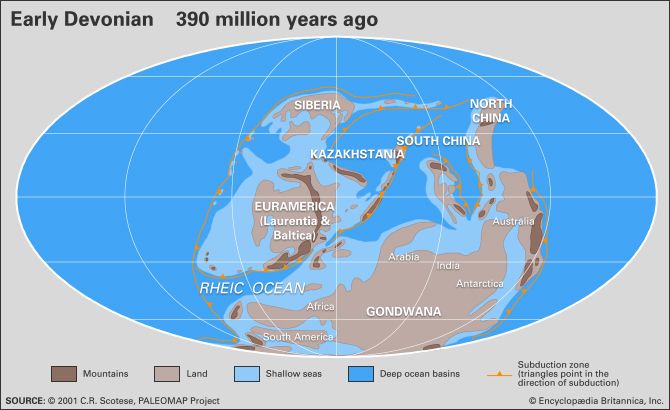
Eospermatopteris is significant in the fossil record as it is considered one of the oldest known trees, forming the world’s first terrestrial forests during the Devonian Period. While some older sources may classify it as a seed fern, modern research identifies it as a member of the extinct group Cladoxylopsida, which reproduced via spores rather than seeds1.12
These plants reached heights of approximately 8 meters and played a transformative role in Earth’s history. By producing an abundance of litter, they likely influenced global carbon budgets by sequestering atmospheric carbon dioxide into biomass. Furthermore, the accumulation of this organic matter is believed to have provided the necessary environment for the evolution of diverse terrestrial arthropod populations. The discovery of these fossils, particularly the complete specimens found near Gilboa, New York, has been instrumental in understanding the transition of early land plants into complex, forest-forming ecosystems.1
How was Eospermatopteris discovered and where are its fossils found?
Eospermatopteris was first discovered in the 1870s near Gilboa, New York, where researchers found fossilized stumps preserved in an upright position, reflecting how they grew in ancient marshy lowlands. For over 130 years, these findings were limited to the lower 0.5 to 1.5 meters of the trunks, leaving the plant’s overall form and foliage a mystery.1
A significant breakthrough occurred in 2007 when a second, more complete set of fossils was discovered in a quarry approximately 13 kilometers (8 miles) from the original site. These specimens provided the necessary evidence to reconstruct the plant, revealing that it reached heights of about 8 meters (26 feet) and possessed a slender trunk topped with finger-like branches.1
Interestingly, branch tips belonging to the same plant had previously been discovered in Belgium and Venezuela and were originally classified under the name Wattieza. The identification of these fossils as a single species helped clarify the evolutionary history of the Cladoxylopsida group.1
How does Eospermatopteris contribute to our understanding of early plant evolution?
Eospermatopteris is a pivotal genus for understanding early plant evolution, as it represents one of the earliest known trees and the formation of the world’s first terrestrial forests during the Devonian Period. While some older classifications, such as those found in dictionary databases, once categorized it as a seed fern, modern paleobotanical research identifies it as a member of the extinct group Cladoxylopsida.12
This group is interpreted as an evolutionary intermediate between primitive land plants and the lineage that eventually gave rise to modern ferns and horsetails. Unlike seed-bearing plants, Eospermatopteris reproduced via spores. Its unique growth pattern—shedding branches and producing significant litter—suggests it played a critical role in early Earth history by sequestering atmospheric carbon dioxide into biomass and creating habitats that likely supported the diversification of early terrestrial arthropods.1
How did the extinction of Eospermatopteris impact the evolution of later plant species?
The provided search results do not contain information regarding the specific impact of the extinction of Eospermatopteris on the evolution of later plant species. While the records detail the role of Eospermatopteris in forming the world’s first terrestrial forests and its contribution to global carbon budgets and arthropod habitats, they do not document the consequences of its disappearance for subsequent plant evolution.1
The broader evolutionary history of plants during the Devonian Period and beyond is characterized by the rise of gymnosperms and later angiosperms, which replaced earlier nonseed plants. However, the specific causal link between the extinction of the Cladoxylopsida group—to which Eospermatopteris belongs—and the development of these later lineages is not addressed in the available data.561
Sources
- Eospermatopteris — Encyclopædia Britannica
- Eospermatopteris — Merriam-Webster
- Devonian Period - North America — Encyclopædia Britannica
- Devonian Period - Correlation of Devonian strata — Encyclopædia Britannica
- plant - Evolution of seed plants and plant communities — Encyclopædia Britannica
- Tropical rainforest - Origin — Encyclopædia Britannica
- Devonian Period - Devonian life — Encyclopædia Britannica
- Devonian Period - Plants — Encyclopædia Britannica
Published on · 3 min read