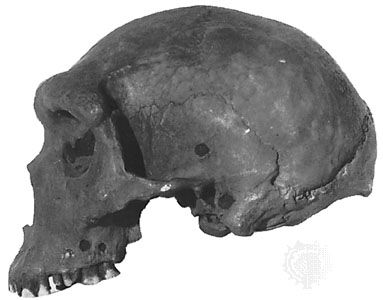
Ardi
"Ardi" (Ardipithecus ramidus, ~4.4 million years ago) and "Lucy" (Australopithecus afarensis, ~3.2 million years ago) are both pivotal, partial skeletons…
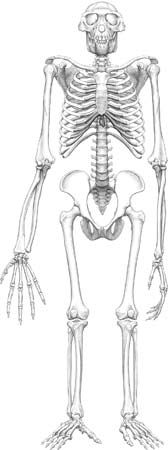
How does Ardi compare to other early hominins like Lucy (Australopithecus afarensis)?
“Ardi” (Ardipithecus ramidus, ~4.4 million years ago) and “Lucy” (Australopithecus afarensis, ~3.2 million years ago) are both pivotal, partial skeletons from Ethiopia that illustrate the complex evolution of hominin locomotion.1
While both species were bipedal, they represent different stages of adaptation:
- Locomotion: Ardi possessed a unique mosaic anatomy; while her pelvis and feet indicate she could walk upright on the ground, she retained a fully opposable great toe and long fingers, making her highly adept at climbing in woodland environments in woodland environments. Lucy’s pelvis was more humanlike, and her knee joint suggests she was a more efficient, habitual strider, though she also retained features like curved fingers and long arms that allowed for arboreal activity.12345
- Dentition and Diet: Ardi had smaller, less specialized teeth than later Australopithecus species, suggesting a generalized omnivorous diet. Lucy and her kin exhibited more robust chewing adaptations, reflecting a shift toward tougher food sources.631
- Brain Size: Both species had small, ape-sized brains, reinforcing that bipedalism preceded the evolution of larger, humanlike brains.741
What is Ardi and when was this hominin fossil discovered?
Ardi is the nickname for a partial female hominid skeleton belonging to the species Ardipithecus ramidus. Discovered in the Afar rift valley at Aramis, Ethiopia, the specimen is approximately 4.4 million years old.26
The excavation of the skeleton took place between 1994 and 1997. After the initial discovery of a hominid metacarpal fragment in the autumn of 1994, researchers recovered more than 100 fragments of the adult female skeleton, designated as specimen number ARA-VP-6/500.26
Ardi is considered a significant find because she presents a unique anatomical mosaic; while her pelvis and foot indicate she walked upright on the ground, she also possessed an opposable great toe and long fingers, suggesting she maintained a partially arboreal existence in a woodland habitat. Most scientists acknowledge Ardi as the earliest hominid skeleton ever recovered.286
What does the discovery of Ardi suggest about early human locomotion and habitat?
The discovery of Ardi (Ardipithecus ramidus) has fundamentally reshaped our understanding of early hominin evolution, suggesting that the transition to bipedalism was a gradual process rather than a sudden shift.76
Locomotion
Ardi exhibits a “mosaic” anatomy that indicates she was a transitional biped. Her pelvis and feet show clear adaptations for upright walking on the ground, yet she retained primitive features—such as a fully opposable great toe and long, flexible fingers—that allowed her to climb effectively in trees. Unlike later hominins like Australopithecus, Ardi lacked the specialized anatomy for knuckle-walking, suggesting that the common ancestor of humans and chimpanzees did not move in that manner.762
Habitat
Evidence from the Aramis site indicates that Ardi lived in a woodland environment, characterized by a mix of trees and open areas, rather than a dense tropical forest or an open savanna. This suggests that early hominins were well-adapted to foraging and potentially sleeping in trees while also utilizing bipedal locomotion to navigate the forest edges and woodland floor. This habitat was part of a broader, changing African landscape that was becoming increasingly dry and seasonal.74
Where was Ardi discovered, and what was the significance of this location?
Ardi was discovered at the Aramis site, located in the Awash River valley within the Afar region of Ethiopia.89
The significance of this location lies in its unique geological and biological preservation. The fossils were found in sediments sandwiched between two volcanic ash horizons—the Daam Aatu and Gàala tuffs—which allowed researchers to precisely date the remains to 4.4 million years ago.8
Beyond the hominid fossils, the site contained a wealth of biological information, including abundant fossil wood and remains of small mammals, birds, kudus, and monkeys. This evidence provided crucial context, implying that the area was a closed-canopy woodland habitat at the time. Aramis serves as a vital link in understanding human evolution, as it provides some of the earliest well-documented evidence of hominin traits, such as reduced canine projection and skull base structures that bridge the gap between ancestral apes and later hominins.89
Sources
- Australopithecus - Ardipithecus kadabba and Ar. ramidus — Encyclopædia Britannica
- Ardi — Encyclopædia Britannica
- Lucy — Encyclopædia Britannica
- Homo sapiens - Origin — Encyclopædia Britannica
- human evolution - The fossil evidence — Encyclopædia Britannica
- Ardipithecus - Anatomical features — Encyclopædia Britannica
- Ardipithecus - Habitat — Encyclopædia Britannica
- Ardipithecus - The discovery of Ardipithecus — Encyclopædia Britannica
- Aramis — Encyclopædia Britannica
Published on · 3 min read