Europasaurus
Europasaurus fossils were discovered in a single quarry located in northern Germany, within deposits dating back to the Late Jurassic Period approximately…
Where were Europasaurus fossils discovered and what can they tell us about its habitat?
Europasaurus fossils were discovered in a single quarry located in northern Germany, within deposits dating back to the Late Jurassic Period approximately 150 million years ago.1
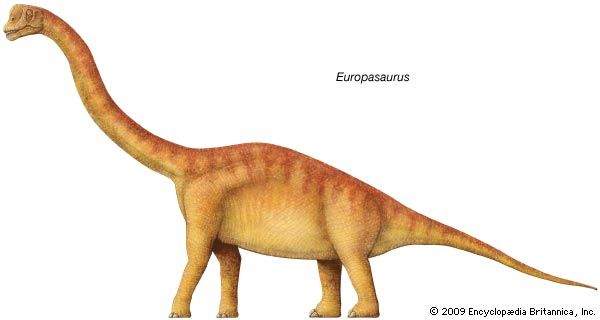
These fossils provide significant insight into the dinosaur’s habitat and evolutionary adaptations. During the Late Jurassic, the region that is now northern Europe consisted of several islands roughly the size of Britain. Scientists believe the small stature of Europasaurus—which reached a maximum length of only 6.2 meters (20 feet)—is a classic example of “island dwarfing”.1
Because these isolated islands had limited resources, they could not support populations of massive sauropods. Over generations, directional selection favored smaller individuals that required fewer resources to survive. Analysis of the bone structure reveals that this reduction in size was achieved through a slower growth rate compared to its larger relatives, rather than by simply stopping growth at an earlier age.1
What can Europasaurus tell us about the geography and climate of Europe during the Late Jurassic period?
The discovery of Europasaurus fossils provides significant evidence regarding the geography and climate of Europe during the Late Jurassic Period, approximately 150 million years ago.
Geography
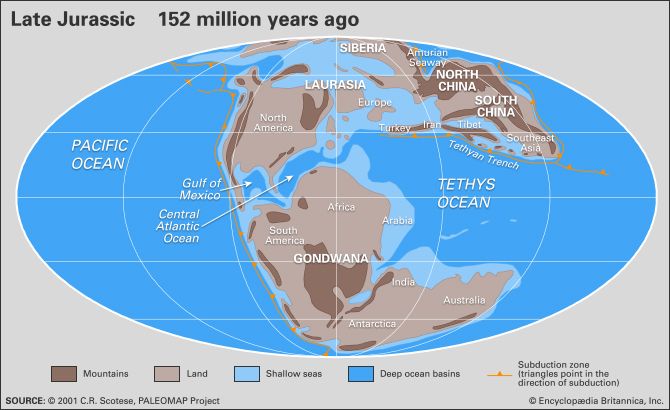
The presence of Europasaurus indicates that northern Europe was characterized by an archipelago of small islands, roughly the size of Britain, rather than a continuous landmass. This fragmented geography was a result of high sea levels during the Jurassic, which caused the Tethys Sea to expand and inundate large portions of the continental interior. These isolated islands were unable to support large populations of massive [sauropods], leading to the phenomenon of “island dwarfing,” where Europasaurus evolved a smaller body size to survive on limited resources.13
Climate
The existence of these dinosaurs aligns with broader evidence of a warm, greenhouse climate during the Late Jurassic. Global temperatures were generally high, with no evidence of polar ice caps. In the region of modern-day Germany, the environment consisted of lagoonal and marginal marine settings adjacent to seaways, where warm, shallow waters supported high faunal productivity.435
How big was Europasaurus compared to other sauropod dinosaurs?
Europasaurus is considered an aberration among sauropods, a group otherwise defined by their immense size as the largest terrestrial animals to ever live. While most sauropods reached lengths of 15 to 30 meters (50 to 100 feet) and could weigh dozens of tons, Europasaurus was significantly smaller.16
The following table compares the size of Europasaurus with other notable sauropods:
Dinosaur
Typical Length
Notable Characteristics
Europasaurus
6.2 meters (20 feet)
Island dwarf; weighed about 500 kg (1,100 lbs)
Apatosaurus
21 meters (69 feet)
Large, typical sauropod size
Dreadnoughtus
26 meters (85 feet)
Massive titanosaurid
Brachiosaurus
30 meters (98 feet)
One of the largest and most massive
The small stature of Europasaurus is attributed to “island dwarfing,” an evolutionary response to the limited resources available on the small islands of Late Jurassic Europe. Unlike its giant relatives, which grew rapidly, Europasaurus achieved its diminutive size through a slower growth rate.1
What does the name Europasaurus mean and how was it chosen?
The name Europasaurus is a combination of “Europa,” referring to the continent of Europe where the fossils were discovered, and the suffix “-saurus.” As is common in dinosaur taxonomy, the suffix “-saurus” is a Latinized form of the Greek word sauros, which literally means “lizard.”88
The name was chosen to reflect the geographic origin of this genus, which was identified from a quarry in northern Germany containing the remains of more than 10 individuals. While the specific naming process is often a choice made by the paleontologists who first describe a new genus, the name serves to highlight that this unique, dwarfed sauropod was a product of the specific island environments found in Europe during the Late Jurassic Period.8
Sources
- Europasaurus — Encyclopædia Britannica
- Jurassic Period — Encyclopædia Britannica
- Jurassic Period - Eurasia and Gondwana — Encyclopædia Britannica
- Jurassic Period - Paleoclimate — Encyclopædia Britannica
- Jurassic Period - Occurrence and distribution of Jurassic rocks — Encyclopædia Britannica
- sauropod — Encyclopædia Britannica
- dinosaur - Prosauropoda — Encyclopædia Britannica
- Why Does -saur Appear So Often in Dinosaur Names? — Encyclopædia Britannica
Published on · 3 min read