European Robin
The European robin (Erithacus rubecula) is a songbird belonging to the Muscicapidae family, which includes Old World flycatchers. It is widely recognized for…
What is a European robin?
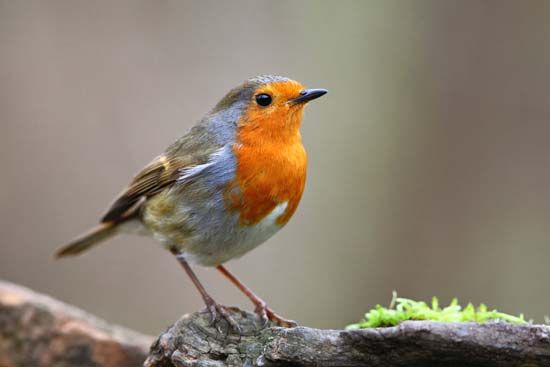
The European robin (Erithacus rubecula) is a songbird belonging to the Muscicapidae family, which includes Old World flycatchers. It is widely recognized for its distinctive orange face and breast, though it was historically referred to as a “redbreast” before the term “orange” was in common usage.1
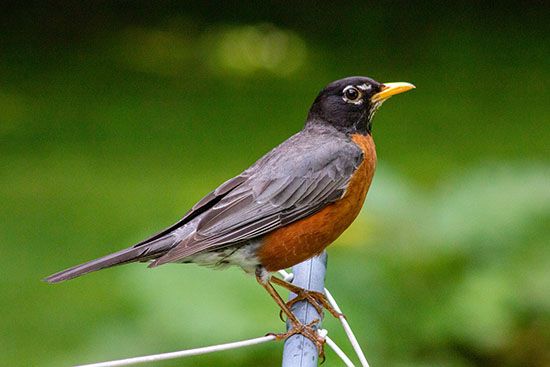
While often confused with the American robin, the two species are not closely related; the American robin is a thrush and is significantly larger and heavier.1
European robins are primarily insectivores that inhabit forests, parks, and gardens across Europe, western Asia, and parts of northern Africa. They are known for their year-round singing and are often the first birds heard at dawn. Culturally, they have been a popular symbol of Christmas in Great Britain since the Victorian era, largely due to their association with the red-uniformed letter carriers of the Royal Mail.1
What does a European robin look like?
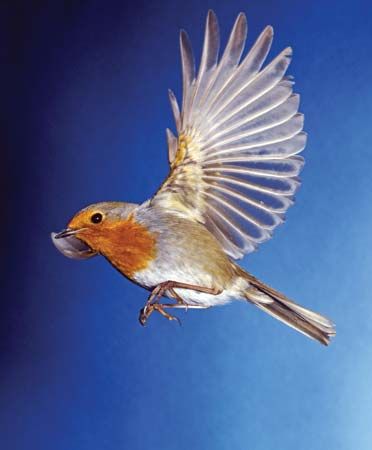
The European robin (Erithacus rubecula) is a plump songbird characterized by its small bill, short tail, and distinctive coloration. Both males and females are identical in appearance, featuring brownish olive upperparts, a white underside, and bluish gray sides. Their most recognizable feature is a bright orange face and breast, paired with dark eyes and brown legs and feet.1
In terms of size, these birds are relatively small, measuring approximately 14 cm (5.5 inches) in length with a wingspan of 20–22 cm (7.9–8.7 inches). They typically weigh between 14 and 21 grams (0.49–0.74 ounces). While adults display the signature orange plumage, juveniles look quite different, appearing brown and white with speckles; they only develop the characteristic orange breast as they mature.1
Where does the European robin live?
The European robin (Erithacus rubecula) is found across a wide geographic range, including Europe, western Asia, northern Africa, western Russia, and the Middle East.1
Within these regions, they inhabit diverse environments such as forests, heathland, parks, and gardens. While most populations are nonmigratory, those that breed in Scandinavia and Russia typically migrate west to other parts of Europe during the winter months.1
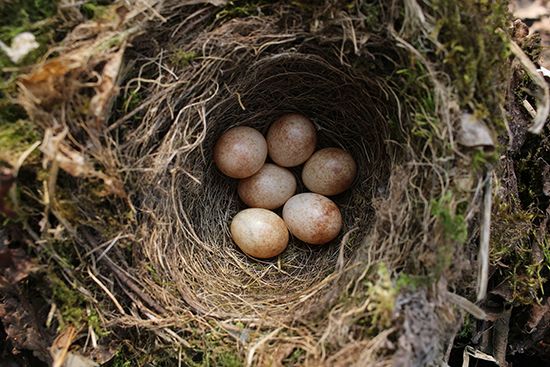
These birds are highly adaptable regarding their nesting sites, often choosing low, sheltered locations like hedges, tree cavities, or wall crannies. They have also been known to nest in unconventional man-made objects, including watering cans, tea kettles, and even clothing pockets.1
What do European robins eat?
European robins are primarily insectivores, meaning their diet consists mainly of insects. In addition to insects, they consume worms and various other invertebrates. Their diet is also supplemented by seeds, grains, and berries.1
As natural ground feeders, they prefer to forage on flat surfaces such as bird tables or ground-feeding trays. They are generally unlikely to visit hanging feeders.1
Sources
- European robin — Encyclopædia Britannica
Published on · 2 min read