Fairy Ring
A fairy ring is a naturally occurring circular formation of mushrooms that expands as its underground mycelium grows outward from a central point. While…
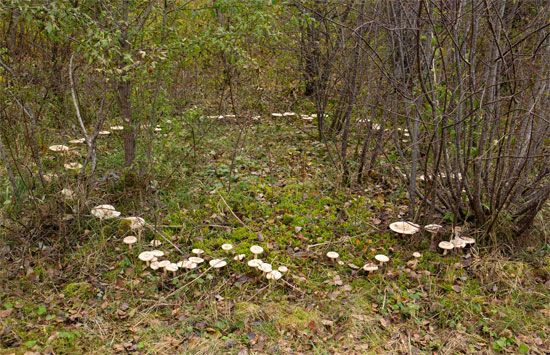
How large can fairy rings grow, and what’s the oldest known fairy ring?
A fairy ring is a naturally occurring circular formation of mushrooms that expands as its underground mycelium grows outward from a central point. While common species like the field mushroom typically form rings measuring about 6 feet (2 meters) in diameter, the fairy ring mushroom (Marasmius oreades) can produce significantly larger, though often irregular, rings that may reach up to 1,200 feet (365 meters) in diameter.1
Regarding the age of these formations, the provided information does not specify the oldest known fairy ring. Because the underground mycelium continues to expand outward while the center dies off, these rings can persist and grow for many years, but specific records for the oldest individual ring are not available in the current data.1
What are the different types of fairy rings, and how do they differ?
Fairy rings are not categorized into distinct biological “types” based on species; rather, they are defined by the growth pattern of basidiomycetous mushrooms that emerge from the periphery of an expanding underground mycelium network.12
While the phenomenon is consistent, the appearance of a fairy ring can manifest in two primary ways:
- Mushroom Rings: These are the classic circular formations of mushrooms that appear on lawns or in other environments as the hyphae grow outward from an initial spore point.12
- Vegetation Rings: These are characterized by a ring of particularly lush or “luxuriant” vegetation, which often occurs in association with the fungal growth.2
The primary difference between these formations lies in the species involved and the scale of their growth. For instance, the field mushroom (Agaricus campestris) typically creates smaller, more uniform rings around 6 feet (2 meters) in diameter, whereas the fairy ring mushroom (Marasmius oreades) is known for producing much larger, irregular rings that can span up to 1,200 feet (365 meters).1
What is a fairy ring in mycology, and how does it form?
A fairy ring is a naturally occurring circular formation of mushrooms found on lawns or in other environments. It originates when the mycelium of a fungus lands in a favorable location and begins to grow outward from an initial point in all directions.12
The formation process involves the following stages:
- Subterranean Growth: The fungus sends out a network of fine, tubular threads called hyphae. These threads grow evenly outward, creating a circular underground mat.13
- Mushroom Emergence: As the mycelium expands, the hyphal branches at the outer edge organize into tissues that develop into mushrooms aboveground, mirroring the circular pattern of the underground network.13
- Expansion and Decay: Over time, the mycelium at the center of the circle dies out, while the living outer edges continue to grow year after year. This causes the diameter of the ring to gradually increase. Eventually, the underground segments may die out entirely, making the surface ring no longer discernible.1
What are some common species of fungi that create fairy rings?
Several species of fungi are known to form fairy rings, each exhibiting different growth characteristics:
- Field Mushroom (Agaricus campestris): This species typically produces smaller, more uniform rings that often measure about 6 feet (2 meters) in diameter.1
- Fairy Ring Mushroom (Marasmius oreades): Widely recognized for this phenomenon, this species creates very large, irregular rings that can reach diameters of up to 1,200 feet (365 meters).12
These rings represent the periphery of an expanding underground mycelium colony. As the fungus grows outward from an initial point, the mushrooms emerge from the edge of this subterranean network, creating the characteristic circular pattern.13
Sources
- fairy ring — Encyclopædia Britannica
- fairy ring — Merriam-Webster
- fungus - Growth — Encyclopædia Britannica
Published on · 3 min read