False Arborvitae
The false arborvitae (Thujopsis dolabrata), also known as hiba arborvitae, is an evergreen tree or shrub belonging to the cypress family (Cupressaceae) and…
What is False arborvitae?
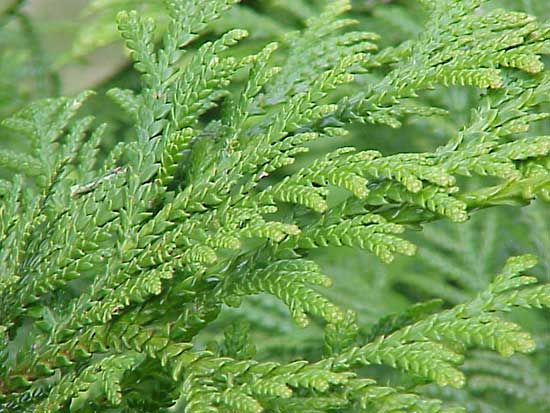
The false arborvitae (Thujopsis dolabrata), also known as hiba arborvitae, is an evergreen tree or shrub belonging to the cypress family (Cupressaceae) and is native to Japan.12
While it is closely related to the arborvitae (Thuja), the false arborvitae is distinguished by its larger leaves, which feature depressed white bands on the underside. These trees can reach heights of up to 35 metres (115 feet).13
The wood of the false arborvitae is yellowish white, soft, elastic, and highly durable, making it a traditional material for boatbuilding. Additionally, many dwarf and shrubby varieties have been cultivated for ornamental purposes.1
How does the wood of the false arborvitae differ from true arborvitae?
The wood of the false arborvitae (Thujopsis dolabrata) and the true arborvitae (genus Thuja) share several physical characteristics, though they originate from different regions and botanical classifications.
Both types of wood are described as soft and highly durable, making them valuable for various applications. Specifically:13
- False Arborvitae: The wood is characterized as yellowish white, soft, elastic, and very durable, with a historical application in boatbuilding.1
- True Arborvitae: The wood is typically yellowish or reddish-brown, soft, light in weight, fragrant, and easily worked. It is widely utilized for timber, with the giant arborvitae serving as the most significant timber-producing species in the genus.3
While both are members of the cypress family, the false arborvitae is distinguished from the true arborvitae primarily by its larger leaves, which feature depressed white bands on the underside, rather than by significant differences in the fundamental quality of their wood.13
What are the main physical differences between Thujopsis and Thuja?
The primary physical differences between the genera Thujopsis (false arborvitae) and Thuja (true arborvitae) are found in their foliage and overall structure.
- Foliage: The most distinct difference is that Thujopsis possesses larger leaves compared to Thuja. Additionally, the leaves of the false arborvitae are marked on their undersides with depressed white bands, a feature not characteristic of the true arborvitae.1
- Branching and Habit: Thuja species are typically characterized by flattened, spraylike branchlet systems with four rows of tiny, scalelike leaves. In contrast, Thujopsis is a monotypic genus native to Japan, distinct from the five species found within the Thuja genus.34
- General Morphology: While both are members of the cypress family and share an evergreen nature, Thuja trees are generally recognized for their pyramidal habit and thin, scaling bark.13
Although they are closely related—as reflected in the etymology of Thujopsis (meaning “resembling Thuja”)—these botanical distinctions allow for clear identification between the two.14
Why is the arborvitae genus often called the tree of life?
The name “arborvitae” is derived from the New Latin term arbor vitae, which literally translates to “tree of life.”53
While the specific historical reason for this designation is not explicitly detailed in the provided records, the name is applied to the genus Thuja—a group of resinous, evergreen conifers belonging to the cypress family. These trees are widely recognized for their durability and their role as both ornamental plants and sources of timber. The term has been in use since at least 1664, reflecting the long-standing association between these resilient, year-round green trees and the symbolic concept of life.35
Sources
- false arborvitae — Encyclopædia Britannica
- false arborvitae — Merriam-Webster
- arborvitae — Encyclopædia Britannica
- Thujopsis — Merriam-Webster
- arborvitae — Merriam-Webster
- eastern arborvitae — Merriam-Webster
Published on · 2 min read