False Cypress
False cypress trees, belonging to the genus Chamaecyparis, are evergreen conifers that share the family Cupressaceae with true cypresses but are…
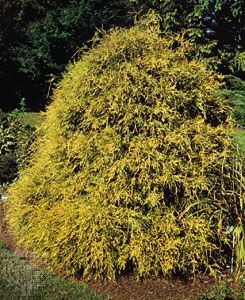
What are the distinguishing features of false cypress trees in terms of leaves, bark, and overall appearance?
False cypress trees, belonging to the genus Chamaecyparis, are evergreen conifers that share the family Cupressaceae with true cypresses but are distinguished by their smaller, rounded cones containing fewer seeds.12
Distinguishing Features
- Overall Appearance: Young trees typically exhibit a pyramidal shape. They range significantly in size, from dwarf ornamental varieties to large timber trees that can exceed 60 meters (200 feet) in height.1
- Leaves: The foliage is generally composed of small, dense, scale-like leaves arranged on the branchlets. While many horticultural varieties retain this juvenile, scale-like foliage even at maturity, some species, such as the Sarawa cypress (C. pisifera), possess sharp-pointed leaves.12
- Bark: While specific bark characteristics can vary by species, the hinoki cypress is noted for its distinct reddish-brown bark.1
These trees are widely cultivated for their ornamental value, and many species are prized for their aromatic, durable wood used in construction, furniture, and boatbuilding.12
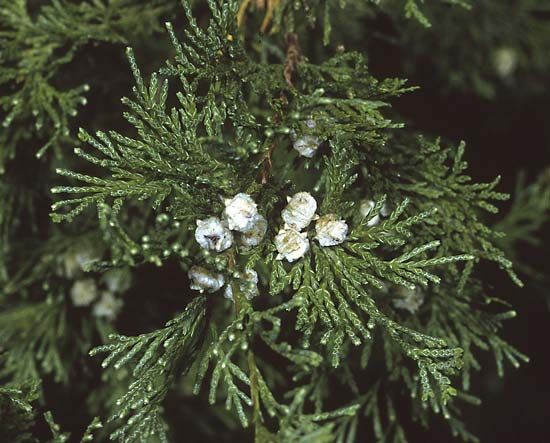
What are the main species of false cypress and where are they commonly found?
The genus Chamaecyparis, commonly known as false cypress, consists of approximately seven or eight species of evergreen conifers native to North America and eastern Asia. These trees are highly valued both as ornamental plants and as sources of timber.23
Main Species and Distribution
- Lawson Cypress (C. lawsoniana): The largest species, reaching heights over 60 meters (200 feet). It is native to North America and is widely cultivated, with over 200 forms used as ornamentals.2
- Nootka Cypress (C. nootkatensis): Also known as yellow cedar or Alaska cedar, this species is found in northwestern North America and is prized for its durable, pale yellow wood.2
- White Cypress (C. thyoides): Native to North America, this tree is an economically significant timber species used for construction and support structures.2
- Hinoki Cypress (C. obtusa): A valuable timber tree native to Japan, known for its bright-green foliage and reddish-brown bark.2
- Sarawa Cypress (C. pisifera): Another Japanese native, this species is frequently cultivated and features sharp-pointed leaves.2
- Formosan Cypress (C. formosensis): A large species native to Asia, utilized locally for construction.2
How tall can false cypress trees grow, and what is their typical lifespan?
False cypress trees (Chamaecyparis) exhibit a wide range of heights depending on the species. The largest, the Lawson cypress, can grow to more than 60 meters (200 feet) tall. Other notable species include the Formosan cypress, which reaches over 58 meters (190 feet), and the Nootka cypress, which can exceed 35 meters (115 feet). Smaller species, such as the white cypress, typically reach heights of 21 to 27 meters (70 to 90 feet).2
Regarding their lifespan, the provided search results do not contain specific information on the typical longevity of false cypress trees.
Are there any endangered species of false cypress, and what conservation efforts are in place?
The provided search results do not contain information regarding the conservation status or specific endangered species within the genus Chamaecyparis (false cypress). Consequently, I cannot provide details on whether any species are currently endangered or describe any specific conservation efforts in place.
Sources
- false cypress — Merriam-Webster
- false cypress — Encyclopædia Britannica
- Chamaecyparis — Merriam-Webster
- cypress — Encyclopædia Britannica
- false arborvitae — Encyclopædia Britannica
Published on · 2 min read