Fantail
The provided information does not contain details regarding the conservation status of fantail birds or specific protection efforts currently in place for…
Are there any conservation concerns for fantail birds, and if so, what efforts are being made to protect them?
The provided information does not contain details regarding the conservation status of fantail birds or specific protection efforts currently in place for them.
How do fantail birds build their nests, and what materials do they use?
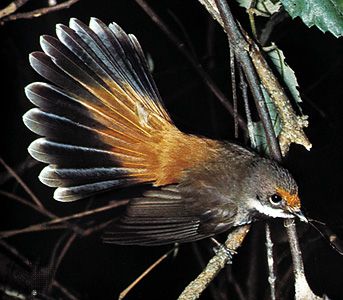
Fantail birds, which belong to the family Rhipiduridae, are known for their distinctive habit of constantly spreading and wagging their long, rounded tails. When it comes to reproduction, these birds construct small, cup-shaped nests.
A notable feature of their nest-building process is the use of cobwebs as a primary binding material. The nests are bound so finely with this silk that they appear to have a shellacked or polished finish. Like many other birds, they utilize a variety of natural materials to create these structures, which serve as essential homes for their eggs and young.
What are the different species of fantail birds, and how do they differ from each other?
There are approximately two dozen species of fantail birds, all belonging to the genus Rhipidura. While they share the characteristic habit of spreading and wagging their long, rounded tails, they vary in size, coloration, and geographic range. Most species feature plumage in shades of gray, black, brown, or rufous, frequently accented with white markings on the belly, eyebrows, or tail.1
Key examples include:
- White-browed fantail (R. aureola): A brownish bird native to Bangladesh and India, measuring approximately 18 cm (7 inches) in length.1
- Gray fantail (R. fuliginosa): Also known as the “cranky fan,” this species is common across Australia, New Zealand, and nearby islands, reaching about 16 cm (6.25 inches) in length.1
- Willy-wagtail (R. leucophrys): One of the larger species at 22 cm (8.5 inches), it is the most well-known Australian fantail. Its range extends to New Guinea and the Solomon Islands, and it is noted for a short, sweet song that it occasionally sings at night.1
How did the fantail bird get its name, and what does it tell us about its behavior?
The fantail bird derives its name directly from its most distinctive physical characteristic: a long, rounded tail that the bird constantly spreads and wags. This behavior is not merely aesthetic; it is a defining trait of the genus Rhipidura and provides insight into the bird’s active nature.1
The name reflects the bird’s tendency to perform erratic, energetic movements while in flight. For instance, the gray fantail—sometimes colloquially called the “cranky fan”—is noted for these unpredictable gyrations, where the term “cranky” refers to the bird’s erratic flight patterns rather than an irritable temperament. This constant tail-fanning and active movement are central to the bird’s identity, distinguishing it as it navigates forest clearings, riverbanks, and gardens across its range from southern Asia to New Zealand.31
Sources
- Fantail — Encyclopædia Britannica
- Nest — Encyclopædia Britannica
- fantail — Merriam-Webster
- 12 More Bird Names that Sound Like Insults (and Sometimes Are) | Cranky fan — Merriam-Webster
Published on · 2 min read