Fish Owl
A fish owl is any of several owl species belonging to the genera Ketupa (Asian) and Scotopelia (African) within the family Strigidae. These birds are…
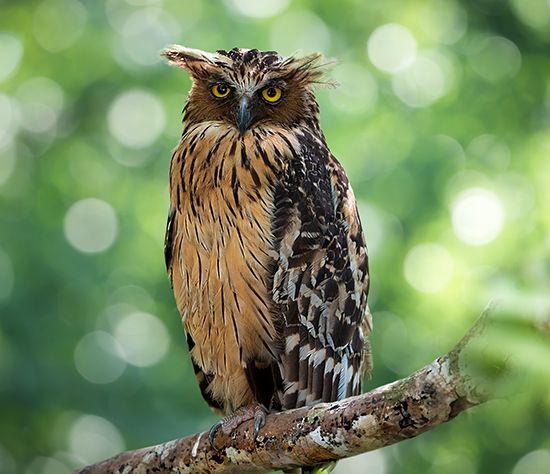
What is Fish owl?
A fish owl is any of several owl species belonging to the genera Ketupa (Asian) and Scotopelia (African) within the family Strigidae. These birds are uniquely adapted to live near water, where they primarily hunt fish, though their diet also includes small mammals and other birds.123
There are three Asian species—the brown fish owl, the tawny fish owl, and the buffy fish owl—and three African species, often called fishing owls, including Pel’s fishing owl. While some taxonomists suggest these birds should be classified under the genus Bubo, they remain distinct for their specialized feeding behavior. Conservation status varies; for instance, the International Union for Conservation of Nature lists the rufous fishing owl as vulnerable and Blakiston’s fish owl—a related species—as an endangered species.13
How do fish owls adapt their hunting techniques to catch prey in water?
Fish owls, which include species in the genera Ketupa and Scotopelia, are specialized predators that have evolved to hunt live fish in aquatic environments. While many other owl species rely on hunting techniques such as sustained flight over grasslands or dropping from perches to catch terrestrial prey, fish owls are uniquely adapted for their semi-aquatic lifestyle.23
The provided search results do not detail the specific physiological or behavioral mechanisms—such as specialized talons or sensory adaptations—that these owls use to capture prey directly from the water. While we know they are adapted for taking live fish and often inhabit wetland or forest-edge environments near water, the specific hunting maneuvers remain outside the scope of the current knowledge base.23
What are the main differences between Asian fish owls and African fishing owls?
Asian fish owls and African fishing owls are distinguished primarily by their taxonomic classification, geographic distribution, and physical characteristics.
Taxonomic and Geographic Differences
- Asian Fish Owls (Ketupa): These species are found across southern and southeastern Asia, ranging from the Mediterranean and India to China and Indonesia. Some taxonomists suggest that, based on DNA studies, these should be reclassified under the genus Bubo.1
- African Fishing Owls (Scotopelia): These species occur exclusively south of the Sahara. Like their Asian counterparts, their classification is subject to debate, with some experts proposing they also be subsumed into the genus Bubo.1
Physical Characteristics
- Appearance: Asian fish owls, such as the brown and tawny varieties, are known for their prominent golden yellow eyes. In contrast, the African Pel’s fishing owl is characterized by a heavily feathered round head that lacks the ear tufts often seen in other owl species.1
- Size: While sizes overlap, the largest African species, Pel’s fishing owl, reaches 50 to 60 cm. Asian species vary significantly, with the buffy fish owl being smaller (40–48 cm) and the related Blakiston’s fish owl being the largest, reaching up to 71 cm.1
Why is Blakiston’s fish owl considered an endangered species?
Blakiston’s fish owl (Bubo blakistoni) is classified as an endangered species by the International Union for Conservation of Nature and Natural Resources (IUCN).1
While the provided text identifies its status as endangered, it does not specify the exact environmental or human-driven factors—such as habitat loss, pollution, or prey depletion—that have led to this classification. The species is known to inhabit lowland forests and wetlands across a range extending from the northern shores of the Sea of Okhotsk down to Manchuria and the Japanese island of Hokkaido.1
Sources
- Fish owl — Encyclopædia Britannica
- fish owl — Merriam-Webster
- Owl - Ecology — Encyclopædia Britannica
- Movement perception - Auditory — Encyclopædia Britannica
- Animal communication - Signal reception — Encyclopædia Britannica
Published on · 3 min read