Flicker
While most woodpeckers chisel nesting cavities into trees, flickers exhibit distinct nesting habits that set them apart from many of their relatives.
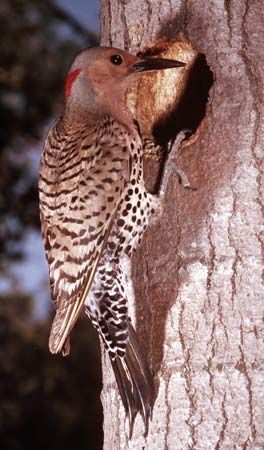
How do flickers’ breeding and nesting habits differ from other woodpeckers?
While most woodpeckers chisel nesting cavities into trees, flickers exhibit distinct nesting habits that set them apart from many of their relatives.1
- Ground Nesting: Unlike the majority of woodpeckers that rely on trees, certain species—specifically the Andean flicker and the campo flicker—regularly nest in the ground by digging cavities into banks.12
- Social Nesting: While most woodpeckers are solitary or territorial, Andean flickers are known to nest in loose colonies, a social behavior less common among other woodpecker species.1
- Indeterminate Laying: Flickers are noted as indeterminate layers, meaning they continue to produce eggs if their clutch is removed. This trait is shared with some other woodpeckers and wrynecks, but it is a significant reproductive strategy that allows for high egg production under certain conditions.1
Despite these differences, flickers still share fundamental woodpecker reproductive traits, such as both parents participating in nest excavation, incubation, and feeding the young.1
How did the flicker get its name and what other common names does it have?
The name “flicker” is believed to be imitative of the bird’s diagnostic “flicker, flicker, flicker” call. First recorded in 1808, the name reflects the vocalizations of these New World woodpeckers belonging to the genus Colaptes.156
While “flicker” is the common name for the group, these birds are known by a vast array of regional titles. The yellow-shafted flicker of eastern North America alone is estimated to have more than 100 local names. Other specific common names for various species and forms include:6
- Red-shafted flicker: The western counterpart to the yellow-shafted form.6
- Gilded flicker: A species found in the southwestern United States.7
- Campos flicker (or pampas flicker): Common in east-central South America.6
- Field flicker: Often considered the same species as the campos flicker.6
What are the different species of flickers and how do they differ?
Flickers are New World woodpeckers belonging to the genus Colaptes, characterized by their habit of foraging for ants on the ground and possessing slightly down-curved, slender bills. While there are six recognized species, they generally share features such as a white rump and a black breastband.1
The primary species and their differences include:
- Yellow-shafted flicker (C. auratus): Found in eastern North America, this golden-winged bird is known for its extensive variety of local names.1
- Red-shafted flicker (C. cafer): Replacing the yellow-shafted form in the West, it is often considered the same species due to frequent hybridization.1
- Gilded flicker (C. chrysoides): Native to the southwestern United States, it resembles the yellow-shafted flicker but lacks the red nape.7
- Campos flicker (C. campestris) and Field flicker (C. campestroides): Common in east-central South America, these are darker birds distinguished by their yellow faces and breasts; they are sometimes classified as a single species.1
Why do some flicker species prefer to nest in the ground rather than in trees?
While most woodpeckers are known for chiseling nesting cavities into trees, certain flicker species have adapted to nest in the ground. Specifically, the ground woodpecker and the Andean flicker always nest in the ground by digging into banks, and the campo flicker of South America often does so as well.1
The choice to nest in the ground is primarily a behavioral adaptation linked to the species’ ecological niche. These birds are specialized ground-dwellers that spend a significant portion of their time foraging for ants on the surface, rather than relying on tree bark for food. Because these species have evolved to exploit terrestrial environments, their nesting habits align with their foraging behavior.23
In the order Piciformes, the ability to excavate nesting cavities—whether in soft earth or wood—is a key factor in the group’s reproductive success, as it provides a concealed environment for their young. For ground-nesting flickers, the earth serves as a suitable substrate for excavation, allowing them to create secure, hidden tunnels that serve the same protective purpose as a tree cavity.1
Sources
- Flicker — Encyclopædia Britannica
- Piciform - Reproduction — Encyclopædia Britannica
- Piciform - Distribution and ecology — Encyclopædia Britannica
- Passeriform - Territoriality and courtship — Encyclopædia Britannica
- flicker — Merriam-Webster
- Birds Say the Darndest Things | ‘Flicker’ (Flicker) — Merriam-Webster
- gilded flicker — Merriam-Webster
- Falconiform - Plumage and molt — Encyclopædia Britannica
Published on · 3 min read