Fire Finch
A fire finch is any of several small African birds belonging to the family Estrildidae. These birds are characterized by their red-and-brown or red-and-black…
What is Fire finch?
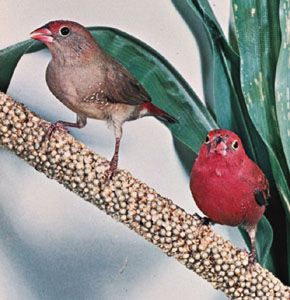
A fire finch is any of several small African birds belonging to the family Estrildidae. These birds are characterized by their red-and-brown or red-and-black plumage, with males often displaying brilliant red feathers and both sexes typically featuring fine white dots on their undersides.12
The most common and familiar species is the red-billed, or Senegal, fire finch (Lagonosticta senegala). Measuring about 8 centimeters (3 inches) in length, this species is frequently found in African scrublands and gardens, where it is known for being quite tame. Due to their striking appearance, these birds are often kept in aviaries or as cage birds.12
What are the main differences between the Estrildidae and other bird families?
The family Estrildidae consists of approximately 140 species of small, Old World birds, including waxbills, mannikins, and fire finches. While they are often grouped under the broad category of “finches” due to their seed-eating habits and conical bills, they possess distinct characteristics that differentiate them from other bird families, such as the true finches (Fringillidae).3
Key Characteristics of Estrildidae
- Vocal Ability: Unlike many other finch-like birds known for their complex and beautiful songs, members of the Estrildidae family are generally considered poor singers. Their vocalizations are typically described as simple, consisting of chirps, buzzes, and chatters.3
- Physical Traits: These birds are small, ranging from 7.5 to 15 cm in length, and are characterized by short, stout bills and short legs. They are known for their wide variety of colors and patterns, often featuring brilliant plumage.3
- Behavior: They are gregarious ground feeders that forage for seeds, berries, and insects. Their adaptability and lively nature make them popular among bird fanciers as cage birds.3
Distinctions from Other Families
While the term “finch” is applied to various families—including Emberizidae and Thraupidae—the Estrildidae are taxonomically distinct. For instance, true finches (Fringillidae) are often excellent singers with complex repertoires, contrasting with the simpler vocalizations of the Estrildidae. Additionally, while many finches are found in temperate regions of the Northern Hemisphere, the Estrildidae are primarily associated with the Old World.43
How do male and female fire finches differ in appearance?
In the case of the common red-billed (or Senegal) fire finch (Lagonosticta senegala), there is a clear difference in appearance between the sexes, a phenomenon known as sexual dimorphism.
The male is primarily light red in color, while the female is brown. Despite these differences in body plumage, both sexes share the characteristic of having a red rump. The brilliant red plumage of the male is a common trait among fire finches, often serving as a visual signal to attract mates or compete with other males, as is typical in many bird species where sexual selection influences physical appearance.126
What kind of environment do fire finches need to thrive in the wild?
Fire finches, which belong to the family Estrildidae, are highly adaptable birds native to Africa. To thrive in the wild, they require environments that provide adequate cover and food sources, such as scrublands and gardens.1
Because they are often described as some of the tamest birds in their range, they frequently inhabit areas near human activity, where they can forage effectively. Their preference for these habitats suggests they are well-suited to environments that offer a mix of dense vegetation for protection and open spaces for feeding.1
Sources
- Fire finch — Encyclopædia Britannica
- fire finch — Merriam-Webster
- Estrildidae — Encyclopædia Britannica
- Passeriform - Evolution and paleontology — Encyclopædia Britannica
- Finch — Encyclopædia Britannica
- Why are male animals more colorful? — Encyclopædia Britannica
Published on · 2 min read