Ferret
The common ferret (Mustela putorius furo) is a domesticated form of the European polecat, which it closely resembles in habits and physical structure. While…
What is the history of ferret domestication?
The common ferret (Mustela putorius furo) is a domesticated form of the European polecat, which it closely resembles in habits and physical structure. While the exact timeline of their initial domestication is not fully documented, the practice of “ferreting”—using these animals to drive rabbits, rats, and other vermin from underground burrows—has been utilized in Asia for a very long time and has been practiced in Europe since Roman times.1
The English name “ferret” is derived from the Latin word fur, meaning “thief,” reflecting the animal’s historical reputation. Beyond their utility in pest control, ferrets were also historically farmed for their fur. Today, they are widely kept as pets and are valued in veterinary research due to their inquisitive and playful nature in captivity.21
How long do ferrets typically live, and how does their lifespan differ between wild and domesticated ferrets?
The provided search results do not contain specific information regarding the typical lifespan of the common domesticated ferret (Mustela putorius furo).
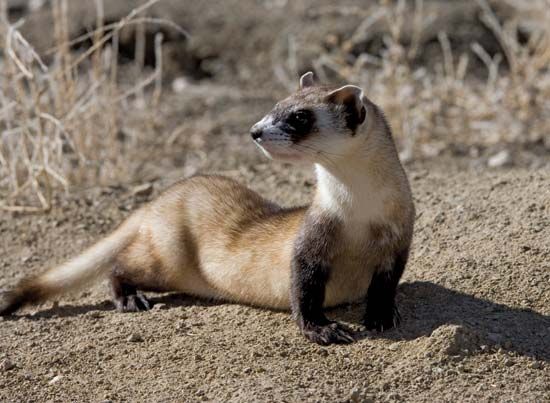
Regarding the black-footed ferret (M. nigripes), while its longevity in the wild remains unknown, individuals in captivity have been documented to live up to 12 years.2
Because the available data does not provide a comparative lifespan for common domesticated ferrets, I cannot offer a contrast between their wild and captive life expectancies.
How are ferrets used in hunting and pest control?
The practice of using ferrets for hunting and pest control, known as “ferreting,” has been utilized in Asia for a very long time and has been practiced in Europe since Roman times.3
Ferrets are uniquely suited for this role due to their long, tubular bodies and short limbs, which allow them to navigate underground burrows effectively, combined with their aggressive hunting instincts. When used to control rabbits, rats, and other vermin, a ferret is released into a burrow to flush the animals out into waiting nets or traps. By the 15th century, the term “ferret” had evolved into a verb to describe this specific hunting action.32
While ferrets were introduced to regions like North America, Australia, and New Zealand during the 18th and 19th centuries specifically to manage rodent and rabbit populations, they are now more commonly recognized as pets or subjects of veterinary research.3
What are the main physical characteristics of ferrets?
Ferrets belong to the family Mustelidae and are characterized by their long, tubular bodies and short limbs, which allow them to navigate underground burrows with ease. As members of the weasel family, they share features such as small flattened heads, long flexible necks, and short, dense fur.42
Physical characteristics vary slightly between the two primary species:
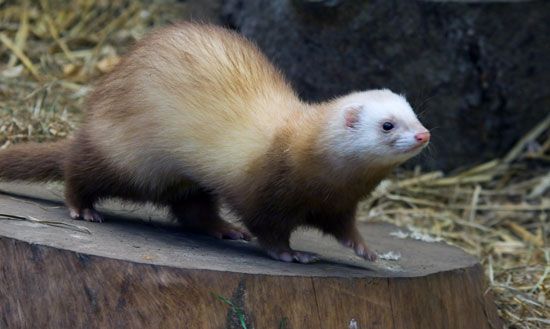
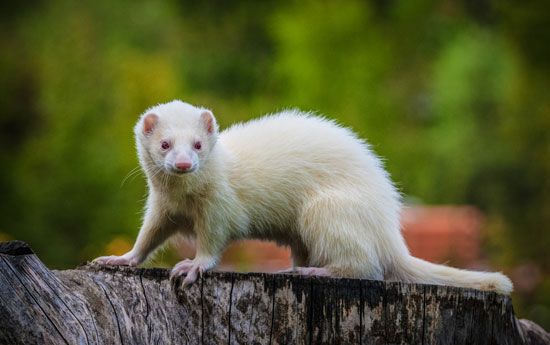
- Common Ferret (Mustela putorius furo): This domesticated form typically has yellowish-white or brown fur and pinkish-red eyes. They average about 51 cm (20 inches) in length, including a 13-cm (5.1-inch) tail, and weigh approximately 1 kg (2 pounds).2
- Black-footed Ferret (M. nigripes): This endangered species is distinguished by a black mask across its eyes and brownish-black markings on its feet and the tip of its tail. They measure 38–50 cm (15–20 inches) in body length, with a tail of 11–15 cm (about 4–6 inches), and generally weigh 1 kg or less.2
In both species, males are typically larger than females.2
Sources
- ferret-polecat — Merriam-Webster
- ferret — Encyclopædia Britannica
- ferret as a Verb — Merriam-Webster
- weasel — Encyclopædia Britannica
Published on · 3 min read