Fur Seal
Fur seals are members of the family Otariidae, often called "eared seals," which distinguishes them from the "true" or "earless" seals of the family…
What are the main physical characteristics that distinguish fur seals from other seal species?
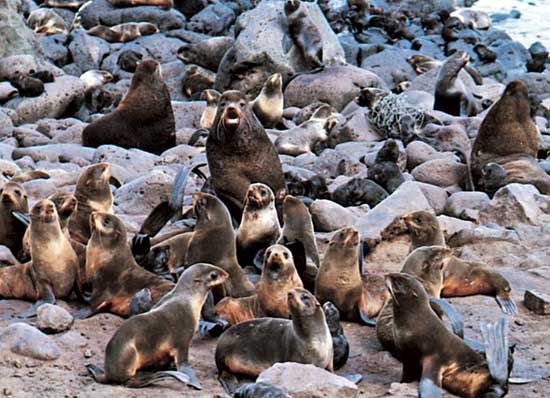
Fur seals are members of the family Otariidae, often called “eared seals,” which distinguishes them from the “true” or “earless” seals of the family Phocidae. Several key physical characteristics set them apart:12
- External Ears: Unlike true seals, which have only small ear holes, fur seals possess visible external ear flaps that protrude from their heads.12
- Flipper Mobility: Fur seals have long flippers and the unique ability to rotate their hind flippers forward under their bodies. This allows them to walk on land, whereas true seals must move by flopping on their bellies or pulling themselves forward with their front limbs.12
- Swimming Mechanics: While true seals propel themselves by moving their hind flippers side-to-side like a fish tail, fur seals use their long front flippers to propel themselves through the water with a rowing motion.123
- Social Behavior: Fur seals are generally more social and vocal than true seals, often communicating through loud barking or bellowing while congregating in groups on land.1
Where are fur seals typically found, and what are their preferred habitats?
Fur seals are categorized into two primary groups based on their geographic distribution and preferred breeding habitats:
- Northern Fur Seals: The northern fur seal is a migratory species found in the northern Pacific Ocean. They are known for breeding during the summer months on specific islands, including the Pribilof and Komandor (Commander) islands in the Bering Sea.56
- Southern Fur Seals: The eight species of the genus Arctocephalus are primarily distributed throughout the Southern Hemisphere. While most reside in southern waters, there is a notable exception: the Guadalupe fur seal, which inhabits Guadalupe Island off the northwest coast of Baja California.56
Across these regions, fur seals are gregarious animals that typically congregate in large groups, or rookeries, on islands to breed. They are marine-dwelling carnivores that rely on the surrounding seas for their food supply, though their populations are sensitive to environmental fluctuations and the availability of prey.56
How do fur seals hunt and what is their primary diet?
Fur seals are carnivorous marine mammals that primarily feed on fish, though their diet may also include squid, other mollusks, and crustaceans.52
As members of the family Otariidae, or “eared seals,” they are highly adapted for hunting in the water. Unlike “true” seals that propel themselves with side-to-side strokes of their hind limbs, fur seals utilize a rowing motion with their long front flippers to maneuver and propel themselves through the water with agility. While they are excellent swimmers and divers capable of reaching significant depths, their hunting success is closely tied to the availability of prey in their marine environments. Populations are known to be sensitive to environmental fluctuations and the overfishing of their food sources, which can directly impact their health and numbers.25
How do the swimming techniques of eared seals differ from those of true seals?
The swimming techniques of eared seals (family Otariidae) and true seals (family Phocidae) differ significantly due to their distinct anatomical adaptations:
- Eared Seals: These animals, which include sea lions and fur seals, rely primarily on their long front flippers for propulsion. They move these flippers in a rowing motion to navigate through the water with agility.12
- True Seals: These seals use their forelimbs primarily for maneuvering. To propel their bodies forward, they utilize side-to-side strokes of their hind flippers, which function similarly to a fish tail.12
These differences in swimming style are linked to broader anatomical variations. Eared seals possess longer flippers and the ability to rotate their hind flippers under their bodies, allowing them to walk on land. In contrast, true seals have shorter front flippers and hind flippers that cannot rotate forward, forcing them to move on land by wriggling on their bellies.12
Sources
- What’s the Difference Between Seals and Sea Lions? — Encyclopædia Britannica
- seal — Encyclopædia Britannica
- Otariidae — Merriam-Webster
- Locomotion - Tetrapodal vertebrates — Encyclopædia Britannica
- fur seal — Encyclopædia Britannica
- fur seal — Merriam-Webster
- ostariophysan - Weberian apparatus and swim bladder — Encyclopædia Britannica
Published on · 3 min read