Fiji
Fiji is a republic governed under a constitution adopted in 2013, which establishes a unicameral 50-member Parliament elected through proportional…
What type of government does Fiji have, and how has it evolved since independence?
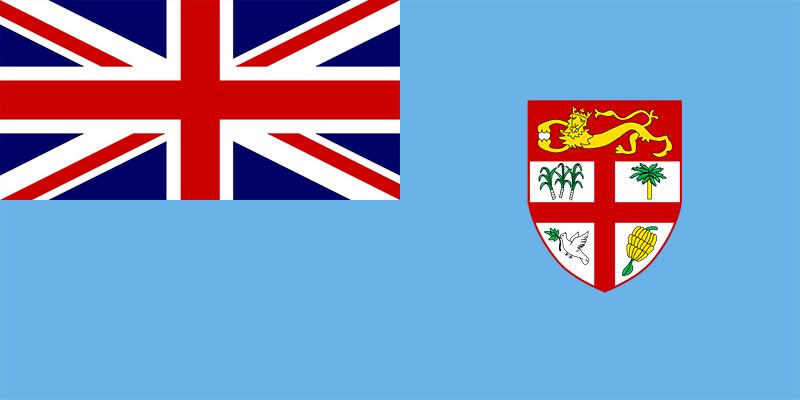
Fiji is a republic governed under a constitution adopted in 2013, which establishes a unicameral 50-member Parliament elected through proportional representation. The prime minister serves as the head of government, while the president acts as the head of state.1
Since gaining independence from Great Britain in 1970, Fiji’s political history has been marked by significant instability and multiple military coups. Initially a dominion and parliamentary democracy, the nation transitioned to a republic in 1987 following military-led coups that sought to entrench indigenous Fijian political dominance.123
Throughout the 1990s and 2000s, the country experienced further constitutional revisions and political upheaval, including the 2000 and 2006 coups. The 2013 constitution replaced previous frameworks, aiming to establish an independent judiciary and universal suffrage, though it has faced international criticism regarding legal immunity for coup participants and the suspension of certain civil liberties during emergencies.12
What is the geographical location and composition of Fiji in the Pacific Ocean?
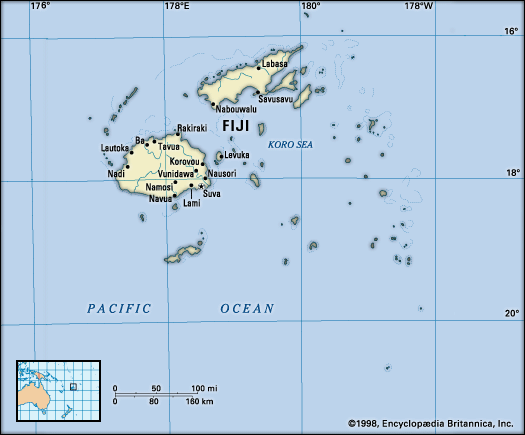
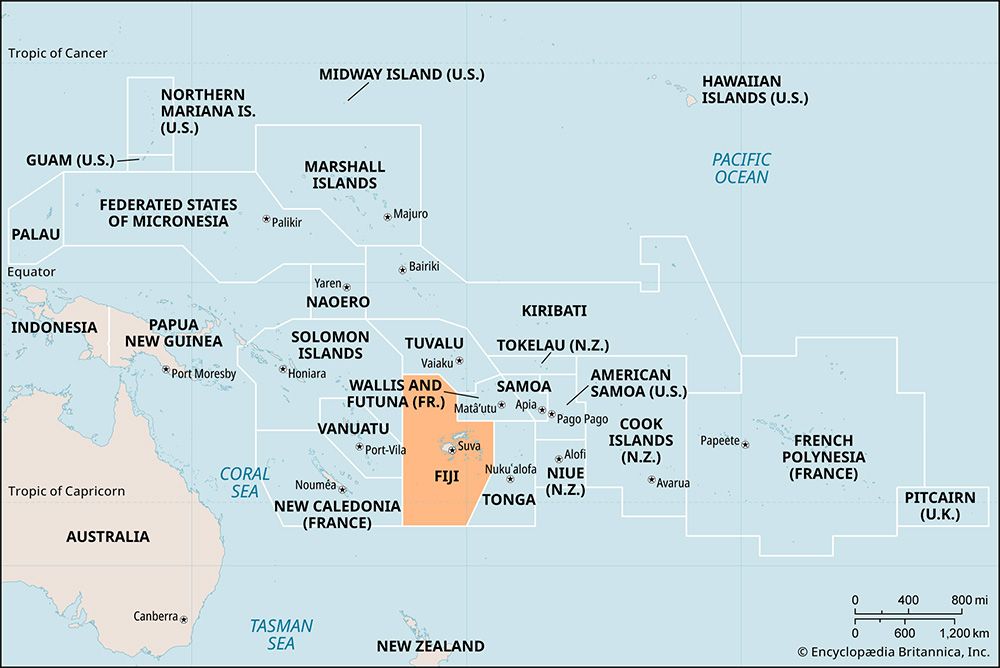
Fiji is an archipelago located in the South Pacific Ocean, situated approximately 1,300 miles (2,100 km) north of Auckland, New Zealand. The nation surrounds the Koro Sea and consists of roughly 300 islands and 540 islets, of which about 100 are inhabited.6
The islands are primarily the result of volcanic activity, sedimentary deposits, and coral formations resting on a submerged ancient platform. The two largest islands are:7
- Viti Levu: Covering over half of the country’s land area, it features a central mountain range that includes the nation’s highest point, Tomanivi (4,344 feet). The capital, Suva, is located on its southeast coast.67
- Vanua Levu: The second largest island, characterized by a central mountain range with peaks exceeding 3,000 feet.7
Smaller island groups, such as the Lau and Yasawa chains, are also volcanic in origin and are surrounded by coral reefs and shoals.7
What are some traditional Fijian customs and practices that are still observed today?
Fiji’s cultural landscape is a vibrant reflection of its diverse ethnic heritage, where many traditional practices remain central to daily life and social structure.
Traditional Fijian Customs
Traditional life is most visible during significant events, such as the investiture of high-ranking chiefs and marriage ceremonies. These occasions serve as a focal point for the preservation of ancestral crafts, including:
- Tapa (masi) manufacture: Creating cloth from the bark of the paper mulberry tree.
- Weaving and Carving: The continued practice of mat weaving, wood carving, and canoe building.
- Kava consumption: Known locally as yanggona, this beverage is central to both formal ceremonies—such as the inauguration of a chief or the conclusion of a public assembly—and everyday social interactions among all ethnic groups in Fiji.89
Indo-Fijian Traditions
The Indian community in Fiji maintains its own distinct cultural heritage. This includes the celebration of Diwali, the Hindu festival of lights, and the observance of traditional marriage rites. Other notable practices include fire walking and ritual self-torture, which are performed during the annual Guru Purnima festival.8
How does Fiji’s economy rely on tourism and other industries?
Fiji’s market economy is primarily driven by tourism and agriculture, supported by a growing manufacturing sector.
Tourism and Services
Tourism is Fiji’s leading economic activity. Despite past fluctuations due to political instability, the sector remains a cornerstone of the economy, attracting travelers from Australia, New Zealand, the United States, and Japan. The industry leverages the country’s tropical appeal, duty-free shopping, and unique accommodations on offshore islands.12
Agriculture and Industry
- Agriculture: The sector includes a significant subsistence component, while commercial production is dominated by sugarcane. Although sugar was historically the largest export, its relative importance has declined due to international pricing reforms.1314
- Manufacturing: The garment industry has become a major employer and source of foreign exchange. Additionally, the bottling of mineral water for export and light-industrial activities, such as boatbuilding and food processing, contribute to the economy.1315
- Resources: The timber industry and commercial fishing have grown in importance, with fish products accounting for a notable portion of export revenue.14
Sources
- Fiji - Constitutional framework — Encyclopædia Britannica
- Fiji: Country Facts — Encyclopædia Britannica
- history of Fiji - Move toward independence — Encyclopædia Britannica
- Fiji - History of Fiji — Encyclopædia Britannica
- history of Fiji - Independent Fiji — Encyclopædia Britannica
- Fiji — Encyclopædia Britannica
- Fiji - Relief — Encyclopædia Britannica
- Fiji - Daily life and social customs — Encyclopædia Britannica
- kava — Encyclopædia Britannica
- history of Fiji - Early history and culture of Fiji — Encyclopædia Britannica
- Fiji - Local government — Encyclopædia Britannica
- Fiji - Economy of Fiji — Encyclopædia Britannica
- Fiji - Agriculture, forestry, and fishing — Encyclopædia Britannica
- Fiji - Services — Encyclopædia Britannica
- Fiji - Trade — Encyclopædia Britannica
- Fiji - Manufacturing — Encyclopædia Britannica
Published on · 3 min read