Finsteraarhorn
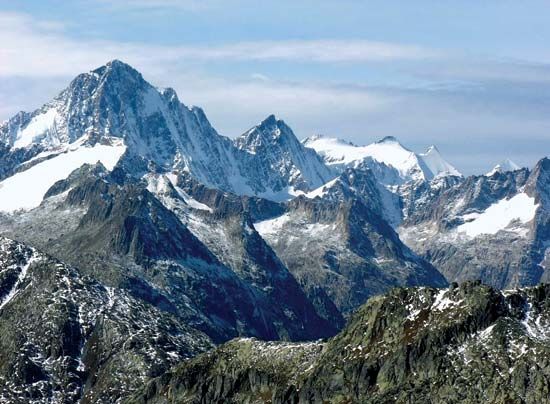
The Finsteraarhorn is the highest peak of the Bernese Alps in south-central Switzerland. Standing at an elevation of 14,022 feet (4,274 meters), the mountain…
What is Finsteraarhorn?
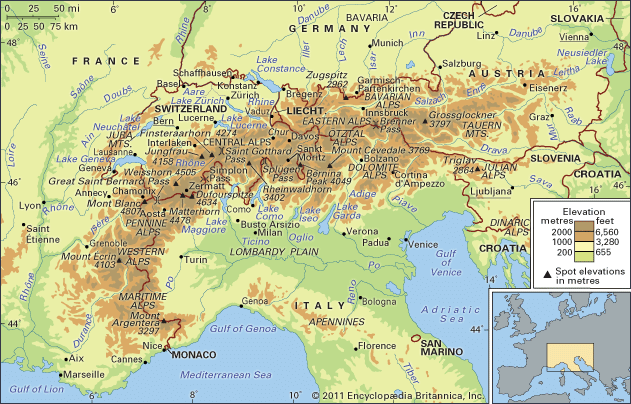
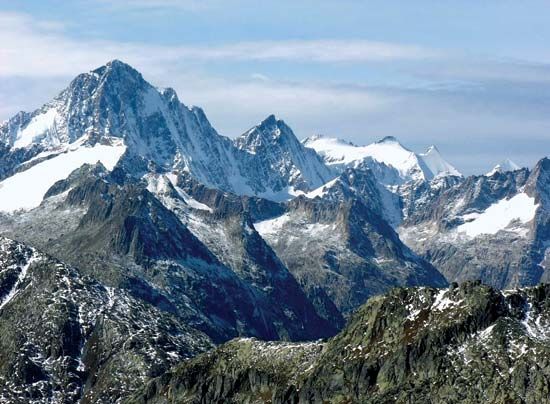
The Finsteraarhorn is the highest peak of the Bernese Alps in south-central Switzerland. Standing at an elevation of 14,022 feet (4,274 meters), the mountain is situated between the cantons of Bern and Valais, located south-southeast of the resort town of Grindelwald.1
The summit is characterized by its glacier-covered terrain and is a popular destination for mountaineers. While historical records suggest a first ascent in 1812 by three Swiss guides, this claim is disputed, and some accounts place the first successful climb in 1829. Climbers typically utilize a hut located at 10,017 feet (3,053 meters) to the south of the peak, while the Finsteraarjoch pass sits to the north.1
What are the Bernese Alps?
The Bernese Alps are a segment of the Central Alps located in southwestern Switzerland, spanning the cantons of Bern and Valais. Geographically, the range lies north of the upper Rhône River and south of the Brienzer and Thunersee lakes, extending from the bend of the Rhône near Martigny-Ville to the Grimsel Pass and the Haslital valley.3
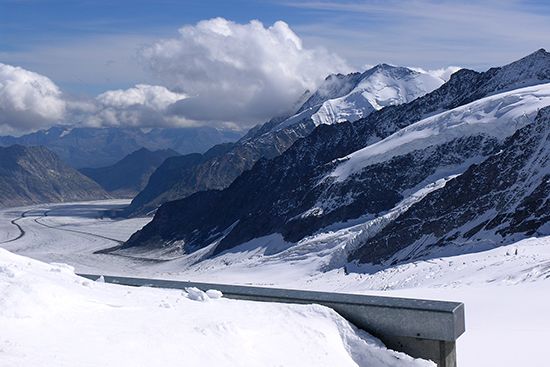
The region is defined by its dramatic topography, with many peaks exceeding 12,000 feet (3,660 meters), including the Finsteraarhorn, Jungfrau, and Aletschhorn. The area is also home to the Aletsch Glacier, one of the longest in the Alps. The landscape was significantly shaped by glaciation, which carved deep valleys and created features such as the Staubbach and Trümmelbach falls in the Lauterbrunnen Valley.34
Renowned for their scenery, the Bernese Alps support numerous resorts, including Interlaken, Grindelwald, and Gstaad, and are a hub for mountaineering and winter sports.3
How do mountaineers prepare to climb high peaks?
Mountaineers prepare for high-altitude climbs through a combination of technical skill development, physical conditioning, and strategic acclimatization. Because mountaineering involves inherent risks, proficiency in hiking, rock climbing, and snow and ice techniques is essential.
Technical and Physical Preparation
- Skill Mastery: Climbers learn to use specialized equipment like ropes, anchors, and ice axes. Mastery of these tools is gained primarily through experience and practice on local cliffs or slopes.6
- Physical Conditioning: Mountaineering requires immense stamina. Climbers must be capable of maintaining a slow, steady, and rhythmic pace for hours, as the most arduous parts of a climb often involve long approaches on lower slopes.6
- Safety Protocols: Preparation includes learning to navigate hazards such as crevasses and avalanches. The use of helmets and proper rope management is critical for safety in technical terrain.6
Acclimatization Strategies
High-altitude environments present the risk of altitude sickness, caused by oxygen deficiency. To mitigate this, climbers employ specific strategies:
- Climb High, Sleep Low: In “siege” style expeditions, climbers establish camps at increasing elevations but return to lower camps to sleep, allowing the body to adapt to lower atmospheric pressure.7
- Acclimatization Periods: Even in lightweight “Alpine” style climbs, mountaineers typically spend at least four weeks at or near base camp to acclimatize before attempting a summit.7
- Medical Precautions: Some climbers use supplemental oxygen or prophylactic medications like acetazolamide to help manage the effects of hypoxia.89
What are some other famous mountains in Switzerland?
Switzerland is home to several iconic peaks, many of which are located within the Bernese Alps. Beyond the Jungfrau, notable mountains include:
- Matterhorn: Perhaps the most famous peak in the Alps, this distinctive horn-shaped mountain straddles the border between Switzerland and Italy near the village of Zermatt.11
- Finsteraarhorn: Standing at 14,022 feet, it is the highest peak in the Bernese Alps.1213
- Eiger: Located in west-central Switzerland, this mountain reaches 13,025 feet and is situated northeast of the Jungfrau.3
- Aletschhorn: Another of the highest summits in the Bernese Alps, reaching an elevation of 13,763 feet.1213
- Dufourspitze: One of the tallest peaks in the entire Alpine range, standing over 14,000 feet high.14
Sources
- Finsteraarhorn — Encyclopædia Britannica
- Finsteraarhorn — Merriam-Webster
- Bernese Alps — Encyclopædia Britannica
- Alps - Geology — Encyclopædia Britannica
- Bernina Alps — Encyclopædia Britannica
- mountaineering - Techniques — Encyclopædia Britannica
- altitude sickness — Encyclopædia Britannica
- Mount Everest - The human challenge — Encyclopædia Britannica
- mountaineering — Encyclopædia Britannica
- Mount Everest - Routes and techniques — Encyclopædia Britannica
- Jungfrau — Encyclopædia Britannica
- Matterhorn — Encyclopædia Britannica
- Eiger — Merriam-Webster
- Exploring 7 of Earth’s Great Mountain Ranges - Alps — Encyclopædia Britannica
Published on · 3 min read