Flamingo
Flamingos utilize a highly specialized feeding method known as filter feeding, a process that bears a striking resemblance to the feeding mechanisms of…
How do flamingos feed, and what is unique about their feeding behavior?
Flamingos utilize a highly specialized feeding method known as filter feeding, a process that bears a striking resemblance to the feeding mechanisms of baleen whales.1
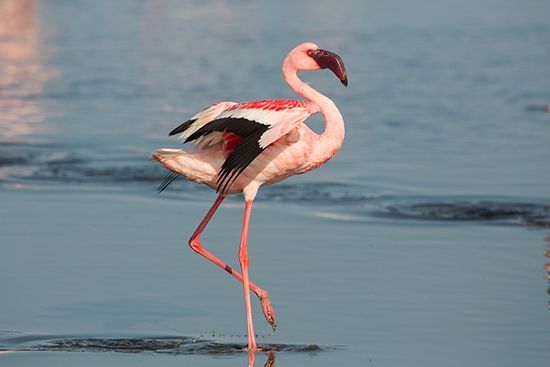
To feed, these birds wade through shallow waters, often stirring up the bottom with their webbed feet to dislodge organic matter. They hold their heads upside down with their bills submerged, swinging them from side to side. As they suck water into their mouths and expel it, small comblike structures—or fine, hairlike plates—inside their mandibles strain out food particles. Once trapped on these plates, the food is moved to the tongue and swallowed.21
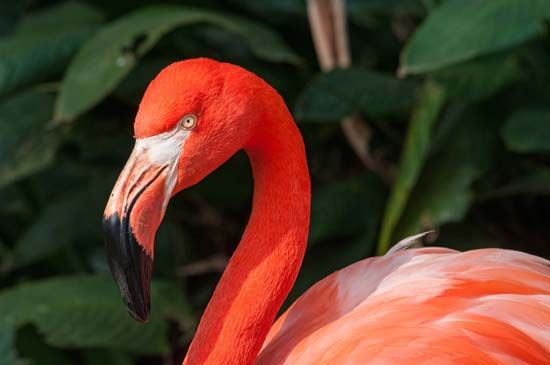
Their diet consists primarily of minute organisms, including diatoms, algae, blue-green algae, and invertebrates such as mollusks and crustaceans. This feeding behavior is not only unique for its mechanical efficiency but also essential for their appearance; the carotenoid pigments found in their food are absorbed during digestion and deposited into their feathers, giving the birds their characteristic pink color.213
What are the different species of flamingos and how do they differ?
There are six distinct species of flamingos, all belonging to the family Phoenicopteridae. While they share common physical traits like long necks, slender legs, and filter-feeding habits, they differ in size, coloration, and geographic distribution.21
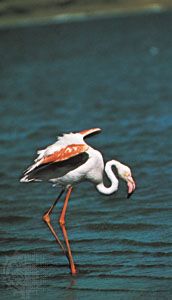
- Greater Flamingo (Phoenicopterus roseus): This species includes the Caribbean flamingo of the tropical Americas and the Old World flamingo found in Africa, southern Europe, and Asia.2
- Chilean Flamingo (Phoenicopterus chilensis): Primarily an inland species, it is distinct from the coastal-dwelling greater flamingo.2
- Andean Flamingo (Phoenicoparrus andinus): One of two species adapted to high altitudes in the Andes Mountains, it is identifiable by a pink band on its yellow legs.2
- Puna (or James’s) Flamingo (Phoenicoparrus jamesi): Also found in the high Andes, this species was once thought to be extinct until a remote population was rediscovered in 1956.2
- Lesser Flamingo (Phoeniconaias minor): The most abundant and smallest species, it is known for being the deepest in color. It inhabits East Africa, parts of South Africa, Madagascar, and India.2
Because their vibrant plumage depends on the carotenoid pigments in their diet, individual coloration varies based on local food sources and habitats, ranging from bright pink and red to pale white.21
What is the typical habitat and geographic distribution of flamingos?
Flamingos are highly gregarious wading birds that thrive in specialized wetland environments, including shallow lagoons, salt lakes, and coastal areas. Their geographic distribution is broad, spanning tropical and subtropical regions across the globe.21
The specific habitats and ranges for the six species include:
- Greater Flamingo (Phoenicopterus roseus): Found along the coasts of the Atlantic Ocean and Gulf of Mexico in the Americas, as well as across Africa, southern Europe, and Asia.2
- Chilean Flamingo (Phoenicopterus chilensis): Primarily inhabits inland areas of South America.2
- Andean Flamingo (Phoenicoparrus andinus) and Puna (James’s) Flamingo (Phoenicoparrus jamesi): These two species are uniquely adapted to high-altitude environments in the Andes Mountains.2
- Lesser Flamingo (Phoeniconaias minor): The most abundant species, inhabiting the lake districts of East Africa and parts of South Africa, Madagascar, and India.2
These birds rely on their wetland habitats to provide the algae, brine shrimp, and larvae necessary for their survival and their signature pink coloration.21
How do flamingos get their pink color, and does it vary among different species?
The vibrant pink color of flamingos is not a hereditary trait; in fact, they are born with dull gray feathers. Their iconic coloration is derived from their diet, which is rich in carotenoid pigments—specifically beta-carotene—found in the algae, brine fly larvae, and brine shrimp they consume in their wetland environments.12
As flamingos digest these foods, enzymes break down the carotenoids, which are then absorbed by fats in the liver and deposited into the birds’ skin and feathers. Because this process requires the ingestion of these pigments in large quantities, the birds’ plumage is directly linked to the availability of these food sources in their specific habitats.1
This coloration varies significantly among the six species and even within populations based on seasonal and regional food availability. Consequently, while some flamingos display deep shades of pink, orange, or red, others may appear quite pale or even white. In captivity, zoos sometimes supplement the birds’ diets with food coloring to prevent their plumage from fading due to a lack of natural carotenoid-rich food.12
Sources
- Why Are Flamingos Pink? — Encyclopædia Britannica
- Flamingo — Encyclopædia Britannica
- Filter feeding — Encyclopædia Britannica
- Ciconiiform - Feeding habits — Encyclopædia Britannica
Published on · 4 min read