Sucking Louse
Sucking lice (Anoplura) have evolved in close association with their hosts, a process often described as co-evolution. This relationship is characterized by…
How have sucking lice evolved alongside their host species?
Sucking lice (Anoplura) have evolved in close association with their hosts, a process often described as co-evolution. This relationship is characterized by high host specificity, where a louse species is typically restricted to a single host species or a group of closely related ones.1
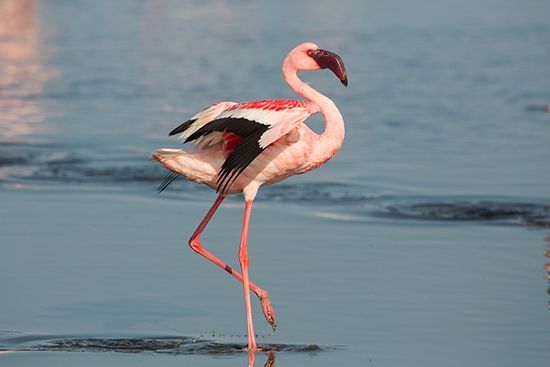
The evolutionary history of lice is closely tied to the divergence of their hosts. As ancestral host populations split and evolved into new species, the lice populations isolated on them also diverged, effectively mirroring the evolutionary tree of the hosts. This parallel evolution is so consistent that the distribution of louse species can sometimes provide insights into the relationships between the hosts themselves; for example, the presence of specific louse genera on flamingos suggests a closer evolutionary link to ducks and geese than to storks.2
However, this direct evolutionary path can be obscured by secondary infestation, where a louse successfully colonizes a new, unrelated host species. Over time, such events can mask the original host-parasite relationship.2
How do scientists classify sucking lice within the larger insect taxonomy?
Scientists classify sucking lice within the order Phthiraptera, which consists of small, dorso-ventrally flattened parasitic insects that live as obligate ectoparasites on birds and mammals.3
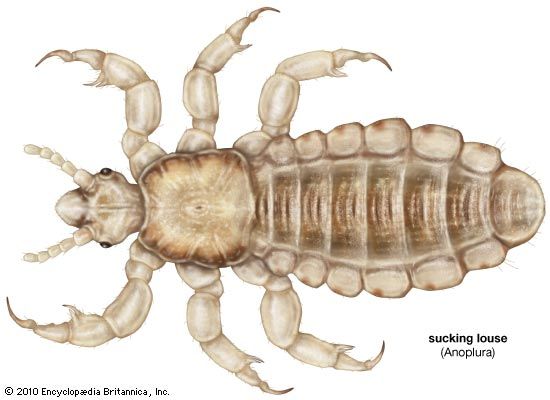
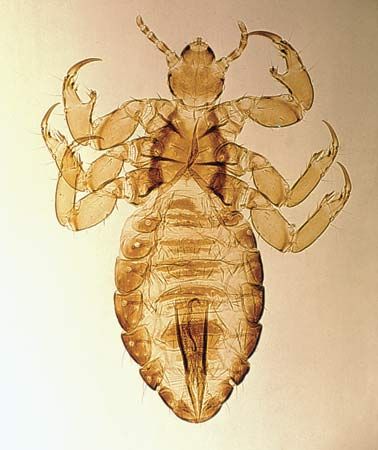
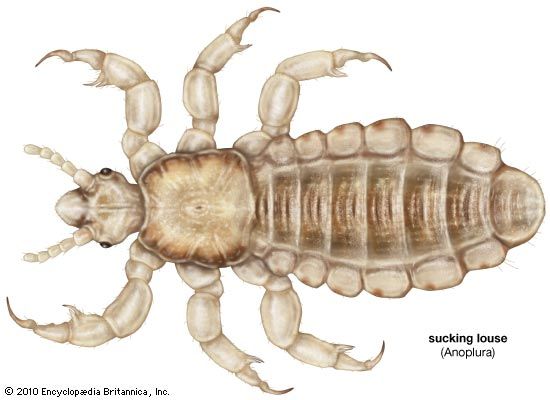
Within this order, sucking lice are categorized into the suborder Anoplura. This group is distinguished from other lice by several specific morphological characteristics:3
- Mouthparts: They possess piercing mouthparts consisting of three fine eversible stylets.3
- Anatomy: The three segments of the thorax are fused together, and the thoracic spiracle is located dorsally.3
- Appendages: They feature filiform antennae with four to five segments and possess a single tarsal claw on at least the second and third pairs of legs.3
- Digestive System: They lack a crop, or if one is present, it is merely a simple enlargement.3
The suborder Anoplura includes approximately 500 species organized into several families, such as Pediculidae (human lice), Echinophthiriidae (seal lice), and Haematopinidae (wrinkled sucking lice).34
What are some common species of sucking lice and their hosts?
Sucking lice (suborder Anoplura) are obligate ectoparasites that feed on the blood and tissue fluids of mammals. Below are some common species and their respective hosts:
Louse Species
Common Name
Primary Host(s)
Pediculus humanus
Human louse
Humans
Pthirus pubis
Pubic louse
Humans
Haematopinus suis
Hog louse
Pigs
Haematopinus eurysternus
Short-nosed cattle louse
Cattle
Haematopinus asini
Horse louse
Horses
Linognathus vituli
Long-nosed cattle louse
Cattle
Linognathus setosus
Dog louse
Dogs
These insects exhibit high host specificity, meaning they are typically restricted to a single host species or closely related groups. While they are primarily known for infesting humans and domestic animals, other families within the suborder, such as Echinophthiriidae, are specialized to parasitize marine mammals like seals.
What is the life cycle of a sucking louse?
The life cycle of a sucking louse is characterized by simple metamorphosis, consisting of three primary stages: egg, nymph, and adult.67
- Egg (Nit): Adult females typically glue their eggs, known as nits, to the hair of their host. The human body louse is an exception, as it lays its eggs on clothing near the skin. When the nymph is ready to hatch, it ingests air to build internal pressure, which forces off the egg cap (operculum).67
- Nymph: Upon hatching, the nymph resembles a smaller, uncolored version of the adult. It undergoes three molting stages, known as instars. With each molt, the nymph grows larger and develops more adult-like characteristics.678
- Adult: After the final molt, the louse reaches sexual maturity. Adults are wingless, dorso-ventrally flattened, and continue to live on the host, feeding on blood and tissue fluids.76
The duration of these stages varies by species and environmental temperature. For example, in the human louse, the egg stage lasts six to 14 days, while the development from hatching to adulthood takes eight to 16 days.6
Sources
- louse - Ecology — Encyclopædia Britannica
- louse - Evolution and paleontology — Encyclopædia Britannica
- louse - Annotated classification — Encyclopædia Britannica
- List of insects - lice (order Phthiraptera) — Encyclopædia Britannica
- sucking louse — Encyclopædia Britannica
- louse - Life cycle — Encyclopædia Britannica
- human louse — Encyclopædia Britannica
- branchiopod - Reproduction and life cycles — Encyclopædia Britannica
- apterygote - Life cycle — Encyclopædia Britannica
- nymph — Encyclopædia Britannica
Published on · 3 min read