Flowstone
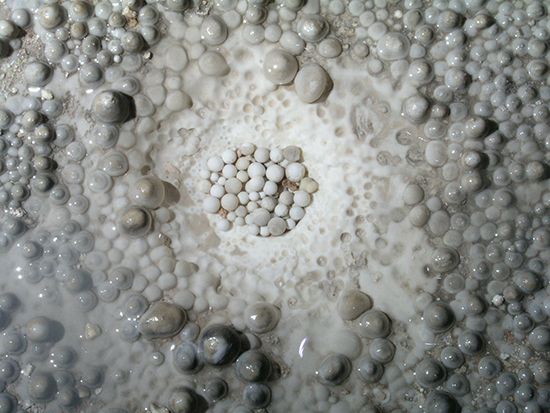
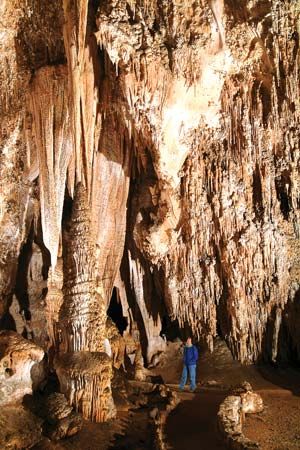
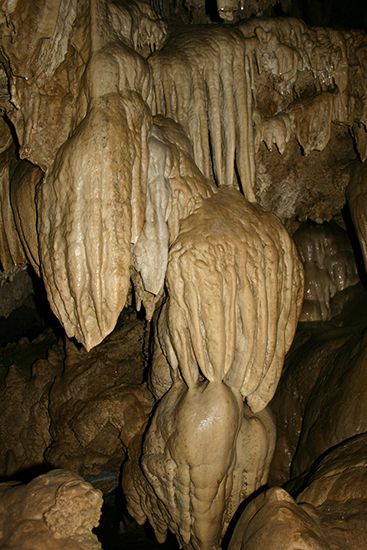
Flowstone is a type of speleothem—a secondary mineral deposit—found in solution caves, typically those formed in limestone.
What is flowstone?
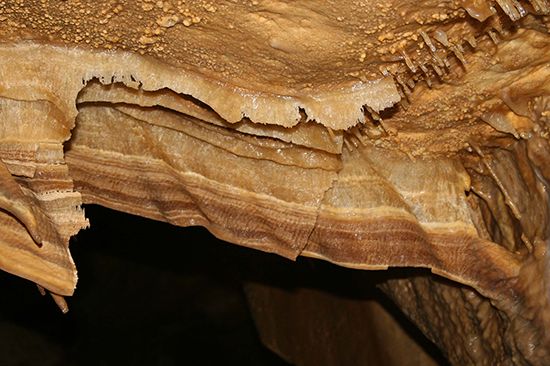
Flowstone is a type of speleothem—a secondary mineral deposit—found in solution caves, typically those formed in limestone.12
It is created when water flows in thin films along cave floors or down sloping walls. As this water moves, it deposits layers of minerals, most commonly calcite (calcium carbonate), though gypsum and other minerals can also form these deposits. The process occurs when water, which has dissolved minerals from the bedrock, loses carbon dioxide upon entering the cave atmosphere, causing the minerals to precipitate out of the solution.12
While flowstone is often white or translucent, it frequently appears in shades of tan, orange, or brown. These colors are typically caused by iron oxides or humic substances—organic products of plant decay—carried into the cave by seepage water. Unlike stalactites or stalagmites, which are formed by dripping water, flowstone is characterized by its sheet-like, massive appearance resulting from flowing water.12
What are the main differences between stalactites and stalagmites?
Stalactites and stalagmites are both types of speleothems formed by mineral-rich water, but they differ significantly in their growth patterns and structure:
- Direction and Location: Stalactites hang downward from the ceiling or sides of a cavern, resembling icicles. Stalagmites rise upward from the cavern floor, appearing as inverted stalactites.43
- Internal Structure: Stalactites typically feature a central canal that carries water from the ceiling to the tip, where it deposits minerals in a ring. In contrast, stalagmites do not have a central canal; they are composed of superimposed caps or layers of mineral matter deposited after the water droplet falls from the ceiling.43
- Growth and Shape: Stalactites often begin as thin, straw-like tubes before thickening into cones. Stalagmites, which form from the same drip-water source, generally have thicker proportions and can take on various shapes, such as mounds, pagodas, or slender “broom-handle” forms. While stalactites are limited by the weight they can support, stalagmites are not as restricted and can reach heights of tens of meters.43
How do helictites grow in such unusual, twisting shapes?
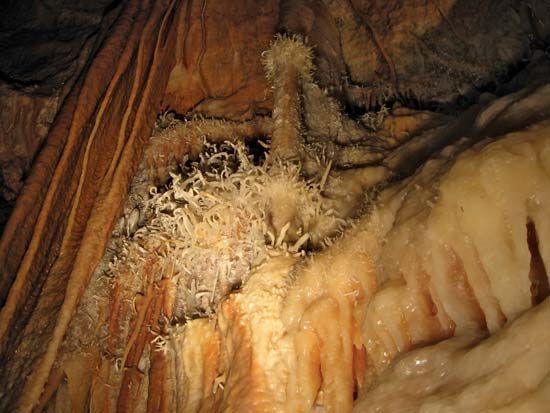
Helictites are unique speleothems known for their branching, curved, or spiraled shapes that appear to defy gravity. While they begin as soda-straw-like tubes similar to stalactites, their growth process differs significantly.63
Unlike stalactites, where water drops fall due to gravity, the water forming a helictite evaporates in place. As individual drops deposit calcium carbonate around the rim, the direction of growth is not dictated by gravitational pull. Instead, it is believed that the orientation is determined by the chance alignment of the crystal axes of the calcite being deposited. Because these formations grow in a stable environment where growth is not interrupted, the forces of crystal development take precedence over the constraints of dripping or flowing water, allowing them to twist and turn in any direction.63
What is the role of carbonic acid in creating limestone caves?
Carbonic acid plays a fundamental role in the creation of limestone caves through a process of chemical dissolution. The process begins when rainwater infiltrates the soil and absorbs carbon dioxide, forming a dilute solution of carbonic acid (H2CO3H_2CO_3).73
As this acidic water percolates downward through fractures and joints in the limestone bedrock, it reacts with the calcite (calcium carbonate) within the rock. This reaction converts the insoluble calcium carbonate into a water-soluble compound, calcium bicarbonate (Ca(HCO3)2Ca(HCO_3)_2), which is then carried away in solution. Over thousands of years, this continuous chemical action enlarges narrow fractures into sizable underground passages and caveses narrow fractures into sizable underground passages and caves.789
Conversely, when this mineral-rich water emerges into a cave’s atmosphere, the loss of carbon dioxide causes the chemical reaction to reverse. This triggers the precipitation of calcium carbonate, which redeposits the mineral to form stalactites, stalagmites, and other speleothems. In this way, the infiltrating water acts as a natural “calcite pump,” removing material from the bedrock above and redepositing it within the cave below.738
Sources
- flowstone — Encyclopædia Britannica
- cave — Encyclopædia Britannica
- cave - Depositional materials and features — Encyclopædia Britannica
- stalactite and stalagmite — Encyclopædia Britannica
- stalagmite — Merriam-Webster
- helictite — Encyclopædia Britannica
- carbonic acid — Encyclopædia Britannica
- oxyacid - Carbonate and hydrogen carbonate salts — Encyclopædia Britannica
- cave - Solution caves — Encyclopædia Britannica
- cave - Initiation phase — Encyclopædia Britannica
Published on · 3 min read