Cave Pearl
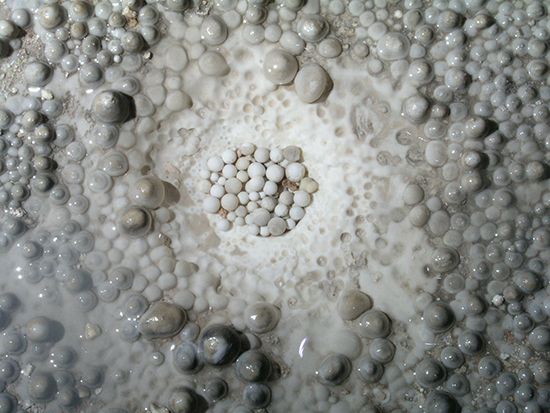
A cave pearl is a small, nearly spherical concretion composed primarily of calcite that forms within a cave pool.
What is cave pearl?
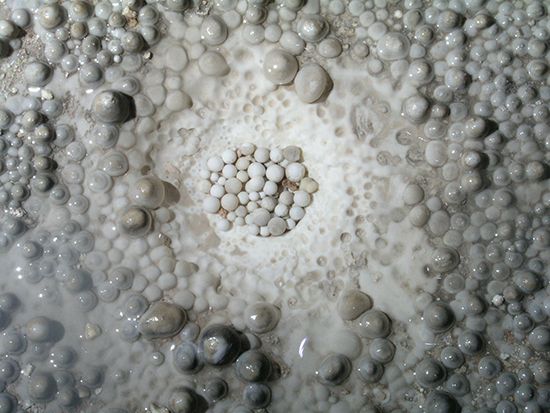
A cave pearl is a small, nearly spherical concretion composed primarily of calcite that forms within a cave pool.12
These formations occur when water saturated with calcium carbonate drips into small pools with enough force to prevent the development of a traditional stalagmite. A small piece of foreign matter acts as a nucleus, becoming coated in layers of calcite. As the water in the pool moves slightly, this nucleus is kept in motion, allowing it to accumulate concentric layers of mineral deposits and become polished. This process continues until the object becomes too large to be moved by the water, at which point it attaches to the surface.2
Cave pearls are a type of speleothem, which is a collective term for secondary mineral deposits formed in caves by dripping, flowing, or standing water.3
What are some other common types of speleothems found in caves?
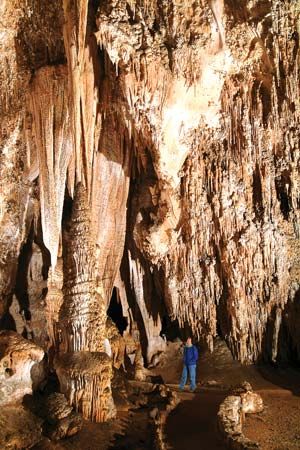
Beyond cave pearls, caves host a wide variety of speleothems—secondary mineral deposits formed by dripping, flowing, or standing water. Common types include:
- Stalactites: Icicle-like formations that hang from the ceiling, created as water drips and leaves behind rings of calcium carbonate.34
- Stalagmites: Mounded or pillar-like formations that rise from the cave floor, built up by mineral-rich water dripping from above.34
- Columns: Formed when a stalactite and a stalagmite grow together to create a single, continuous structure connecting the floor to the ceiling.4
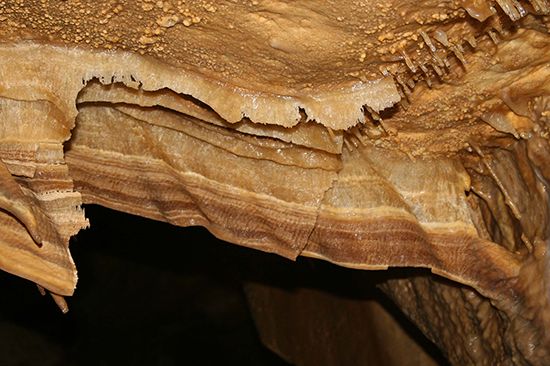
- Flowstone: Sheet-like deposits of calcite that form as water flows along cave walls or ledges.35
- Helictites: Unusual, twisting formations that grow in various directions, seemingly defying gravity, often starting as thin, straw-like tubes.36
- Anthodites: Radiating clusters of needle-like crystals, typically composed of aragonite.3
- Draperies: Thin, wavy sheets of mineral deposits that hang from ceilings or walls, sometimes called drip curtains.5
- Gypsum Flowers: Radiating, curved masses of fibrous crystals that grow in dry caves through the evaporation of sulfate-bearing solutions.3
How do stalactites and stalagmites differ in their formation?
Stalactites and stalagmites are both speleothems formed by mineral-rich water, but they differ significantly in their growth patterns and structure:
- Formation Location: Stalactites hang downward from the cave ceiling or walls, while stalagmites rise upward from the cave floor.43
- Internal Structure: Stalactites typically feature a central canal that carries water from the rock to the tip, allowing them to grow as thin, straw-like tubes before thickening into cones. In contrast, stalagmites do not have a central canal; they are formed by mineral deposits left behind after water droplets fall across the open air and strike the floor, resulting in a structure of superimposed caps or layers.43
- Growth Dynamics: Stalactites grow as water drips from a pendant drop, leaving a ring of calcite at the contact point. Stalagmites grow from the same drip-water source but accumulate mineral matter only after the water has fallen.43
While they often form in pairs, they do not always occur together. When they do, their continued elongation can eventually lead them to meet, forming a column.4
What role does carbon dioxide play in creating cave features?
Carbon dioxide plays a fundamental, dual role in the life cycle of a cave: it acts as both the primary agent of excavation and the catalyst for the creation of decorative features.
The Dissolution Process
The formation of solution caves begins when rainwater infiltrates the soil and absorbs carbon dioxide, forming a dilute solution of carbonic acid. This acidic water percolates through fractures in limestone or dolomite, reacting with the calcite bedrock to dissolve it and carry it away in solution. Over thousands of years, this chemical action enlarges narrow joints into sizable passages.35910
The Deposition Process
Once this mineral-rich water emerges into the cave atmosphere, the process reverses. Because the cave air typically contains less carbon dioxide than the water, the gas escapes from the solution. As the water loses carbon dioxide, its ability to hold calcium carbonate in solution decreases, forcing the mineral to precipitate out. This deposition creates speleothems, such as:3115
- Stalactites: Formed as water drips from the ceiling, leaving behind rings of calcite.311
- Stalagmites: Built up on the floor as the mineral-laden water strikes the surface.311
- Flowstone: Formed as water flows along walls and ledges, leaving behind sheets of calcite.311
Essentially, the infiltrating water acts as a “calcite pump,” removing mineral matter from the surface bedrock and redepositing it to decorate the cave interior.35
Sources
- cave pearl — Merriam-Webster
- cave pearl — Encyclopædia Britannica
- cave - Depositional materials and features — Encyclopædia Britannica
- stalactite and stalagmite — Encyclopædia Britannica
- cave deposit — Encyclopædia Britannica
- helictite — Encyclopædia Britannica
- helictite — Merriam-Webster
- stalactite — Merriam-Webster
- carbonic acid — Encyclopædia Britannica
- calcite - Origin and occurrence — Encyclopædia Britannica
- cave - Initiation phase — Encyclopædia Britannica
- cave - Solution caves — Encyclopædia Britannica
- oxyacid - Carbonate and hydrogen carbonate salts — Encyclopædia Britannica
Published on · 3 min read