Helictite
A helictite is a unique type of cave deposit, or speleothem, characterized by its branching, curved, or spiraled shape. Unlike stalactites, which grow…
What is helictite?
A helictite is a unique type of cave deposit, or speleothem, characterized by its branching, curved, or spiraled shape. Unlike stalactites, which grow downward due to gravity, helictites can grow in any direction, often appearing to defy gravitational forces.123
These formations typically begin as thin, soda-straw-like tubes. While they share a central canal with stalactites, their growth is not dictated by the fall of water droplets. Instead, the water evaporates in place, and the direction of growth is believed to be determined by the chance orientation of the crystal axes of the calcite or other minerals being deposited. Because they form in stable cave environments, their development is governed more by the forces of crystal growth than by the flow of water.13
What are the main differences between stalactites and stalagmites?
Stalactites and stalagmites are both types of speleothems—mineral deposits formed by dripping water—but they differ significantly in their growth patterns and physical structure.43
Key Differences
Feature
Stalactite
Stalagmite
Growth Direction
Hangs downward from the ceiling or sides of a
cavern
.
Rises upward from the floor of a cavern.
Internal Structure
Contains a central canal that carries water to the tip.
Does not have a central canal; consists of superimposed layers or caps.
Shape
Often tapers downward, ranging from thin “soda straws” to massive pendants.
Typically thicker and more varied, ranging from slender to mound- or pagoda-like shapes.
Formation
Forms as water drips from the ceiling, leaving mineral deposits around the rim of a pendant drop.
Forms when water droplets fall to the floor, depositing minerals after the impact.
While these formations often appear in pairs, they do not always occur together. When a stalactite and a stalagmite meet through continuous elongation, they form a column. Both are primarily composed of calcite, though their growth is dependent on specific environmental conditions, such as slow water percolation and the release of carbon dioxide within the cave atmosphere.43
How do cave environments influence the growth of different speleothems?
Cave environments act as stable, controlled settings that dictate the formation and growth of speleothems through specific physical and chemical processes. Because these environments maintain relatively constant temperatures and relative humidity for thousands of years, they allow for the slow, uninterrupted growth of mineral crystals.3
The primary influence on speleothem development is the behavior of water as it moves through the cave:
- Dripping Water: When water emerges from ceiling joints, it forms pendant drops. As carbon dioxide escapes into the cave atmosphere, calcium carbonate precipitates, creating stalactites on the ceiling and stalagmites on the floor where the drops impact.356
- Flowing Water: Water moving along walls and ledges deposits sheets of calcite, resulting in flowstone formations.3
- Crystal-Controlled Growth: In stable environments, some formations, such as helictites, grow based on the orientation of crystal axes rather than gravity, allowing them to twist in various directions.3
- Evaporation: In dry caves, the evaporation of mineral-bearing seepage water leads to the growth of sulfate minerals like gypsum, which can form delicate, fibrous structures known as gypsum flowers.3
Ultimately, the cave’s internal conditions—including the rate of water flow and the chemical composition of the infiltrating water—determine the diversity and beauty of these secondary mineral deposits.35
What are anthodites and how do they differ from helictites?
Anthodites and helictites are both distinct types of speleothems, but they differ significantly in their composition, structure, and growth mechanisms.1
Anthodites
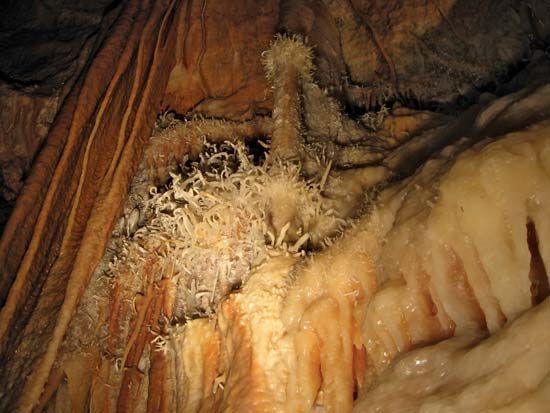
Anthodites are radiating clusters of needlelike crystals that often resemble flowers or sprays. They are typically composed of aragonite, a form of calcium carbonate that possesses a different crystal habit than the more common calcite.1
Helictites
Helictites are long, tubular formations that share similarities with stalactites because they contain a central canal. However, unlike stalactites, which grow downward due to gravity, helictites twist and turn in various directions. Their growth is not guided by the gravitational pull on water drops but is instead thought to be determined by the chance orientation of the crystal axes of the calcite carried in the water.13
Key Differences
- Structure: Anthodites form as radiating, needlelike clusters, whereas helictites are tubular, branching, or spiraled structures.31
- Composition: Anthodites are commonly made of aragonite, while helictites are typically composed of calcite.31
- Growth Mechanism: Helictites grow via a central canal that allows water to deposit minerals as it evaporates in place, whereas anthodites grow as crystalline clusters.31
Sources
- helictite — Encyclopædia Britannica
- helictite — Merriam-Webster
- cave - Depositional materials and features — Encyclopædia Britannica
- stalactite and stalagmite — Encyclopædia Britannica
- cave deposit — Encyclopædia Britannica
- carbonic acid — Encyclopædia Britannica
- cave - Geomorphic characteristics of solution caves — Encyclopædia Britannica
- cave - Enlargement phase — Encyclopædia Britannica
- anthophyllite — Encyclopædia Britannica
- pyroxene - Chemical composition — Encyclopædia Britannica
Published on · 3 min read