Frisian Islands
The Frisian people are a Germanic group native to the North Sea coastal region, historically spanning from the Netherlands to modern-day Germany. Their…
What are the main cultural and linguistic characteristics of the Frisian people?
The Frisian people are a Germanic group native to the North Sea coastal region, historically spanning from the Netherlands to modern-day Germany. Their cultural identity is deeply rooted in a history of seafaring, commerce, and a strong tradition of self-governance; the medieval adage “Every Frisian is a nobleman” reflects their historical rejection of foreign overlords and feudalism. Traditionally, they have been known for cattle raising and agriculture, activities documented as far back as the 1st century BCE.1
Linguistically, the Frisian language is the West Germanic language most closely related to English. It is divided into three distinct groups:2
- West Frisian: Spoken in the Dutch province of Friesland, it has seen a modern revival and is recognized as an official language used in schools and courts.23
- East Frisian: Now spoken by a very small population in the German Saterland.3
- North Frisian: Spoken along the coast of Schleswig and on offshore islands like Sylt and Helgoland, existing in numerous, often mutually unintelligible dialects.234
How were the Frisian Islands formed, and what is their geological history?
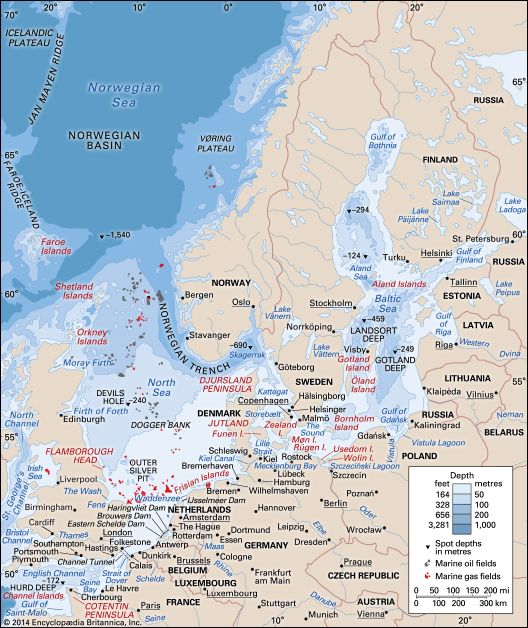
The Frisian Islands are a low-lying chain of islands that form a single physical feature, stretching in an arc from the northern Netherlands, along the German coast, to the southern Jutland Peninsula in Denmark. Their formation and geological history are closely tied to the evolution of the North Sea and the post-glacial rise in sea levels.
Geological Origins
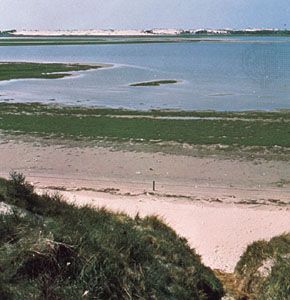
Following the final retreat of the glaciers about 8,000 years ago, rising sea levels flooded the land bridge that once connected Britain to the European mainland. By approximately 7,000–5,000 BCE, the North Sea had established a southwestern outlet to the Atlantic, and its southeastern shoreline began to coincide with the present curve of the Frisian Islands. The islands were shaped by periodic subsidence, intense storms, and flooding, which separated them from the mainland by a narrow belt of shallow waters and tidal mud flats known as wadden (or Watten).
Factors Influencing Development
- Tectonic Subsidence: The region is characterized by a long-term negative tectonic trend. The Netherlands and northwestern Germany are experiencing subsidence, a process complicated by the compaction of water-saturated sediments in the Rhine delta region.
- Sea Level Fluctuations: Throughout the Holocene Epoch, the coastline has been shaped by alternating transgressive (rising sea) and regressive (falling sea) phases. These fluctuations led to the development of barrier beaches, tidal flats, and dune systems.
- Human Intervention: Much of the current landscape has been modified by human activity. Governments have invested heavily in coastal protection and land reclamation, creating polders—land previously under water—to expand agricultural areas.
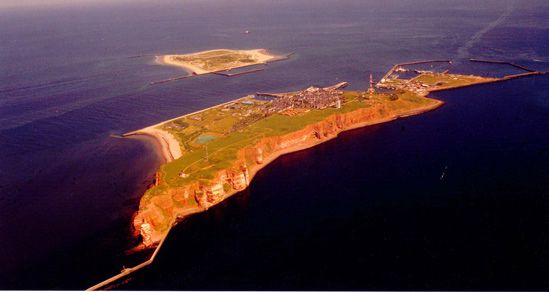
While most of the islands share this sandy, low-lying origin, the island of Helgoland is a notable exception, as it is composed of rocky red sandstone and stands apart both geologically and geographically.
What are some of the most popular tourist attractions and activities in the Frisian Islands?
The Frisian Islands are a popular destination for travelers, offering a unique blend of natural beauty, maritime history, and recreational activities. Tourism is a significant economic asset for the region, particularly during the summer months when visitors flock to the islands’ sandy beaches and resorts.74
Popular Activities and Attractions
- Beach and Coastal Recreation: The islands are renowned for their extensive sandy beaches, which serve as the primary draw for tourists seeking relaxation and seaside activities.7
- Water Sports: In the Dutch province of Friesland, tourism is heavily centered on water sports, taking advantage of the region’s vast network of canals, lakes, and coastal waterways.13
- Nature Exploration: The islands offer diverse natural environments. For instance, Eierland on the northern part of Texel is a significant nature reserve where thousands of seabirds nest. Additionally, Terschelling features a dedicated nature reserve for seals.713
- Island Hopping: Holiday steamers frequently ply the sheltered southern coasts of the islands, providing a scenic way for visitors to travel between locations.7
- Resort Towns: Several islands feature popular resort towns, such as Nordseebad Borkum and Norderney, which are well-equipped to host summer visitors.7
- Local Transport: Many islands utilize light railways to transport visitors inland from the coast, enhancing accessibility to the villages and farmsteads scattered across the landscape.7
How do the inhabitants of the Frisian Islands maintain their unique way of life in the modern world?
The inhabitants of the Frisian Islands maintain their unique way of life by balancing traditional practices with the demands of the modern world. Their cultural identity is anchored in a long history of self-governance and resilience against the sea, which has fostered a distinct heritage that persists today.4
Cultural and Linguistic Preservation
- Language: While the Frisian language faced potential extinction in the 19th century, it has experienced a significant resurgence, particularly in the Dutch province of Friesland. It is now recognized as an official language, taught in primary schools, and used in legal proceedings. In Germany, however, the status of Frisian is more tenuous, often serving as a local dialect alongside German.46114
- Cultural Movements: Societies dedicated to the preservation of Frisian culture and language have been instrumental in maintaining local traditions, supported by institutions like the Frisian Academy.61
Economic Adaptation
- Traditional Livelihoods: Agriculture remains a cornerstone of island life, with inhabitants continuing to engage in cattle and sheep raising, as well as fishing. Traditional architecture, such as the single-story Frisian house designed to shelter both livestock and living quarters, reflects this deep-rooted connection to farming.75
- Modern Economy: To thrive in the modern era, islanders have integrated tourism into their economic model. Resort towns and natural attractions draw visitors, while infrastructure like light railways and holiday steamers help manage the flow of tourism while supporting local connectivity.47
Environmental Resilience
Sources
- Frisian language — Encyclopædia Britannica
- West Germanic languages - Frisian — Encyclopædia Britannica
- West Germanic languages - Characteristics — Encyclopædia Britannica
- Frisia — Encyclopædia Britannica
- West Germanic languages - Dialects — Encyclopædia Britannica
- West Germanic languages - History — Encyclopædia Britannica
- Frisian Islands — Encyclopædia Britannica
- Frisian Islands — Merriam-Webster
- Wadden Sea — Encyclopædia Britannica
- North Sea - Geology — Encyclopædia Britannica
- North Sea - Physiography — Encyclopædia Britannica
- Holocene Epoch - Continental shelf and coastal regions — Encyclopædia Britannica
- Friesland — Encyclopædia Britannica
- East Friesland — Encyclopædia Britannica
Published on · 5 min read