Ganges Shark
The Ganges shark (Glyphis gangeticus) is a rare species of river shark endemic to the tropical freshwater, brackish, and coastal marine estuary habitats of…
What is Ganges shark?
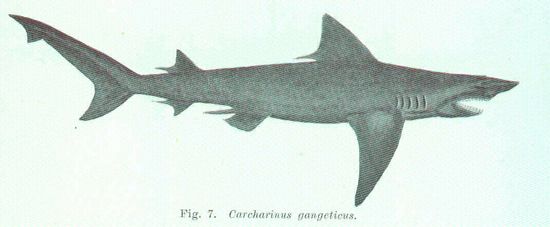
The Ganges shark (Glyphis gangeticus) is a rare species of river shark endemic to the tropical freshwater, brackish, and coastal marine estuary habitats of the Indian Ocean and western Pacific Ocean.1
Physically, the shark is stocky with a dark gray back, white underside, rounded snout, and prominent hooked caudal fins. Its small, upward-tilted eyes are an adaptation to murky river waters, and it possesses large, serrated teeth. While they can reach lengths of 2.75 meters (9 feet), they typically average 1.8 meters (5.8 feet).21
Classified as a critically endangered species by the IUCN, the Ganges shark is among the 20 most threatened shark species globally, with an estimated population of fewer than 240 mature individuals. Major threats include bycatch in subsistence fishing, habitat degradation from pollution, sand mining, and fragmentation caused by dams.21
How do bull sharks differ from Ganges sharks?
While both the Ganges shark and the bull shark are classified as river sharks that frequent freshwater and estuarine environments, they are distinct species with significant differences in their taxonomy and status.13
- Taxonomy: The Ganges shark belongs to the genus Glyphis, whereas the bull shark is a member of the genus Carcharhinus.1
- Conservation Status: The Ganges shark is a critically endangered species with an estimated population of fewer than 240 mature individuals, making it one of the most threatened shark species globally. In contrast, the bull shark is more widely distributed and abundant.1
- Identification: Because they share similar habitats, the two are often confused. Authorities note that attacks on humans attributed to the Ganges shark are frequently misidentifications of the more common bull shark.1
- Predation: While the Ganges shark has no known natural predators, there is speculation that bull sharks may prey upon juvenile Ganges sharks.1
What are some other examples of critically endangered shark species?
Beyond the Ganges shark, several other shark species are classified as critically endangered by the IUCN. These species face severe population declines primarily due to commercial fishing, bycatch, and the demand for shark fins.671
Notable examples include:
- Oceanic whitetip shark: Once common in tropical waters, its population has plummeted by nearly 98 percent over the last 60 years, largely due to longline and gillnet fishing operations.6
- Scalloped hammerhead shark: This species has experienced dramatic population crashes, with some regional populations falling by more than 80 percent in just over two decades. They are now a primary focus of conservation efforts in areas like the Galapagos Marine Reserve.7
The International Union for Conservation of Nature has assessed over 1,000 species of sharks, rays, and chimaeras, finding that a significant percentage are threatened with extinction. Protecting these apex predators is essential, as their removal can trigger a “domino effect” that destabilizes entire marine ecosystems.17
Why are river habitats particularly difficult for sharks to survive in?
River habitats present significant physiological and environmental challenges for most sharks, making them difficult environments to inhabit.
Physiological Challenges
Most sharks are physiologically adapted to marine environments, where they maintain osmotic balance by retaining urea in their blood to keep their internal salt concentration slightly higher than that of seawater. In freshwater, however, this strategy becomes a liability. Because freshwater has a much lower concentration of salts than a shark’s body, osmosis causes water to constantly diffuse into the shark’s tissues while essential salts leach out. To survive in such conditions, a shark must be able to significantly lower its blood urea concentration and actively transport salts back into its body, a complex physiological adjustment that few species can manage.319
Environmental Threats
Beyond internal regulation, riverine habitats are often precarious due to human activity:
- Habitat Degradation: Rivers are frequently impacted by pollution from chemical runoff, sand mining, and soil erosion, which degrade water quality.1011
- Fragmentation: The construction of hydroelectric dams and barrages creates physical barriers that fragment habitats, restricting movement and isolating populations.1011
- Fishing Pressure: River-dwelling sharks are highly vulnerable to bycatch in small-scale and subsistence fishing operations, which often target them for their meat, fins, and oil.1011
Sources
- Ganges shark: Top Questions — Encyclopædia Britannica
- Ganges shark — Merriam-Webster
- Ganges shark — Encyclopædia Britannica
- shark - Description and habits — Encyclopædia Britannica
- river shark — Merriam-Webster
- carcharhinid — Encyclopædia Britannica
- Saving Sharks in the 2020s — Encyclopædia Britannica
- Man Bites Shark — Encyclopædia Britannica
- bull shark — Encyclopædia Britannica
- chondrichthyan - Distribution and abundance — Encyclopædia Britannica
- Biosphere - Salinity — Encyclopædia Britannica
- Excretion - Fishes — Encyclopædia Britannica
- fish - Excretory organs — Encyclopædia Britannica
Published on · 3 min read