Osteolepis
Osteolepis is an extinct genus of lobe-finned fishes that lived during the Devonian Period, specifically appearing in the Middle to Late Devonian. These…
What is Osteolepis?
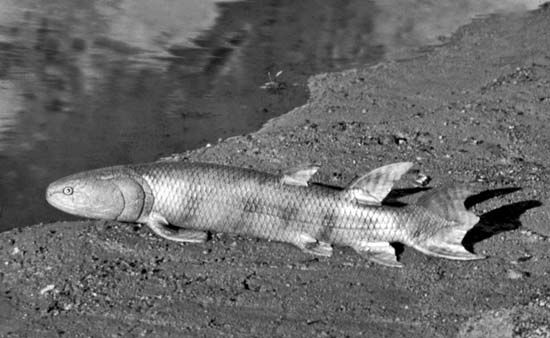
Osteolepis is an extinct genus of lobe-finned fishes that lived during the Devonian Period, specifically appearing in the Middle to Late Devonian1. These freshwater, Paleozoic-era vertebrates are characterized by their slender, elongated bodies covered in large, rhomboid scales and a well-ossified cranium.123
Notably, Osteolepis is the type genus for the family Osteolepidae. The bone structure of its skull and jaws bears a striking resemblance to that of the earliest tetrapods, leading scientists to consider this group to be among the closest relatives of—and potentially on the direct ancestral line to—the first amphibians.132
What are lobe-finned fishes?
Lobe-finned fishes, belonging to the class Sarcopterygii, are an ancient group of bony fishes characterized by their paired, fleshy, lobed fins that resemble limbs. Unlike the more common ray-finned fishes (Actinopterygii), whose fins are supported by bony or horny rays, the fins of sarcopterygians contain internal bone structures that are structurally similar to the limbs of tetrapods.4567
These fishes first appeared in the Devonian Period and are considered by many scientists to be the ancestors of terrestrial vertebrates. Some groups, such as lungfishes, possess lungs that allow them to breathe air, an adaptation that may have helped their ancestors survive in shallow or seasonal waters.46859
While once a diverse and widespread group, most lobe-finned fishes are now extinct. Today, the class is represented by only a few surviving lineages, including:
- Coelacanths: Once thought to be extinct since the Cretaceous, they were famously rediscovered in 1938.6
- Lungfishes: Modern species, such as the Australian lungfish, still exhibit behaviors like using their fins for support, which may provide insight into how early tetrapods developed walking behaviors.59
How did fish evolve into tetrapods?
The transition from fish to tetrapods (four-legged land vertebrates) occurred during the Devonian Period, roughly 397 million years ago. This evolutionary process involved descendants of Sarcopterygii, or lobe-finned fishes, which possessed key pre-adaptations such as lungs for aerial respiration and fleshy, lobed fins with internal skeletal structures.1213614
The transformation was a gradual, aquatic-based process rather than a sudden “fish-to-amphibian” leap. Early forms like Eusthenopteron and Tiktaalik roseae demonstrate intermediate features:1514
- Limb Development: Fins evolved into limbs with joints (elbows, wrists, knees) capable of bending, initially used to navigate shallow, vegetation-dense waters rather than for walking on land.1514
- Skeletal Changes: Over time, the pectoral girdle detached from the skull to allow for a flexible neck, and the pelvic girdle strengthened to anchor to the vertebral column, providing the support necessary for terrestrial locomotion.14
- Physiological Shifts: As these animals spent more time out of water, natural selection favored stronger skeletons to counter gravity, as well as sensory adaptations like the loss of the lateral-line system and the development of aerial vision and sound reception.14
What was the Devonian Period like?
The Devonian Period, spanning from approximately 419.2 to 359 million years ago, is famously known as the “Age of Fishes” due to the remarkable diversification and abundance of fish species in its seas.17
Geography and Climate
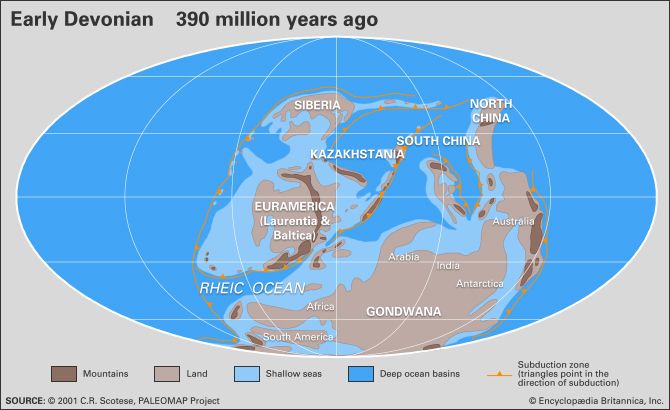
During this time, the Earth’s landmasses were organized differently than today. Most of North America, Greenland, and Europe were united into a supercontinent called Laurussia (or Euramerica), while the southern continents were joined as Gondwana. The climate was generally warm and equitable, with little evidence of significant polar ice caps. However, the period was marked by frequent sea-level fluctuations and episodes of ocean anoxia—reduced oxygen levels—which contributed to major extinction events.17181920
Life and Evolution
The Devonian was a pivotal era for life:
- Marine Life: The oceans teemed with ammonites, brachiopods, corals, and trilobites.1721
- Terrestrial Colonization: Forests first appeared, and the Old Red Sandstone deposits provide evidence of plants and fish colonizing freshwater rivers and lakes.1718
- Vertebrate Evolution: By the end of the period, the first four-legged amphibians emerged, marking the transition of vertebrates onto land.17
Sources
- Osteolepis — Encyclopædia Britannica
- Osteolepis — Merriam-Webster
- Osteolepidae — Merriam-Webster
- lobe-finned — Merriam-Webster
- Sarcopterygii — Merriam-Webster
- muscle - Origins of the tetrapod limbs — Encyclopædia Britannica
- fish - Annotated classification — Encyclopædia Britannica
- fish - Sarcopterygii: fleshy-finned fishes — Encyclopædia Britannica
- lungfish - Evolution — Encyclopædia Britannica
- lobe-fin — Merriam-Webster
- ray-finned — Merriam-Webster
- tetrapod — Encyclopædia Britannica
- Tiktaalik roseae — Encyclopædia Britannica
- Eusthenopteron — Encyclopædia Britannica
- amphibian - Evolution and classification — Encyclopædia Britannica
- Devonian Period - Devonian life — Encyclopædia Britannica
- A Journey Through Time Since the Precambrian - Devonian Period: 419.2 million to about 359 million years ago — Encyclopædia Britannica
- Devonian Period - Paleoclimate — Encyclopædia Britannica
- Devonian Period - Significant geologic events — Encyclopædia Britannica
- Devonian Period - Extinction events — Encyclopædia Britannica
- Devonian Period - Invertebrates — Encyclopædia Britannica
Published on · 3 min read