Gawler Ranges
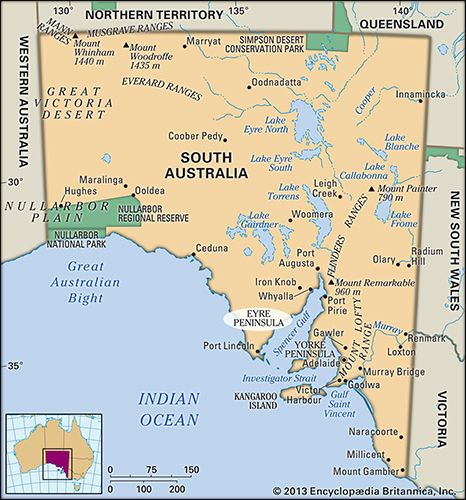
The Gawler Ranges are a series of mountains and hills located in South Australia, extending 100 miles (160 km) across the northern part of the Eyre…
What is Gawler Ranges?
The Gawler Ranges are a series of mountains and hills located in South Australia, extending 100 miles (160 km) across the northern part of the Eyre Peninsula. Situated south of Lake Gairdner, these ranges reach elevations of up to 1,550 feet (475 meters) at Mount Bluff.1
Geologically, the ranges are composed of rounded, Precambrian volcanic rocks that are more than 541 million years old. They were first sighted by the explorer Edward John Eyre in 1839 and named in honor of George Gawler, a former governor of the colony.21
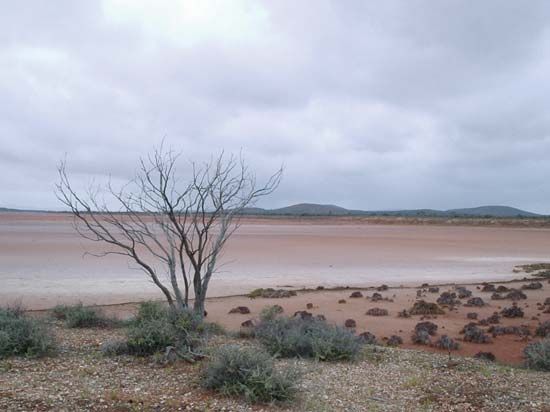
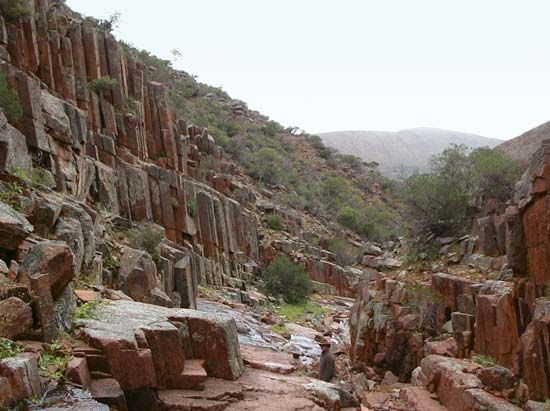
The region is characterized by semiarid shrub vegetation, which limits livestock grazing. Notable sites within the area include the Yantanabie Historic Reserve, which features an old Aboriginal quarry, and the Yardea National Estate, known for its picturesque porphyry columns. While the main ranges are volcanic, the eastern sector—often referred to as the Middleback Ranges—is distinct for its rich iron ore deposits, which have been mined since the early 20th century.1
What are some unique geological features of the Gawler Ranges?
The Gawler Ranges, located in South Australia, are defined by several distinct geological characteristics:
- Volcanic Origins: The ranges are primarily composed of Precambrian volcanic rocks that are more than 541 million years old.14
- Rounded Topography: Unlike the sharp, folded ridges found in other Australian mountain belts, the Gawler Ranges are characterized by a rounded appearance in their central and northern sections.4
- Porphyry Formations: The region is noted for its picturesque columns of porphyry, a type of igneous rock, particularly within the Yardea National Estate.1
- Structural Complexity: The broader Gawler block is geologically complex, featuring a mix of crystalline and sandstone uplands in the east and sandstone plateaus in the northeast.4
- Mineralization: The eastern sector of the region, known as the Middleback Ranges, is geologically distinct for its rich iron ore deposits, which have been a focus of mining activity since the early 20th century.1
How did Edward John Eyre’s exploration shape the history of South Australia?
Edward John Eyre played a significant role in the early development of South Australia through his pioneering work as a sheep farmer and explorer. As an “overlander,” he established vital stock routes by driving livestock from Sydney to Adelaide, facilitating the colony’s economic growth.5
His geographical contributions were equally impactful. Between 1838 and 1841, he explored the region now known as the Eyre Peninsula, which was subsequently named in his honor. Furthermore, his hazardous 1840–1841 expedition along the Great Australian Bight—traveling over 1,300 miles from Adelaide to Albany—was instrumental in mapping the continent’s southern coastline and confirming that the interior was a vast desert rather than an inland sea. Beyond exploration, Eyre served as a magistrate and protector of Aborigines, gaining knowledge of their languages and customs during his time in the colony.657
What kind of wildlife can be found in the Gawler Ranges National Park?
The Gawler Ranges, characterized by their semiarid environment, support a variety of wildlife typical of the broader South Australian arid pastoral zone. While the region’s biodiversity has been impacted by the competition of domesticated livestock, several native species remain present in the area.
Common fauna found within this landscape include:
- Marsupials: The region is home to western gray kangaroos and red kangaroos, which are among the species that have remained relatively common despite historical habitat loss.8
- Monotremes: The echidna (spiny anteater) is still regularly sighted across the South Australian mainland, including in arid regions.8
- Reptiles and Amphibians: South Australia hosts over 200 species of reptiles and amphibians. While specific endemic species like the gibber dragon and Woomera slider are found within the state, the arid shrublands of the Gawler Ranges provide habitat for various lizards and other reptiles adapted to dry conditions.8
- Birds: The area serves as part of the broader habitat for hundreds of bird species that inhabit or visit the state.8
Sources
- Gawler Ranges — Encyclopædia Britannica
- Australia - The Western Plateau — Encyclopædia Britannica
- Gawler — Encyclopædia Britannica
- Australia - The Precambrian — Encyclopædia Britannica
- Eyre Peninsula — Encyclopædia Britannica
- Edward John Eyre — Encyclopædia Britannica
- European exploration - Australia — Encyclopædia Britannica
- South Australia - Plant and animal life — Encyclopædia Britannica
Published on · 3 min read