Great Australian Bight
The Great Australian Bight is a wide embayment of the Indian Ocean that indents the southern coast of Australia. While the International Hydrographic Bureau…
What is Great Australian Bight?
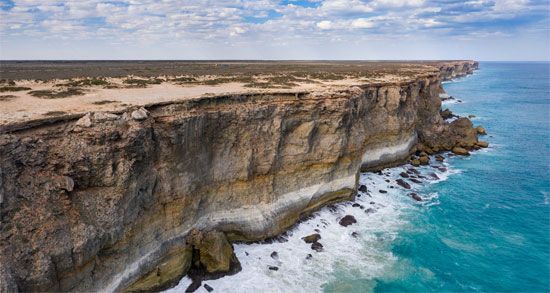
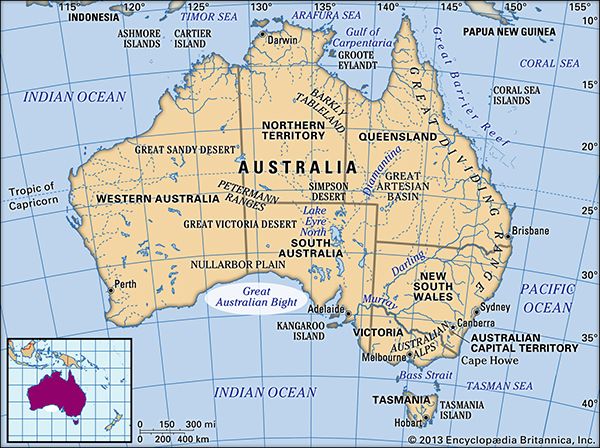
The Great Australian Bight is a wide embayment of the Indian Ocean that indents the southern coast of Australia. While the International Hydrographic Bureau defines its extent from West Cape Howe in Western Australia to South West Cape in Tasmania, it is more generally recognized as stretching 720 miles (1,160 km) between Cape Pasley and Cape Carnot.1
The head of the bight is characterized by a continuous line of cliffs reaching heights of 200–400 feet (60–120 metres), which abut the arid Nullarbor Plain. Known for its rough seas and storms due to the influence of winter westerly winds, the region includes several island groups, such as the Archipelago of the Recherche and the Nuyts Archipelago. The coastline was first visited by the Dutch navigator Pieter Nuyts in 1627 and later surveyed by Matthew Flinders in 1802.1
What is the Nullarbor Plain?
The Nullarbor Plain is a vast limestone plateau located in southwestern Australia, spanning across South Australia and Western Australia. Its name is derived from the Latin Noneus arbor, meaning “no tree,” reflecting its character as a largely treeless expanse.34
Covering approximately 100,000 square miles (260,000 square km), the plain extends from the Great Australian Bight in the south to the Great Victoria Desert in the north. The landscape is generally flat, with an average elevation of 600 feet (180 m), and is characterized by calcareous loams and stony soils. The region is known for its numerous limestone caves, such as Koonalda Cave, and is protected in part by the Nullarbor National Parkbor National Park](https://www.britannica.com/place/Nullarbor-National-Park).35
The area is traversed by the Eyre Highway and the world’s longest stretch of straight railroad track. It was first crossed by Edward John Eyre in 1841.3
Which marine animals live in the Great Australian Bight?
The Great Australian Bight is home to various marine species, though the provided search results focus primarily on the presence of sharks in Australian coastal waters.
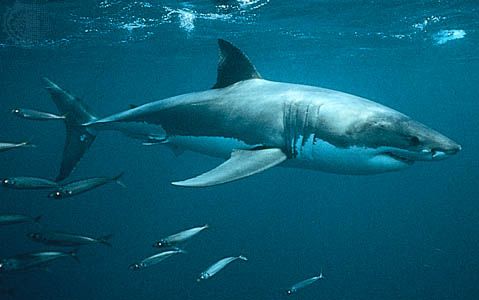
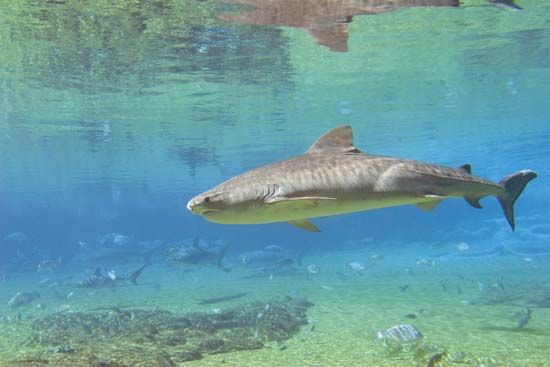
- Sharks: The great white shark (Carcharodon carcharias) is known to range into the cooler waters of both hemispheres, including those off the coast of Australia. Other species found in Australian coastal waters that have been implicated in human encounters include the tiger shark, bull shark, hammerhead, blue shark, and oceanic whitetipoceanic whitetip](https://www.britannica.com/animal/whitetip-shark).176
- General Marine Life: While specific species lists for the Bight are not detailed in the provided text, the region’s marine environment supports diverse organisms that participate in horizontal and vertical migrations related to feeding and reproduction.78
It is important to note that while some shark species are perceived as threats, most shark species are too small, live at depths too great, or are otherwise unsuited to pose a danger to humans.1
Who was Matthew Flinders and what did he discover?
Matthew Flinders (1774–1814) was a distinguished English navigator and Royal Navy officer who played a pivotal role in mapping the Australian continent.10
His significant contributions to exploration include:
- Circumnavigation of Tasmania: In 1798–1799, alongside George Bass, he circumnavigated Tasmania, confirming it was an island separated from the mainland by the Bass Strait.1011
- Surveying the Southern Coast: As commander of the Investigator, he surveyed the entire southern coastline of Australia, including the Great Australian Bight, between 1801 and 1803.1011
- Circumnavigation of Australia: Flinders successfully circumnavigated the Australian continent, proving that no strait existed between the southern bight and the Gulf of Carpentaria.1011
- Naming the Continent: He is credited with suggesting that the landmass be named Australia, a name that eventually replaced earlier designations.11
Flinders documented his findings in his work, Voyage to Terra Australis, published shortly before his death.10
Sources
- Great Australian Bight — Encyclopædia Britannica
- Limmen Bight — Encyclopædia Britannica
- Nullarbor Plain — Encyclopædia Britannica
- Nullarbor Plain — Merriam-Webster
- Western Australia - Soils — Encyclopædia Britannica
- Marine ecosystem - Migrations of marine organisms — Encyclopædia Britannica
- chondrichthyan - Danger to human life — Encyclopædia Britannica
- Migration - Fish — Encyclopædia Britannica
- shark - Hazards to humans — Encyclopædia Britannica
- Matthew Flinders — Encyclopædia Britannica
- European exploration - Westward voyages to the Pacific — Encyclopædia Britannica
Published on · 3 min read