Genesee River
The Genesee River originates in the state of Pennsylvania and flows generally north through New York state before emptying into Lake Ontario.
Where does the Genesee River originate, and through which states does it flow?
The Genesee River originates in the state of Pennsylvania and flows generally north through New York state before emptying into Lake Ontario.1
Spanning 158 miles, the river is notable for its dramatic landscape, including a 17-mile-long gorge known as the “Grand Canyon of the East” located within Letchworth State Park. As it travels through Rochester, the river passes through another gorge containing waterfalls that are utilized for hydroelectric power utilized for hydroelectric power. The name Genesee is derived from an Iroquoian term meaning “beautiful valley,” reflecting the region’s historical significance to the Seneca people, who referred to the waterway as the “River of Many Falls”.12
What are some notable geographical features or landmarks along the Genesee River?
The Genesee River features several striking geological and man-made landmarks along its 158-mile course:
- The Grand Canyon of the East: Located at Portageville, this 17-mile-long postglacial gorge features rocky walls rising up to 600 feet. It serves as the centerpiece of Letchworth State Park, which also houses a museum dedicated to Native American and pioneer history.1
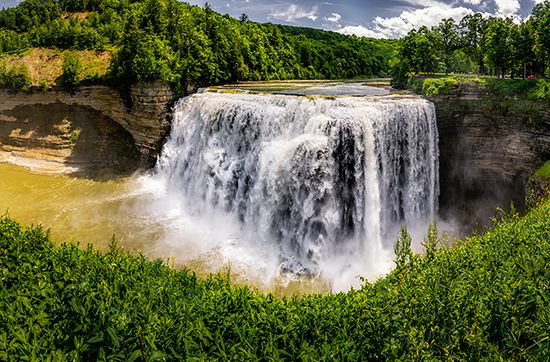
- Waterfalls: The river is famous for its cascades. At the southern end of Letchworth State Park, the river flows over three distinct waterfalls. Additionally, as the river passes through Rochester, it enters a second 7-mile-long gorge that contains three more waterfalls, which are harnessed to generate hydroelectric power.1
- Mount Morris Dam: This structure serves as a critical flood-control mechanism, situated where the river exits the gorge to enter a wide, moraine-filled plain.1
- New York State Canal System: The river crosses this historic waterway, which connects the New York region to broader inland navigation routes.1
How has the Genesee River been used for hydroelectric power generation?
The Genesee River has been utilized for hydroelectric power generation primarily through the exploitation of its natural topography in Rochester, New York. As the river flows through a 7-mile-long gorge within the city, it encounters three distinct waterfalls. These natural drops in elevation provide the necessary hydraulic head to drive turbines, allowing the river to serve as a consistent source of renewable energy for the surrounding area.1
How has the Genesee River been important in Native American history and culture?
The Genesee River holds deep significance in the history and culture of the Seneca, one of the original five nations of the Iroquois (Haudenosaunee) Confederacy. The name “Genesee” is derived from an Iroquoian term meaning “beautiful valley,” while the Seneca specifically referred to the river as Casconchiagon, or “River of Many Falls.”1
The river served as a vital geographic anchor for the Seneca, whose territory expanded during the 17th century to encompass the region between Seneca Lake and the Genesee River. This area provided the tribe with abundant resources, including game and fertile land for the cultivation of corn and other vegetables, which were central to their subsistence.2
Today, the river’s cultural legacy is preserved at Letchworth State Park, which features a well-known museum dedicated to Native American and pioneer history. Additionally, the Tonawanda Indian Reservation remains located in the northwestern corner of the region, reflecting the enduring presence of Iroquoian-speaking peoples in the area.14
Sources
- Genesee River — Encyclopædia Britannica
- Genesee — Encyclopædia Britannica
- Genesee — Merriam-Webster
- Northeast Indian - Territorial and political organization — Encyclopædia Britannica
- Seneca — Encyclopædia Britannica
Published on · 2 min read