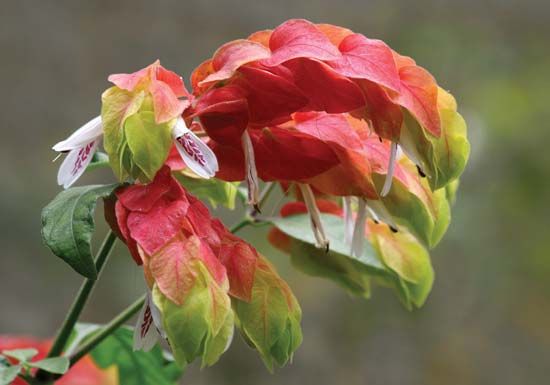
Gesneriaceae
Gesneriaceae is a family of flowering plants within the order Lamiales. It comprises approximately 147 genera and 3,200 species, primarily consisting of…

What is Gesneriaceae?
Gesneriaceae is a family of flowering plants within the order Lamiales. It comprises approximately 147 genera and 3,200 species, primarily consisting of tropical and subtropical herbaceous or slightly woody plants.1
While some sources may categorize the family under the order Polemoniales, it is taxonomically classified within Lamiales. These plants are widely recognized for their horticultural value, most notably the African violet (Saintpaulia) and gloxinias (Sinningia speciosa).12
Key botanical characteristics of the family include:
- Flowers: They feature bilaterally symmetrical, bisexual flowers with a two-lipped corolla of five fused petals.1
- Structure: The calyx consists of five lobes, and the flowers typically possess two or four anthers that are often joined.1
- Ovary: The ovary is superior or partly inferior, containing a single chamber where numerous small seeds develop on the walls.1
The family is named after the genus Gesneria, which honors the Swiss naturalist Konrad Gesner.3
How do African violets grow best?
African violets (Saintpaulia) are popular houseplants that are well-suited for indoor environments because they can thrive in low-light conditions. These small perennial herbs are capable of blooming throughout the year, provided they are given proper care.4
To grow them successfully, consider the following:
- Light: They are highly adaptable to lower light levels, making them excellent choices for indoor spaces where brighter sunlight may not be available.4
- Propagation: If you wish to expand your collection, these plants are easily propagated using leaf cuttings.4
- Environment: As they are native to higher elevations in tropical eastern Africa, they generally prefer stable, moderate indoor temperatures.4
What makes a flower bilaterally symmetrical?
A flower is considered bilaterally symmetrical—or zygomorphic—when it can be divided by only a single plane into two equal, mirror-image halves.5
This type of symmetry is often associated with more advanced floral evolution, which frequently involves a reduction in the number of floral parts and the fusion of those parts, such as the formation of a floral tube. In contrast, primitive flowers are typically actinomorphic, or radially symmetrical, meaning they can be divided into symmetrical halves by multiple planes passing through the center.15
The bilateral structure is a defining characteristic of several plant families, such as the Gesneriaceae, where flowers often feature a two-lipped corolla. Common examples of bilaterally symmetrical flowers include the snapdragon, orchid, and sweet pea.56
What are some other families in the Lamiales order?
The Lamiales order is a diverse group of flowering plants comprising 24 families and over 23,000 species. Beyond the Gesneriaceae family, which includes the African violet, the order contains several other notable families:
- Lamiaceae: The mint family.
- Verbenaceae: The verbena family.
- Plantaginaceae: The plantain family.
- Scrophulariaceae: The figwort family.
- Orobanchaceae: The broomrape family.
- Acanthaceae: The acanthus family.
- Bignoniaceae: The bignonia family.
- Oleaceae: The olive family.
- Pedaliaceae: The sesame family.
- Lentibulariaceae and Byblidaceae: Small families of carnivorous plants.8
These families are part of the asterid lineage and are classified within the lamiids group by the Angiosperm Phylogeny Group IV system.8
Sources
- Gesneriaceae — Encyclopædia Britannica
- Gesneriaceae — Merriam-Webster
- gesneria — Merriam-Webster
- African violet — Encyclopædia Britannica
- Symmetry — Encyclopædia Britannica
- plant - Flowers — Encyclopædia Britannica
- Zingiberales - Inflorescences — Encyclopædia Britannica
- Lamiales — Encyclopædia Britannica
Published on · 2 min read