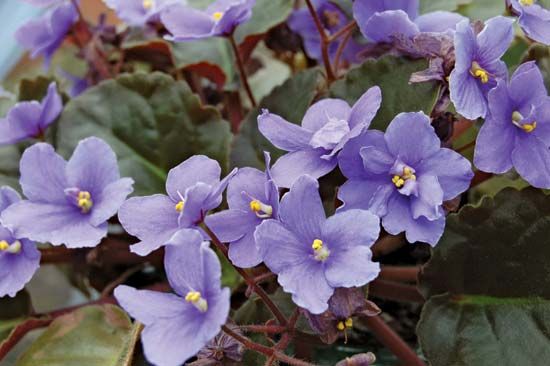
African Violet
African violets (Saintpaulia) are native to the higher elevations of tropical eastern Africa, where they are adapted to specific environmental conditions.…
Can African violets be grown outdoors, or are they strictly indoor plants?
African violets (Saintpaulia) are native to the higher elevations of tropical eastern Africa, where they are adapted to specific environmental conditions1. While they are widely cultivated as houseplants due to their ability to thrive in low-light indoor settings and bloom year-round, they are not typically grown outdoors in most climates.12
Because these plants are tropical perennials, they require consistent warmth and protection from harsh elements, which makes them ill-suited for outdoor environments outside of their native tropical range. Attempting to grow them outdoors in temperate regions would likely expose them to temperatures and light conditions that they cannot tolerate. Consequently, they are almost exclusively kept as indoor plants to ensure they receive the stable environment necessary for their health and flowering.12
What are the different varieties of African violets available?
While the genus Saintpaulia consists of only six distinct species of flowering plants, breeders have developed hundreds of horticultural varieties over time.1
These varieties are primarily categorized by their diverse aesthetic traits, which include:
- Flower Colors: While the original species typically feature violet-colored flowers, modern varieties have been bred to produce white and pink blooms.12
- Flower Shapes: Horticulturalists have cultivated plants with a wide range of petal shapes and configurations beyond the standard five-petal structure.1
- Plant Size: Varieties are often distinguished by their physical dimensions, most notably the development of half-sized miniatures that are popular for indoor cultivation.1
The most common species used for these varieties is Saintpaulia ionantha, which is prized for its ability to bloom year-round in low-light conditions.1
Where do African violets originate from, and how did they become popular houseplants?
African violets (Saintpaulia) are native to the higher elevations of tropical eastern Africa, specifically within the region formerly known as German East Africa, which is modern-day Tanzania.1
The plants were discovered by Europeans in 1892 by Walter, Freiherr (baron) von Saint Paul-Illaire, a German colonial official for whom the genus is named. Following their discovery, they were introduced to the horticultural world and gained popularity as houseplants by the late 1890s.123
Their enduring appeal as indoor plants is largely due to their ability to thrive in low-light conditions and their capacity to bloom throughout the year. Because they are small perennial herbs that are easily propagated from leaf cuttings, they became accessible and manageable for home gardeners, leading to the development of hundreds of diverse horticultural varieties.1
How do you propagate African violets?
African violets are widely recognized for being easily propagated from leaf cuttings. This method allows gardeners to clone their favorite plants by utilizing the thick, hairy leaves that characterize the genus Saintpaulia.1
To propagate an African violet, a healthy leaf with its long petiole (leaf stem) is typically removed from the parent plant. This cutting is then placed in a suitable growing medium or water, where it can develop roots and eventually produce a new plantlet at the base of the leaf. Because these plants are small perennial herbs, this simple process is highly effective for home cultivation, contributing to their enduring popularity as houseplants.1
Sources
- African violet — Encyclopædia Britannica
- African violet — Merriam-Webster
- Saintpaulia — Merriam-Webster
Published on · 2 min read