Gir National Park
Gir National Park is situated in the Gujarat state of west-central India. It is located approximately 33 miles (53 km) south-southwest of the city of…
What is the geographical location and size of Gir National Park?
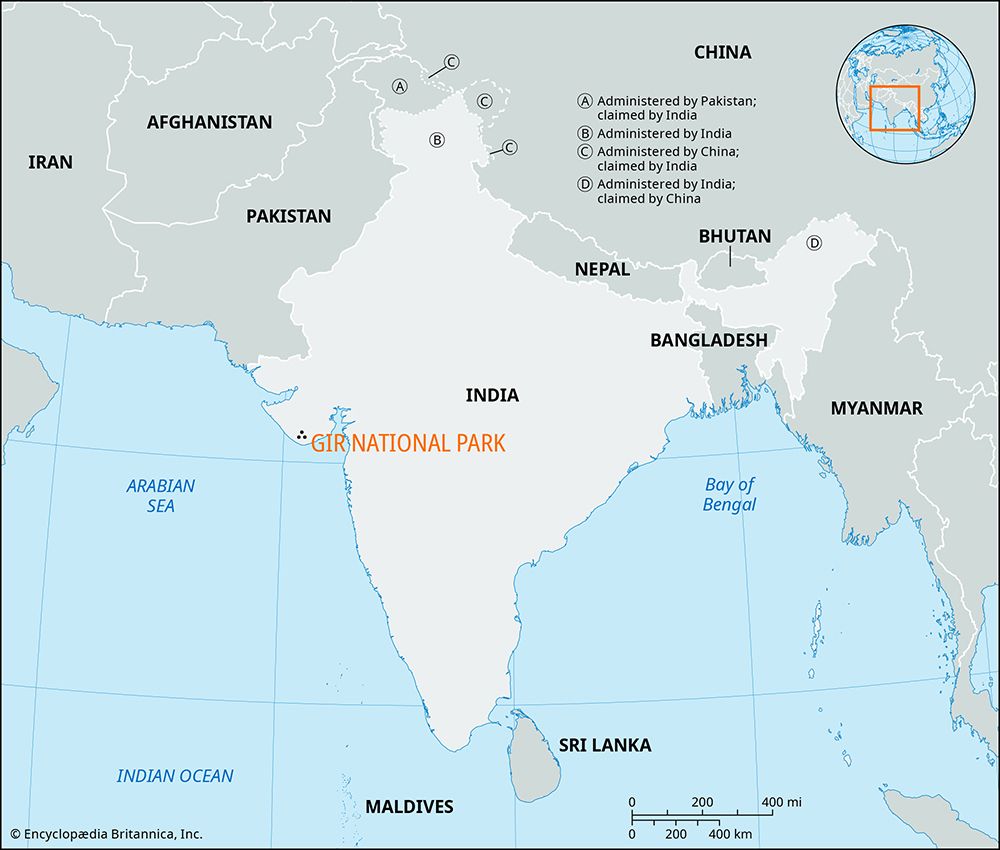
Gir National Park is situated in the Gujarat state of west-central India. It is located approximately 33 miles (53 km) south-southwest of the city of Junagadh within the hilly, dry scrubland of the Kathiawar Peninsula.1
The total protected area covers about 545 square miles (1,412 square km). This area is divided into two primary sections:
- National Park: Approximately 100 square miles (259 square km).1
- Sanctuary: Approximately 445 square miles (1,153 square km).1
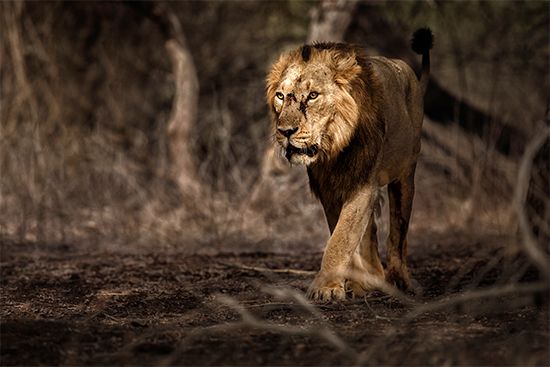
Established to protect the Asiatic lion, the park serves as the only remaining natural habitat for the species.1
What is the ecosystem like in Gir National Park, and how does it support its diverse wildlife?
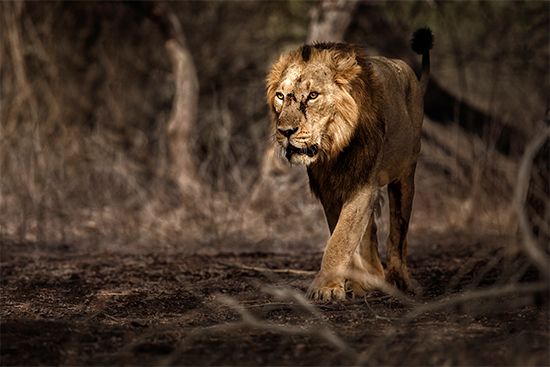
The ecosystem of Gir National Park is characterized by a hilly, dry scrubland environment located on the Kathiawar Peninsula in India. The vegetation is primarily composed of teak mixed with deciduous trees—such as sal (Shorea robusta) and dhak (Butea frondosa)—as well as thorn forests.12
This environment supports a diverse array of wildlife by providing essential habitats and resources:
- Asiatic Lions: The park is the world’s only natural habitat for the Asiatic lion, which has been protected in the region since the early 20th century.1
- Prey and Predators: The ecosystem sustains approximately 38 species of mammals, including leopards and various herbivores like spotted deer, nilgai, four-horned antelope, and chinkaras.1
- Water Resources: A large central water hole serves as a critical resource for the park’s fauna, including a population of crocodiles.1
- Avian Diversity: The park is home to an estimated 300 species of birds, which thrive within the varied forest cover.1
What is the historical significance of Gir National Park in India?
The historical significance of Gir National Park lies primarily in its role as the last remaining natural refuge for the Asiatic lion. Once ranging from Turkey to India, the species faced near-extinction due to habitat loss and colonial-era hunting. By the 1880s, only about 12 individuals were estimated to remain in the Gir forest.15
Key milestones in the park’s conservation history include:
- 1913: The creation of the Gir Forests Reserve to protect the surviving lion population.1
- 1965: The establishment of the Gir Protected Area by the Indian Forest Department, which marked the beginning of a steady population recovery.15
- 1975: The formal designation of 100 square miles (259 square km) as a national park.1
These efforts have been remarkably successful, with the population growing from 177 in 1968 to nearly 700 by 2020. Today, the park remains a critical site for global biodiversity, serving as the sole wild habitat for this vulnerable subspecies.51
What unique species of wildlife can be found in Gir National Park?
Gir National Park is home to a diverse range of wildlife, most notably serving as the world’s only natural habitat for the Asiatic lion.
In addition to the Asiatic lion, the park supports approximately 38 species of mammals, including:
- Predators: Leopards and wild pigs.1
- Herbivores: Spotted deer, nilgai (a type of antelope), four-horned antelope, and chinkaras (a type of gazelle).1
The park’s ecosystem also features a central water hole that supports a population of crocodiles. Furthermore, the area is a haven for avian life, hosting an estimated 300 species of birds.1
Sources
- Gir National Park — Encyclopædia Britannica
- giraffe — Encyclopædia Britannica
- Gir Range — Encyclopædia Britannica
- Kathiawar Peninsula — Encyclopædia Britannica
- Asiatic lion — Encyclopædia Britannica
Published on · 3 min read