Gordon Setter
The Gordon setter is a breed of sporting dog that originated in 17th-century Scotland. It is named after the Duke of Gordon, whose kennels were instrumental…
What is Gordon setter?
The Gordon setter is a breed of sporting dog that originated in 17th-century Scotland. It is named after the Duke of Gordon, whose kennels were instrumental in bringing the breed to prominence.1
As a member of the setter family, the breed was historically developed to locate game birds and indicate their presence to hunters. While early ancestors—known as setting spaniels—would crouch or lie down to allow nets to be cast over birds, modern setters like the Gordon are trained to maintain an upright stance.12
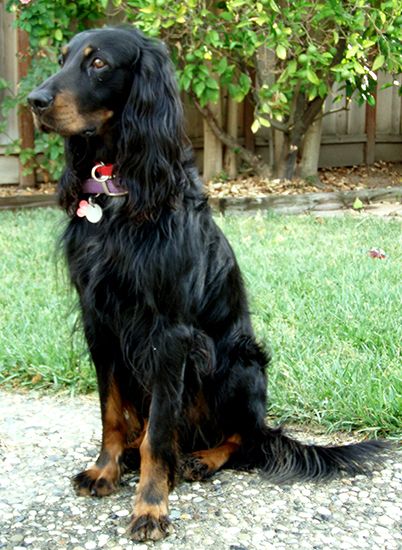
Physically, the Gordon setter stands between 23 and 27 inches (58 to 69 cm) tall and weighs between 45 and 80 pounds (20 to 36 kg). It is easily recognized by its soft, wavy black coat accented with tan markings on the head, throat, chest, and legs. Known for its loyalty and lively temperament, the breed is considered methodical when working in the field.1
How do Gordon setters differ from English and Irish setters?
While all three breeds are sporting dogs historically developed to locate game birds, they differ significantly in their origins, physical appearance, and temperament.3142
Key Differences
Feature
Gordon Setter
English Setter
Irish Setter
Origin
17th-century Scotland
England (400+ years)
18th-century Ireland
Coat Color
Black with tan markings
White with flecks (belton) or tricolour
Solid mahogany or chestnut red
Build
23–27 in; 45–80 lbs
24–25 in; 40–70 lbs
25–27 in; 60–70 lbs
Temperament
Methodical, loyal, lively
Mellow, friendly, people-oriented
Gregarious, fun-loving, exuberant
Distinctive Characteristics
- Gordon Setter: Known for being the most methodical in the field, this breed is recognized by its distinct black and tan coat and sturdy, powerful frame.1
- English Setter: Often described as rugged yet aristocratic, this breed is noted for its “belton” coat pattern and a mellow, friendly disposition that makes it a valued companion.3
- Irish Setter: Renowned for its elegant, graceful gait and bright mahogany coat, this breed is highly energetic and swift in the field. It is famously gregarious, often treating strangers as friends.4
What does it mean for a dog to be a pointer?
A dog is considered a “pointer” because of its instinctual behavior of assuming a rigid, statuesque posture to indicate the location of game to a hunter. The breed derives its name directly from this characteristic stance, where the dog freezes and points its body toward the hidden quarry, allowing the hunter to approach for a shot.567
While the term refers to a specific breed of sporting dog, “pointing” is also a functional classification for various breeds that use their scenting ability to locate birds on land. These dogs are categorized as gun dogs, a group that also includes setters, retrievers, and spaniels. Unlike some other sporting dogs that flush game into the air, a pointer’s primary role is to find the bird and remain steady, effectively “pointing out” the target until the hunter is in position. This hunting instinct is highly developed, often appearing in pointers as early as two months of age.6875
What were the original roles of hunting dogs in the 17th century?
In the 17th century, hunting dogs were specialized for distinct roles based on their ability to track, locate, or capture game. The primary functions of these dogs evolved alongside the development of hunting techniques and weaponry.
- Pointing and Tracking: First recorded around 1650 in England, the pointer was originally used to locate hares, effectively pointing them out so that greyhounds could track and pursue them.5
- Setting: Setters were derived from the medieval “setting spaniel.” Their original role involved finding birds and then “setting”—crouching or lying down—to allow a hunter to throw a net over both the birds and the dog.8
- Coursing and Scenting: Other dogs were utilized for coursing, which involved the pursuit of game by sight, or for tracking small game like hares and rabbits using scent.2
- Early Gundogs: By the late 17th century, the term gundog began to emerge, describing dogs trained to work closely with hunters to locate and retrieve game.10
Sources
- Gordon setter — Encyclopædia Britannica
- setter — Encyclopædia Britannica
- English setter — Encyclopædia Britannica
- Irish Setter — Encyclopædia Britannica
- pointer — Encyclopædia Britannica
- dog - Sporting dogs — Encyclopædia Britannica
- sporting dog — Encyclopædia Britannica
- hunting - Dogs — Encyclopædia Britannica
- field trial — Encyclopædia Britannica
- gundog — Merriam-Webster
- dog - Origin of breeds — Encyclopædia Britannica
Published on · 3 min read