Great Bahama Canyon
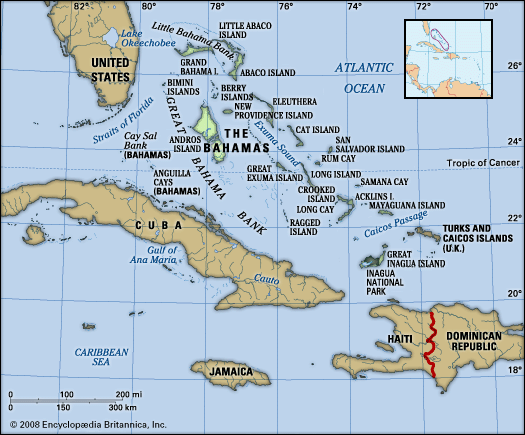
The Great Bahama Canyon is a massive submarine canyon located in the Atlantic Ocean off the coast of the Bahamas. Situated northeast of the Great Bahama…
What is Great Bahama Canyon?
The Great Bahama Canyon is a massive submarine canyon located in the Atlantic Ocean off the coast of the Bahamas. Situated northeast of the Great Bahama Bank, it is formed by the merging of two primary branches: the Tongue of the Ocean and the Northwest Providence.1
This geological feature is among the largest of its kind, with vertical rock walls that rise approximately 14,060 feet (4,285 meters) from the canyon floor to the surrounding seabed. For comparison, these walls are significantly higher than those of the Grand Canyon on land. The canyon has been traced for over 140 miles (225 km) in length and reaches a width of 23 miles (37 km) at its deepest point. Like other submarine canyons, it serves as a conduit for transporting sediment from the continental margin to the deep sea, primarily through the action of turbidity currents.12
How do submarine canyons differ from deep-sea trenches?
Submarine canyons and deep-sea trenches are distinct geological features defined by their locations, formation processes, and tectonic settings.
Key Differences
- Tectonic Setting: Deep-sea trenches are primarily found in subduction zones, where one tectonic plate slides beneath another. In contrast, submarine canyons are typically located along the slopes of continental margins, cutting into continental slopes and continental rises.23
- Formation: Submarine canyons are often formed by erosion and the transport of sediments via turbidity currents, sometimes originating from subaerial erosion during periods of lower sea level. Deep-sea trenches are created by the downward bending of oceanic plates as they subduct into the Earth’s interior.23
- Function: Submarine canyons serve as vital conduits that transport sediment from continental shelves to the deep-sea abyssal plains. Deep-sea trenches, while also containing some sediment, are characterized by the subduction of the seafloor itself.23
What are turbidity currents and how do they shape the ocean floor?
Turbidity currents are underwater density currents composed of a dense, sediment-laden slurry that flows along the ocean floor. These transient phenomena are typically triggered when accumulated sediments on continental shelves or at the heads of submarine canyons become unstable due to events such as earthquakes or underwater landslides.456
Shaping the Ocean Floor
Turbidity currents act as powerful geological agents that significantly reshape the seafloor through erosion and deposition:
- Canyon Formation: By flowing down the continental slope, these currents erode the seabed, serving as a primary mechanism for the creation and deepening of submarine canyons.26
- Sediment Transport: They function as vital conduits, transporting vast amounts of land-derived sediment—including sand, silt, and gravel—from continental margins to the deep sea.726
- Submarine Fans: As the currents reach the base of the continental slope and lose velocity, they deposit their sediment load, forming submarine fans that resemble alluvial fans found on land.45
- Abyssal Plains: These currents are responsible for smoothing out irregular topography on the ocean floor. By depositing layers of coarse material in deep-sea depressions, they help build and maintain abyssal plains.76
The resulting sedimentary deposits, known as turbidites, are characterized by distinct grading, where grain size typically decreases from the bottom to the top of a layer.476
How does the Great Bahama Canyon compare in size to the Grand Canyon?
The Great Bahama Canyon and the Grand Canyon are both immense geological features, but they differ significantly in their dimensions and environments.
Size Comparison
- Depth: The Great Bahama Canyon is significantly deeper than the Grand Canyon. Its vertical rock walls rise approximately 14,060 feet (4,285 meters) from the canyon floor, with some estimates suggesting a height of nearly 5 km (3 miles). In comparison, the deepest sections of the Grand Canyon reach about 6,000 feet (1,800 meters), or roughly 1.6 km (1 mile).182
- Width: The Great Bahama Canyon measures 23 miles (37 km) at its widest point. The Grand Canyon is narrower, ranging from about 175 yards (160 meters) to 18 miles (29 km) in width.182
- Length: The Grand Canyon extends for approximately 277 miles (446 km). The Great Bahama Canyon has been traced for more than 140 miles (225 km), though it may extend further to the base of the North American continental slope.21
While the Grand Canyon is a terrestrial chasm carved by the Colorado River, the Great Bahama Canyon is a massive submarine canyon shaped primarily by marine processes.18
Sources
- Great Bahama Canyon — Encyclopædia Britannica
- submarine canyon — Encyclopædia Britannica
- deep-sea trench - Structure — Encyclopædia Britannica
- turbidity current — Encyclopædia Britannica
- density current - Turbidity currents — Encyclopædia Britannica
- abyssal plain — Encyclopædia Britannica
- marine sediment — Encyclopædia Britannica
- Grand Canyon — Encyclopædia Britannica
Published on · 3 min read