Great Belt
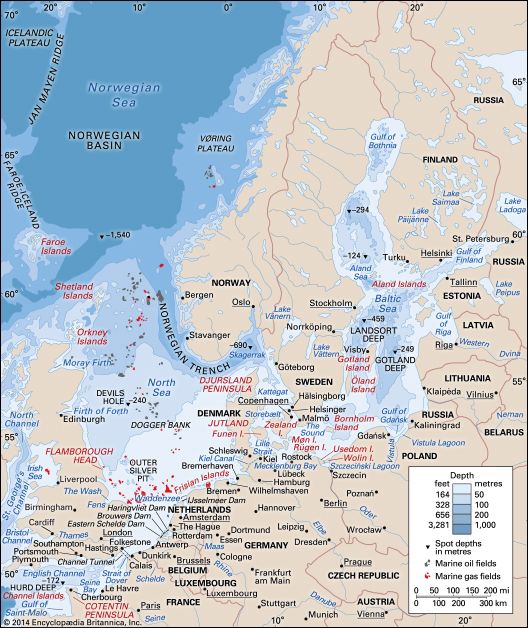
The Great Belt is a vital strait in Denmark that serves as a primary maritime connection between the Baltic Sea and the Kattegat, an arm of the North Sea.…
What is the historical significance of the Great Belt for Danish maritime trade?
The Great Belt is a vital strait in Denmark that serves as a primary maritime connection between the Baltic Sea and the Kattegat, an arm of the North Sea. While the provided information highlights its role as a critical component of Denmark’s modern transportation infrastructure—specifically through the Great Belt Fixed Link that connects the islands of Zealand and Funen—the available records do not detail its specific historical significance regarding maritime trade patterns or economic history.12
Denmark’s geography, characterized by numerous harbors and strategic straits, has long provided favorable conditions for both domestic and international shipping, but the specific historical trade impact of the Great Belt remains outside the scope of the current Britannica knowledge base.2
How does the Great Belt connect different parts of Denmark?
The Great Belt is a strait that separates the Danish islands of Funen and Langeland to the west from Zealand and Lolland to the east.2
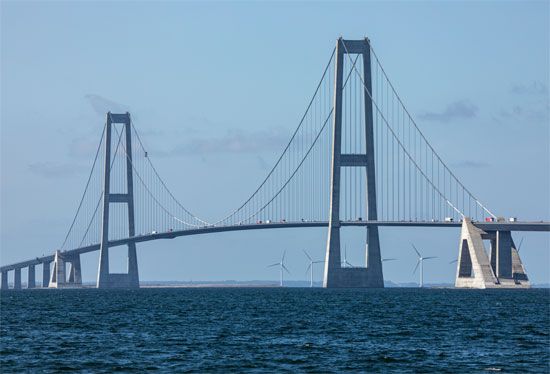
To connect these regions, the Great Belt Fixed Link was constructed as the largest engineering project in Danish history. This system links the islands of Zealand and Funen by passing through the small island of Sprogø using the following components:2
- East Bridge: A suspension bridge connecting Zealand and Sprogø, featuring one of the world’s longest spans at 5,328 feet (1,624 meters).2
- East Tunnel: A 5-mile (8-km) railway tunnel that opened in 1997.2
- West Bridge: A 4.1-mile (6.6-km) rail and road bridge linking Sprogø and Funen, which opened in 1998.2
How does the Great Belt compare to other Danish straits like the Little Belt and The Sound?
The Great Belt, The Sound, and the Little Belt are the three primary straits that connect the Baltic Sea to the Kattegat and the North Sea, formed following the retreat of glaciers after the Pleistocene Epoch.4
Geographic and Structural Differences
- The Great Belt (Storebælt): Located between the islands of Funen and Zealand, it is characterized as a deeper passage compared to the others. It is now spanned by the Great Belt Fixed Link, a massive bridge and tunnel system completed in the late 1990s.24
- The Sound (Øresund): Situated between Denmark and Sweden, this is one of the world’s busiest sea-lanes. It is narrower and shallower than the Great Belt, with a minimum depth of 23 feet (7 meters), restricting larger vessels. It is crossed by the Øresund Link, which connects Copenhagen and Malmö.54
- The Little Belt (Lillebælt): This strait separates eastern Jutland from the island of Funen.4
Historical Significance
While the Great Belt is a major modern transit route, The Sound historically held immense strategic and commercial importance. Because it was the shortest route to the Baltic, Denmark controlled it for centuries, levying tolls on all passing ships from 1429 until 1857 to secure significant revenue and political influence.5
What is the Great Belt and where is it located in Denmark?
The Great Belt is a strait located in Denmark that serves as a vital maritime passage. It stretches approximately 40 miles (64 km) and connects the Baltic Sea to the Kattegat, which is an arm of the North Sea situated between the Jutland peninsula and Sweden.1
Geographically, the strait separates the Danish islands of Funen and Langeland to the west from Zealand and Lolland to the east.1
Modern connectivity across this waterway is provided by the Great Belt Fixed Link, the largest engineering project in Danish history. This system utilizes the small island of Sprogø to connect Zealand and Funen through a combination of a suspension bridge, a railway tunnel, and a road bridge, all of which were completed between 1997 and 1998.1
Sources
- Little Belt — Encyclopædia Britannica
- Great Belt — Encyclopædia Britannica
- Denmark - Transportation and telecommunications — Encyclopædia Britannica
- The Sound — Encyclopædia Britannica
- Hanseatic League - Danish War (1368–70) — Encyclopædia Britannica
- Baltic Sea - Physiography — Encyclopædia Britannica
Published on · 3 min read