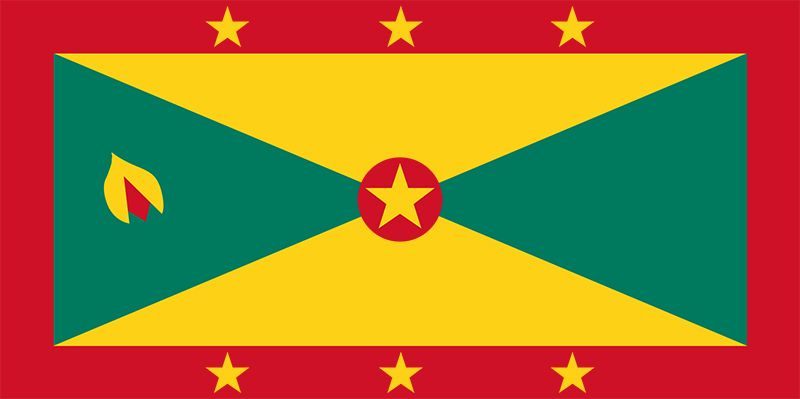
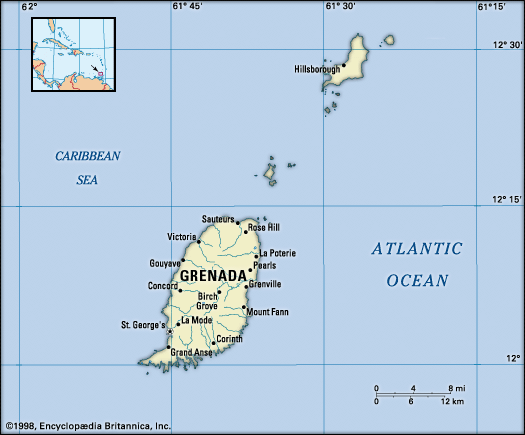
Grenada
Before European colonization, the original inhabitants of Grenada were the Arawak people. They were eventually displaced and killed off by the Carib people…
Who were the original inhabitants of Grenada before European colonization?
Before European colonization, the original inhabitants of Grenada were the Arawak people. They were eventually displaced and killed off by the Carib people, who dominated the island for approximately 150 years prior to the arrival of Europeans.1
When Christopher Columbus first sighted the island in 1498, he did not land, and the Carib population remained in control of the territory, successfully resisting early attempts at settlement by British merchants in 1609.1
How did Grenada gain its independence and what is its current form of government?
Grenada achieved its independence from the United Kingdom on February 7, 1974. The transition to sovereignty was marked by significant political controversy and social unrest surrounding the leadership of Prime Minister Eric Gairy. Following years of political instability, including a 1979 coup that established a socialist government and a subsequent 1983 military coup that led to the death of Prime Minister Maurice Bishop, a U.S.-led military intervention restored order. Constitutional government was subsequently reinstated, and democratic elections were held in December 1984.56
Today, Grenada operates as a constitutional monarchy. Under this framework:78
- Head of State: The British monarch, who is represented by a governor-general.7
- Executive Authority: Vested in a prime minister, who serves as the head of the majority party in the elected House of Representatives.7
- Legislature: A two-chamber system consisting of the House of Representatives (15 members) and the Senate (13 members), the latter of which is appointed by the governor-general on the advice of the prime minister and the opposition leader.78
How did the U.S. invasion of Grenada in 1983 impact the country?
The 1983 U.S.-led invasion of Grenada, known as Operation Urgent Fury, had immediate and lasting impacts on the nation:
- Political Transition: The invasion overthrew the military government that had seized power following the execution of Prime Minister Maurice Bishop. It restored the authority of the governor-general, Sir Paul Scoon, who appointed an interim advisory council to lead the country until democratic elections were held in December 1984.78
- Restoration of Democracy: The intervention facilitated the return to constitutional government. The 1984 election was won by the New National Party, marking a shift away from the socialist policies of the previous regime.8
- Security and Stability: U.S. and OECS forces quickly subdued the Grenadian army and Cuban personnel, ending the immediate military crisis. A peacekeeping force remained in the country until 1985 to ensure stability during the transition.78
- Human Cost: The conflict resulted in 24 civilian deaths and 337 injuries, alongside casualties among the Grenadian, Cuban, and U.S. forces involved.7
What are the main industries and economic activities in Grenada?
Grenada’s economy is primarily driven by agriculture and tourism, with secondary industries and fishing playing increasingly significant roles.10
Agriculture and Natural Resources
Grenada’s arable land is largely divided into small holdings, where farmers cultivate a diverse range of crops. Key agricultural exports include:
- Spices and Crops: Nutmeg, mace, cocoa, and bananas are central to the export economy.11
- Produce: The island produces various tropical fruits, such as mangoes, citrus, and passion fruit, alongside staple vegetables like sweet potatoes, pumpkins, and corn.11
- Forestry and Fishing: The forestry sector provides teak and mahogany, while the government continues efforts to upgrade the fishing industry.11
Manufacturing and Services
Tourism is a major economic pillar, supported by improved air transport and frequent cruise ship visits. Other secondary industries include:12
- Processing and Manufacturing: Activities include rum distilling, brewing, sugar milling, food canning, soapmaking, and cigarette manufacturing.12
- Trade: The United States is Grenada’s principal trading partner, with other significant trade occurring with Malaysia, the United Kingdom, and Barbados.12
Sources
- Grenada - History — Encyclopædia Britannica
- Grenada - People — Encyclopædia Britannica
- Grenada - Cultural life — Encyclopædia Britannica
- Grenada — Encyclopædia Britannica
- Grenada - Constitutional framework — Encyclopædia Britannica
- Grenada: Country Facts — Encyclopædia Britannica
- U.S. invasion of Grenada — Encyclopædia Britannica
- Grenada - Independence of Grenada — Encyclopædia Britannica
- Ronald Reagan - The Middle East and Central America — Encyclopædia Britannica
- Grenada - Agriculture, forestry, and fisheries — Encyclopædia Britannica
- Grenada - Manufacturing, services, and trade — Encyclopædia Britannica
- Grenada - Economy — Encyclopædia Britannica
Published on · 3 min read