Dominica Channel
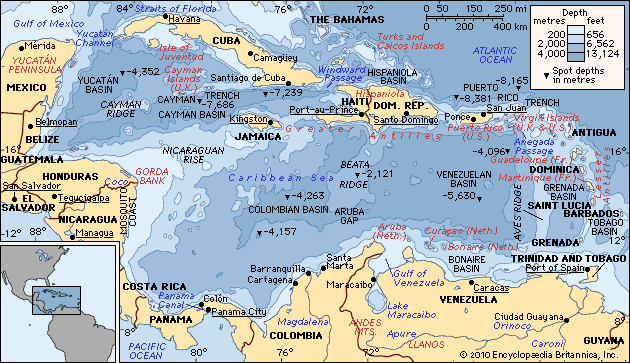
The Dominica Channel is a marine passage located in the Lesser Antilles of the West Indies. It serves as a vital connection between the Caribbean Sea and the…
What is Dominica Channel?
The Dominica Channel is a marine passage located in the Lesser Antilles of the West Indies. It serves as a vital connection between the Caribbean Sea and the open Atlantic Ocean to the east Atlantic Ocean to the east.1
The channel spans approximately 25 miles (40 km) in width and flows between the island of Dominica to the north and the French overseas département of Martinique to the south of Martinique to the south.1
What are the Lesser Antilles?
The Lesser Antilles are a long arc of small islands in the Caribbean Sea that extend in a north-south direction from the Virgin Islands to Grenada. Geologically, this island chain was formed by the subduction of the central Atlantic lithosphere beneath the eastern portion of the Caribbean Plate.34
The islands are traditionally divided based on the prevailing easterly trade winds:
- Windward Islands: Ranging south from Dominica to Grenada.3
- Leeward Islands: Arcing westerly from Guadeloupe to the Virgin Islands.3
Additionally, the definition of the Lesser Antilles often includes islands along the northern coast of Venezuela, such as Aruba and Margarita Island. While these are physiographically part of the South American continental shelf, they are frequently grouped with the region and are sometimes referred to as the Leeward Antilles.3
How do marine channels influence ocean currents?
Marine channels and straits significantly influence ocean currents by acting as conduits, regulators, and accelerators for water movement. Their impact is primarily observed in the following ways:
- Flow Regulation and Acceleration: When water is forced through narrow passages, the channel can act like a venturi tube, where the constriction causes the fluid to speed up as it passes through the throat. This is particularly evident in tidal inlets and estuaries, where the volume of water—known as the tidal prism—must pass through a narrow opening, often resulting in swift tidal currents that can exceed two metres per second.56
- Directing Major Currents: Channels serve as essential gateways for large-scale circulation. For instance, surface waters enter the Caribbean Sea through various channels in the Antilles and are subsequently forced through the narrow Yucatán Channel into the Gulf of Mexico. This accumulation of water creates a hydrostatic head that is considered a primary driving force for the Gulf Stream.7
- Water Mass Exchange: Channels allow for the exchange of water with varying characteristics, such as temperature, salinity, and oxygen content, between different basins. Deep-ocean circulation is often restricted or facilitated by the depth of these sills; for example, the shallow depths of the Antillean arc block the entry of cold Antarctic bottom water into the Caribbean, keeping its bottom temperature significantly warmer than that of the Atlantic.7
What is the difference between an island nation and an overseas department?
The primary difference between an island nation and an overseas department lies in their political sovereignty and administrative status.
Island Nations An island nation is a fully sovereign state. It possesses its own government, manages its own diplomacy and defense, and is recognized as an independent entity under international law. Examples in the Caribbean include Cuba, Dominica, and Jamaica, which have gained independence from colonial powers and maintain their own political systems, ranging from republics to constitutional monarchies.1415
Overseas Departments An overseas department (such as those of France) is an integral part of a sovereign nation, not an independent state. While these territories may have locally elected legislative councils and varying degrees of autonomy regarding local economic or administrative matters, they remain under the jurisdiction of the central government of the parent country. For instance, France is responsible for the defense and diplomacy of its overseas departments, such as Martinique and Guadeloupe.16171814
Sources
- Dominica Channel — Encyclopædia Britannica
- Guadeloupe — Encyclopædia Britannica
- Lesser Antilles — Encyclopædia Britannica
- North America - 120 to 30 million years ago — Encyclopædia Britannica
- Caribbean Sea - Hydrology — Encyclopædia Britannica
- List of Important Straits — Encyclopædia Britannica
- ocean current - Distribution of ocean currents — Encyclopædia Britannica
- ocean current - The subtropical gyres — Encyclopædia Britannica
- ocean current — Encyclopædia Britannica
- venturi tube — Encyclopædia Britannica
- undersea exploration - Measurements of ocean currents — Encyclopædia Britannica
- tidal flat — Encyclopædia Britannica
- coastal landforms - Tides — Encyclopædia Britannica
- France - The overseas territories — Encyclopædia Britannica
- West Indies — Encyclopædia Britannica
- Martinique - Developments since World War II — Encyclopædia Britannica
- Guadeloupe - Political and economic changes since 1950 — Encyclopædia Britannica
- list of islands - France — Encyclopædia Britannica
- sovereignty - Nonsovereign states — Encyclopædia Britannica
Published on · 3 min read