Antilles
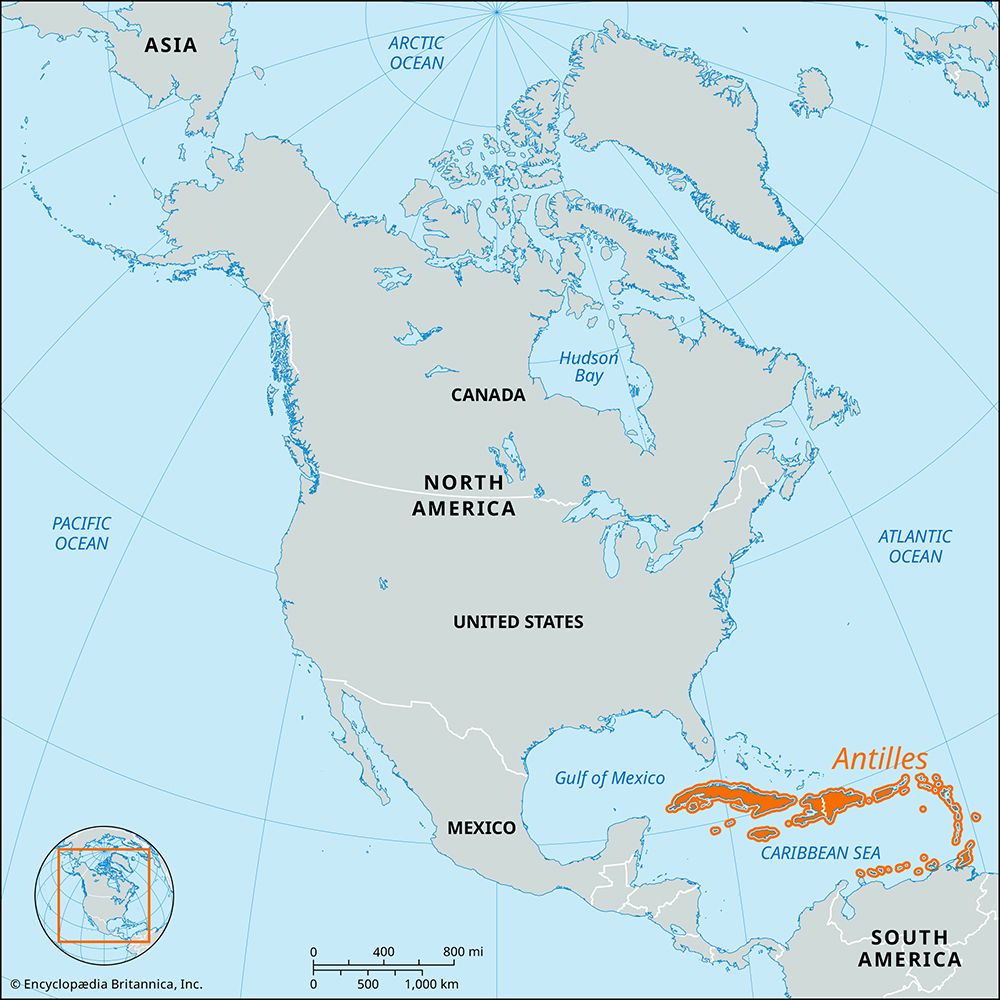
The Antilles are a group of islands located in the Caribbean Sea that comprise nearly all of the West Indies, with the notable exception of The Bahamas.
What is Antilles?
The Antilles are a group of islands located in the Caribbean Sea that comprise nearly all of the West Indies, with the notable exception of The Bahamas.1
The region is divided into two primary groups:
- Greater Antilles: This group includes the four largest islands—Cuba, Hispaniola (home to Haiti and the Dominican Republic), Jamaica, and Puerto Rico—along with their outlying islands and the Cayman Islands.21
- Lesser Antilles: This chain consists of the remaining, smaller islands in the region.1
The term “Antilles” has historical roots in the medieval concept of “Antilia,” a semi-mythical landmass believed to exist in the Atlantic Ocean before the arrival of Europeans in the Americas. Following the voyages of Christopher Columbus, the name was applied to the newly encountered Caribbean islands.1
How do the Lesser Antilles differ from the Greater Antilles in terms of their formation?
The formation of the Greater Antilles and the Lesser Antilles is rooted in the complex tectonic evolution of the Caribbean Plate as it moved eastward between the North and South American plates.56
- Greater Antilles: These islands originated as a volcanic arc carried on the prow of a buoyant oceanic plateau that now floors the Caribbean Sea. Between approximately 60 and 35 million years ago, this volcanic arc collided with the Bahamas limestone platform. This collision caused the arc to be sheared off the Caribbean Plate and fixed to the North American Plate, forming the core of the Greater Antilles, including Cuba6.56
- Lesser Antilles: In contrast, the Lesser Antilles volcanic arc was formed by the ongoing subduction of the central Atlantic lithosphere beneath the eastern edge of the Caribbean Plate. This process of subduction continues to drive the volcanic activity that characterizes this island chain.56
While both groups are part of the broader Antillean arc, the Greater Antilles were shaped by a major tectonic collision and subsequent plate reorganization, whereas the Lesser Antilles were primarily formed by the subduction of the Atlantic floor.56
What are the main differences between the Windward and Leeward Islands?
The distinction between the Windward Islands and the Leeward Islands is primarily based on their geographic position relative to the prevailing easterly trade winds that sweep across the Caribbean Sea.5
- Geographic Division: The names reflect the historical importance of these winds to sailing vessels. The Windward Islands, located in the southern arc of the Lesser Antilles, are positioned to receive the winds first. The Leeward Islands, situated to the north and west, are sheltered from the direct force of these winds.51011
- Location: The Windward group generally ranges from Dominica south to Grenada. The Leeward group arcs north and west from Guadeloupe toward the Virgin Islands.51011
- Climate: Because the Windward Islands intercept the moisture-laden trade winds, they often experience higher rainfall, particularly on their eastern sides. In contrast, the Leeward Islands generally have a drier climate, though rainfall varies significantly by elevation and specific location.51011
Why are hurricanes common in the Caribbean region?
Hurricanes are common in the Caribbean Sea because the region provides the specific atmospheric and oceanic conditions necessary for these powerful storms to develop and intensify.1314
Key Factors for Hurricane Formation
- Warm Ocean Temperatures: Hurricanes require surface water temperatures of at least 26.5 °C (79.7 °F) to fuel the evaporation and upward movement of moist air that drives the storm.1415
- Atmospheric Stability: Development requires low wind shear, which allows rising air to form organized, rotating thunderstorms without being disrupted by changing wind speeds or directions aloft.1416
- Coriolis Force: The system must be located at least 500 km (300 miles) north of the Equator so that the Coriolis force can induce the characteristic counterclockwise rotation.1415
Many hurricanes originate as tropical depressions off the coast of Africa and follow the path of the trade winds into the Caribbean. While the official hurricane season runs from June 1 to November 30, these storms occur most frequently in September.131417
Sources
- Greater Antilles — Encyclopædia Britannica
- Antilles — Encyclopædia Britannica
- West Indies — Encyclopædia Britannica
- Netherlands Antilles — Encyclopædia Britannica
- Lesser Antilles — Encyclopædia Britannica
- North America - 120 to 30 million years ago — Encyclopædia Britannica
- North America - Mesozoic and Cenozoic orogenic belts — Encyclopædia Britannica
- Caribbean Sea - Geology — Encyclopædia Britannica
- Lesser Antilles — Merriam-Webster
- Windward Islands — Merriam-Webster
- Leeward Islands — Encyclopædia Britannica
- Windward Islands — Encyclopædia Britannica
- Caribbean Sea - Climate — Encyclopædia Britannica
- Factors Affecting Hurricane Development in the Atlantic Ocean — Encyclopædia Britannica
- Deadliest Hurricanes in the U.S.: Top Questions — Encyclopædia Britannica
- Climate - Conditions associated with cyclone formation — Encyclopædia Britannica
- Factors Affecting Hurricane Development in the Atlantic Ocean: Top Questions — Encyclopædia Britannica
Published on · 3 min read